
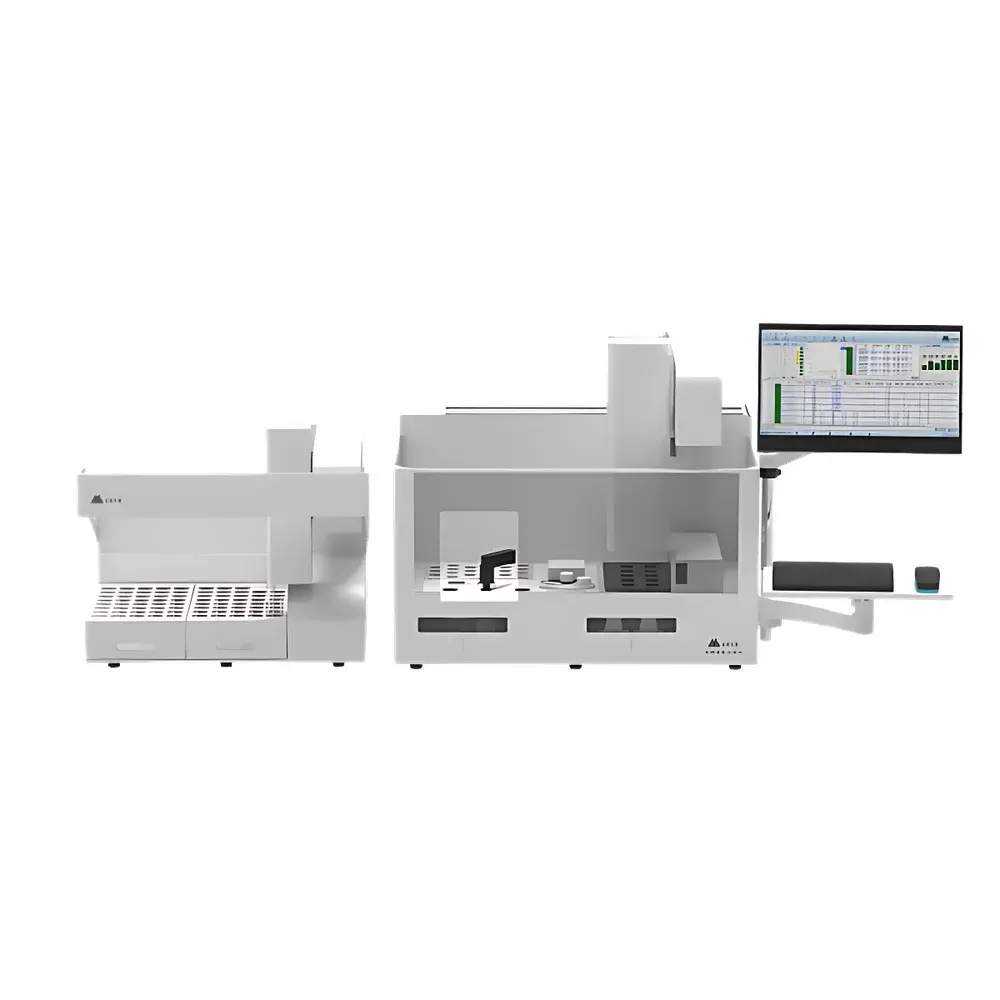
BEIYU CTP-700 Total Phosphorus Analyzer
| Brand | BEIYU TECHNOLOGIES |
|---|---|
| Origin | Shanghai, China |
| Model | CTP-700 |
| Compliance | GB 11893–1989, HJ 636–2012 |
| Measurement Principle | Ammonium Molybdate Spectrophotometry after High-Temperature Acid Digestion |
| Automation Level | Fully Automated Sample Handling, Digestion, Dilution, Colorimetric Detection, and Data Reporting |
| Detection Wavelength | 700 nm (fixed) |
| Sample Throughput | Up to 48 samples per batch (with optional 48-position autosampler) |
| Digestion Temperature Range | Ambient to 180 °C (programmable, ±1 °C accuracy) |
| Pressure Rating | ≤ 1.5 MPa for digestion vessels |
| Reagent Monitoring | Real-time level sensing with threshold alerts |
| LIMS Interface | ASTM E1384-compliant bidirectional data exchange via TCP/IP and RS232 |
| Safety Certification | CE-marked per EN 61010-1:2010 for laboratory equipment |
Overview
The BEIYU CTP-700 Total Phosphorus Analyzer is a fully automated benchtop instrument engineered for precise, reproducible quantification of total phosphorus (TP) in environmental water matrices—including surface water, wastewater, groundwater, and effluent—according to standardized regulatory methodologies. It implements the ammonium molybdate spectrophotometric method (GB 11893–1989 and HJ 636–2012), which requires complete oxidation of all phosphorus species into orthophosphate via high-temperature, high-pressure acidic digestion followed by colorimetric detection at 700 nm. Unlike semi-automated or manual systems, the CTP-700 integrates robotic sample manipulation, thermally controlled digestion, reagent metering, dilution logic, and optical measurement into a single platform. Its architecture eliminates manual intervention after initial loading, supporting unattended operation for up to 48 samples per run. The system is designed for routine compliance monitoring in municipal laboratories, third-party testing facilities, and industrial environmental QA/QC departments operating under GLP or ISO/IEC 17025 frameworks.
Key Features
- Fully automated sample handling via programmable robotic arm: gripper-based tube transfer, cap sealing/unsealing, reagent dispensing, and vial positioning.
- High-reliability digestion module with individually monitored heating zones (±1 °C control), pressure-rated digestion vessels (≤1.5 MPa), and real-time temperature/pressure logging.
- Integrated dilution algorithm: automatically detects absorbance saturation and initiates proportional dilution using calibrated peristaltic pumps (CV < 1.5% RSD).
- Self-calibrating photometric system: fixed-wavelength LED source (700 nm), dual-beam optical path, and auto-compensation for turbidity and chromatic interference.
- Reagent management system with capacitive level sensors, low-volume alerts, and configurable expiration tracking per reagent lot.
- Modular autosampler compatibility: supports 12-, 24-, and 48-position trays; tray recognition and position mapping are software-verified prior to run initiation.
- Full-duplex LIMS integration: supports ASTM E1384–2021 message structures, including sample metadata ingestion, result export with audit trail, and instrument status polling.
- Digestion vessel cleaning cycle: post-analysis ultrasonic + chemical rinse protocol ensures carryover < 0.5 µg/L P between samples.
Sample Compatibility & Compliance
The CTP-700 accepts aqueous samples in standard 16 mm × 100 mm borosilicate glass digestion tubes (supplied or user-provided). It accommodates turbid, colored, and suspended-solid-laden matrices typical of municipal wastewater and agricultural runoff—enabled by real-time turbidity compensation and adaptive baseline correction. All analytical procedures align strictly with GB 11893–1989 (equivalent to ISO 6878:2004) and HJ 636–2012 (China’s national standard for TP/TN analysis). Instrument firmware and data logs comply with ALCOA+ principles (Attributable, Legible, Contemporaneous, Original, Accurate, Complete, Consistent, Enduring, Available) and support FDA 21 CFR Part 11 readiness when deployed with validated electronic signatures and role-based access control.
Software & Data Management
The embedded CTP-OS v3.x operating system provides intuitive workflow configuration, method validation tools (linearity, LOD/LOQ, recovery, precision), and full electronic lab notebook (ELN) functionality. All raw absorbance values, digestion profiles, dilution events, and calibration parameters are stored with immutable timestamps and operator ID. Data export formats include CSV, PDF analytical reports (with digital signature), and XML structured for LIMS ingestion. Audit trails record every user action—including method edits, calibration updates, and result overrides—with hash-verified integrity. Remote diagnostics and firmware updates are supported over secure TLS 1.2 connections.
Applications
- Regulatory compliance testing for TP discharge limits under local environmental protection ordinances.
- Long-term trend analysis in watershed monitoring programs requiring high inter-day repeatability.
- Wastewater treatment plant process control: influent, effluent, and sludge supernatant analysis.
- Research-grade phosphorus speciation studies when coupled with offline fractionation protocols.
- Multi-parameter environmental labs integrating TP analysis with parallel TN (total nitrogen) modules (CTN-700 series interoperability).
FAQ
Does the CTP-700 support simultaneous total nitrogen analysis?
No—the CTP-700 is dedicated to total phosphorus only. For combined TP/TN workflows, BEIYU recommends synchronized deployment with the CTN-700 Total Nitrogen Analyzer using shared autosampler and LIMS interface.
What safety certifications does the instrument hold?
The CTP-700 carries CE marking per EN 61010-1:2010 (Safety Requirements for Electrical Equipment for Measurement, Control, and Laboratory Use) and complies with IEC 61326-1:2012 for electromagnetic compatibility.
Can the digestion vessels be reused indefinitely?
Yes—vessels undergo automated cleaning after each run and are qualified for ≥500 cycles under routine use; lifetime validation reports are provided upon request.
Is method validation documentation included?
Yes—each unit ships with a Factory Validation Report (FVR) covering optical linearity, digestion recovery (using certified reference material NIST SRM 1643e), and system precision (n=10, RSD ≤ 2.1%).
How is data integrity ensured during network transmission to LIMS?
All transmitted data packets are signed with SHA-256 HMAC and encrypted via TLS 1.2; failed transmissions trigger local retry queues with timestamped failure logs.







