
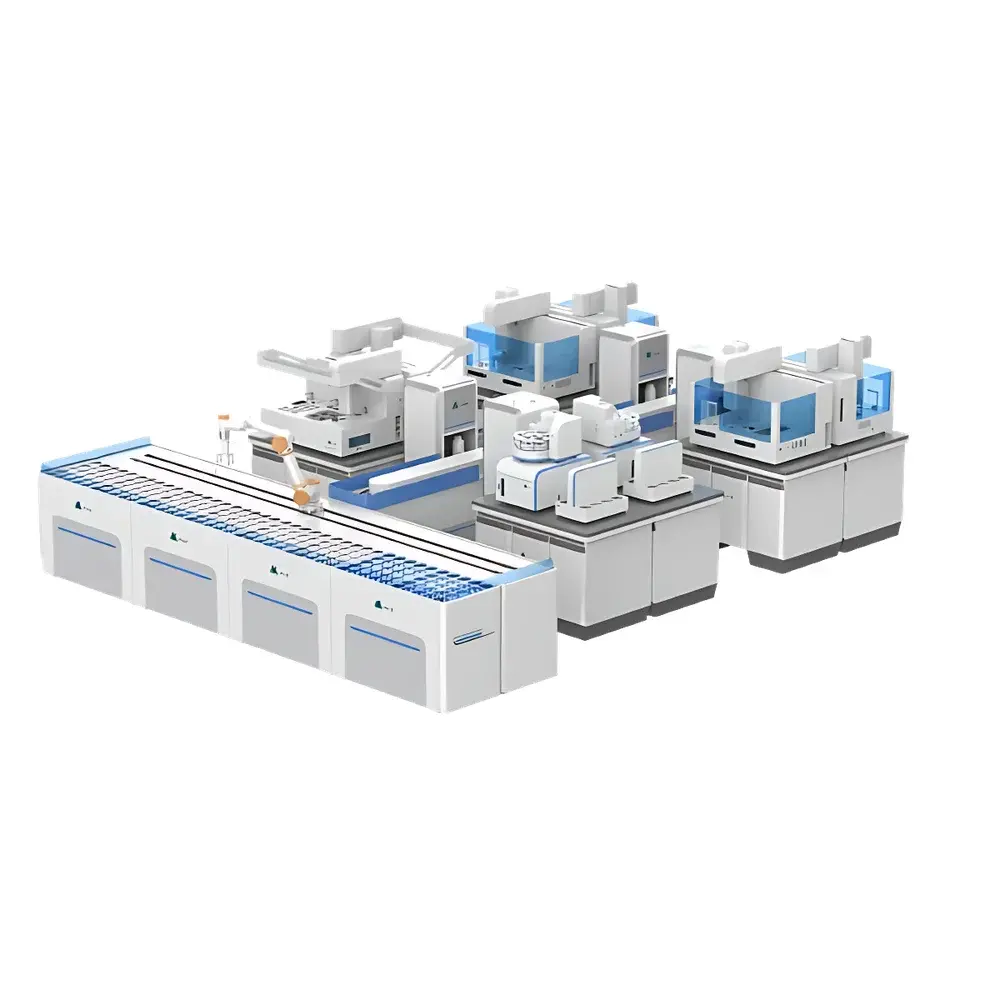
BEIYU TECHNOLOGIES Smart Unmanned Water Quality Analysis System
| Brand | BEIYU TECHNOLOGIES |
|---|---|
| Origin | Shanghai, China |
| Manufacturer Type | Authorized Distributor |
| Product Origin | Domestic (China) |
| Model | Smart Unmanned Water Quality Analysis System |
| Pricing | Available Upon Request |
Overview
The BEIYU TECHNOLOGIES Smart Unmanned Water Quality Analysis System is an integrated, modular laboratory automation platform engineered for continuous, unattended operation in environmental monitoring laboratories and municipal water quality control centers. It implements a distributed architecture based on standardized analytical workflows—leveraging discrete instrumental modules (e.g., gas-phase molecular absorption spectrometry, intelligent total phosphorus/total nitrogen analyzers, ion chromatography, atomic fluorescence, and electrochemical sensors) interconnected via a central pneumatic/hydraulic sample transport system and unified control software. Unlike single-purpose benchtop analyzers, this system operates as a programmable, method-driven analytical ecosystem: each module executes standardized test protocols compliant with GB/T (Chinese National Standards), HJ (Environmental Protection Industry Standards), and ISO 5667 series for water sampling and analysis. The system supports real-time method selection, automated sample routing, and synchronized QA/QC execution—including auto-dilution, spike recovery, duplicate analysis, trend-based verification, and cross-parameter correlation checks—ensuring data integrity aligned with ISO/IEC 17025:2017 requirements for testing and calibration laboratories.
Key Features
- Modular hardware architecture enabling plug-and-play integration of third-party instruments—including Agilent ICP-OES/ICP-MS/GC-MS/LC-MS/MS, Thermo Fisher ion chromatographs and potentiometric titrators, IDEXX microbial enumeration systems, Haiguang hydride generation atomic fluorescence spectrometers, and INESA electrochemical sensors.
- Flexible operational modes: individual module autonomy or synchronized multi-instrument workflows, coordinated via centralized scheduling logic and bidirectional instrument communication (RS232, Ethernet, Modbus TCP).
- Full method compliance: all embedded analytical procedures conform to GB/T 5750, GB/T 11893, HJ 484–2009 (cyanide), HJ 485–2009 (copper), HJ 486–2009 (zinc), HJ 636–2012 (total nitrogen), and HJ 671–2013 (total phosphorus), with traceable reference to ASTM D3370 and ISO 15586 where applicable.
- Automated QA/QC routines: scheduled blind sample insertion, automatic standard addition/recovery calculation, dynamic dilution series generation, repeat analysis triggers upon outlier detection, and inter-parameter consistency validation (e.g., NO₃⁻–N + NO₂⁻–N vs. total nitrogen discrepancy thresholds).
- Scalable infrastructure design:预留 hardware I/O expansion slots (8× digital I/O, 4× analog input channels) and software API endpoints (RESTful JSON interface) for future integration of new modules, LIMS synchronization, or remote audit trail export.
Sample Compatibility & Compliance
The system accepts liquid samples across standard environmental matrices—including raw surface water, treated drinking water, wastewater effluent, and groundwater—with volume ranges from 5 mL to 500 mL per analysis cycle. Sample introduction utilizes chemically inert PTFE/PFA tubing and corrosion-resistant peristaltic or syringe pumps, ensuring minimal carryover (<0.1%) and compatibility with high-salinity, acidic, or particulate-laden samples (up to 50 µm suspended solids). All internal wetted components meet USP Class VI biocompatibility standards. Method validation documentation—including precision (RSD ≤5% at ≥3× LOD), accuracy (recovery 85–115%), and linearity (R² ≥0.999 over defined calibration ranges)—is provided per parameter and aligns with GLP principles. Full audit trail logging satisfies FDA 21 CFR Part 11 requirements for electronic records and signatures when configured with user authentication and role-based access controls.
Software & Data Management
The proprietary BEIYU LabOS v4.x software provides a browser-based interface for method configuration, instrument scheduling, real-time status monitoring, and report generation. It enforces version-controlled method templates, configurable alarm thresholds (e.g., calibration drift >5%, recovery outside 85–115%), and automated PDF/CSV report export with embedded metadata (operator ID, instrument serial number, calibration date, QC results). Raw data files are stored in vendor-neutral formats (CSV, XML) with SHA-256 checksums. Audit trails record all user actions—including method edits, result overrides, and calibration events—with immutable timestamps and operator attribution. Integration with enterprise LIMS is supported via HL7 v2.5 or ASTM E1384-compliant interfaces, enabling seamless transfer of sample IDs, test requests, and final results without manual re-entry.
Applications
- 24/7 autonomous monitoring in municipal drinking water treatment plants (DWTPs) and wastewater treatment facilities (WWTPs), delivering hourly updates on key parameters including total nitrogen, total phosphorus, nitrate, nitrite, ammonia, sulfide, cyanide, heavy metals (As, Cd, Cr, Pb, Hg), and microbial indicators.
- Regulatory compliance testing for environmental agencies conducting routine surveillance under China’s “Blue Sky & Clear Water” initiative and the Ministry of Ecology and Environment’s (MEE) annual monitoring plans.
- Research-grade water quality profiling in ecological field stations, where modular deployment enables rapid adaptation to site-specific analyte panels without hardware replacement.
- Contract laboratory service delivery, where method flexibility and audit-ready documentation streamline accreditation maintenance (CNAS, CMA) and client-specific reporting requirements.
FAQ
Does the system support dual-mode operation—standalone instrument use and networked multi-module workflows?
Yes. Each analytical module retains independent functionality with local touchscreen control; when connected to the central LabOS server, it automatically registers and participates in coordinated sample routing and method sequencing.
How does the system ensure method traceability and regulatory compliance during audits?
All analytical methods are digitally signed, versioned, and linked to validated SOP documents. Every analysis generates a timestamped, tamper-evident record containing raw signals, processed values, QC flags, and operator context—exportable in PDF/A-2b or XML format for external review.
What third-party instruments have been verified for interoperability?
Instrument drivers and communication protocols have been validated for Agilent (ICP-MS 8900, GC-MS 5977B), Thermo Fisher (ICS-600 ion chromatograph, Orion Star A329 titrator), Haiguang (AFS-9700 atomic fluorescence), and INESA (DZ-1000 electrochemical analyzer). Custom driver development is available for other platforms upon request.
Can the system perform method validation according to ISO/IEC 17025 requirements?
Yes. Built-in tools support repeatability assessment, intermediate precision evaluation, limit of detection (LOD) determination, and recovery studies—all documented within the audit trail and exportable as validation reports.
Is remote diagnostics and software update capability included?
LabOS supports secure remote access via TLS 1.3-encrypted VPN tunneling. Firmware and software updates are delivered as signed packages with rollback capability and pre-update health checks to ensure system stability.







