
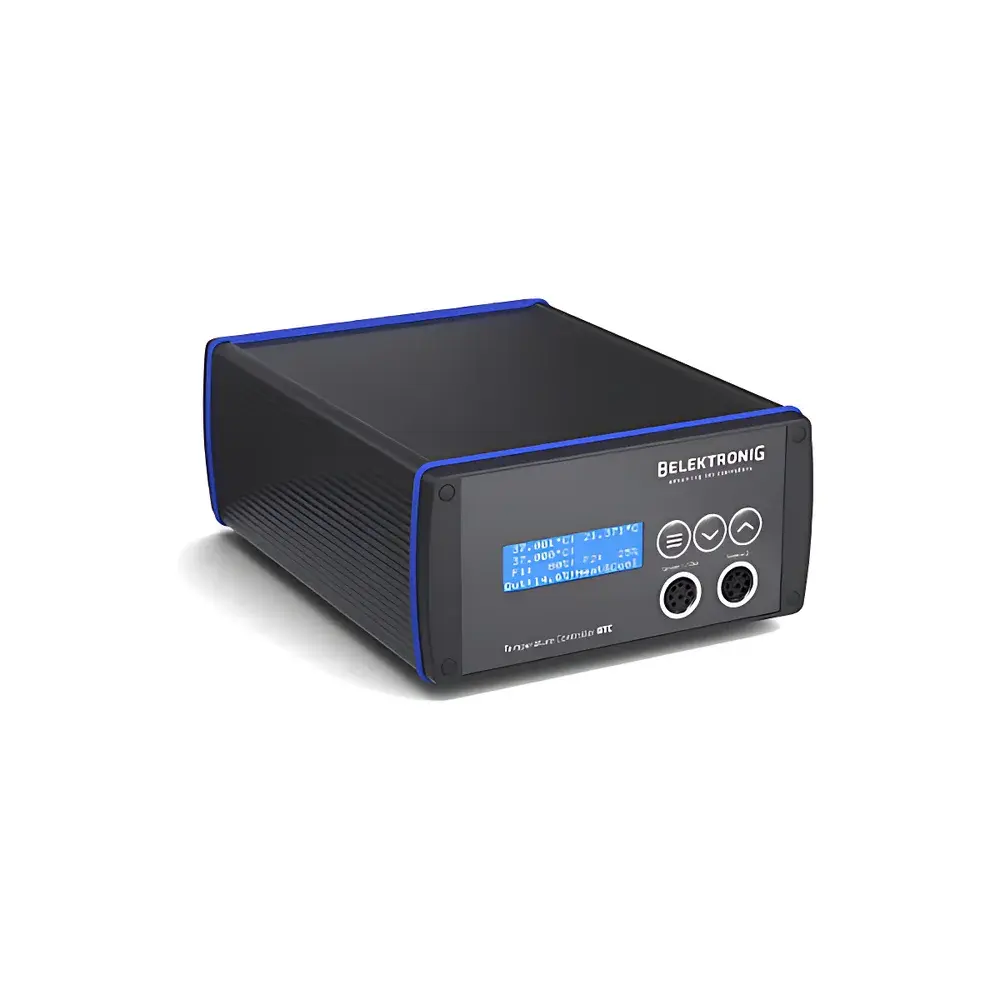
BelektroniG BTC Series Microfluidic High-Precision Temperature Controller
| Brand | BelektroniG |
|---|---|
| Origin | Germany |
| Manufacturer Type | Authorized Distributor |
| Product Line | BTC Series |
| Power Output | ±27 V DC, max. 10 A |
| Dimensions | 226 × 172 × 91 mm (L × W × H) |
| Temperature Uniformity | 0.1 °C / 0.01 °C / 0.001 °C (selectable per sensor configuration) |
| Temperature Control Range | −200 °C to +800 °C |
| Temperature Measurement Resolution | 0.001 °C (with calibrated Pt1000 or thermocouple input) |
| Sampling Rate | 10 Hz |
| Fan Supply | 0–12 V DC, max. 300 mA |
| Weight | 3.2 kg |
Overview
The BelektroniG BTC Series Microfluidic High-Precision Temperature Controller is an engineered solution for dynamic thermal regulation in microscale life science and bioengineering applications. Designed specifically for integration with Peltier-based heating/cooling modules—including BelektroniG’s BPM-A140 air-cooled and BPM-P140 plate-type thermal actuators—the BTC controller implements closed-loop PID regulation with high-resolution analog power output (±27 V, up to 10 A) to deliver stable, responsive, and repeatable thermal control across extreme operational ranges (−200 °C to +800 °C). Its architecture supports ultra-fine temperature resolution down to 0.001 °C when paired with traceable Pt1000 sensors or Class I thermocouples, enabling precise thermal profiling required in microfluidic assay development, on-chip reaction kinetics, and low-volume sample conditioning. Unlike general-purpose lab chillers or ovens, the BTC Series is purpose-built for bidirectional (heating/cooling), fast-settling thermal actuation in constrained geometries—making it suitable for OEM integration into custom microfluidic platforms, automated ELISA workstations, and micro-rheological test cells.
Key Features
- Ultra-high-resolution temperature control with selectable resolution modes: 0.1 °C, 0.01 °C, and 0.001 °C—calibrated against NIST-traceable reference standards
- Programmable PID parameters (P, I, D, anti-windup, derivative filtering) with auto-tuning capability for diverse thermal loads (e.g., Peltier modules, resistive heaters, cryo-stages)
- Dual-output architecture: primary ±27 V / 10 A DC drive for main thermal actuator + auxiliary 0–12 V / 300 mA fan supply for active heat-sink management
- 10 Hz real-time sampling and internal data logging (buffered RAM + optional USB export), supporting time-series analysis of thermal transients
- Rugged aluminum chassis (226 × 172 × 91 mm, 3.2 kg) with EMC-compliant shielding and industrial-grade connectors (Phoenix Contact screw terminals, USB-B)
- Firmware-upgradable via USB; supports remote command execution using ASCII-based SCPI-like protocol for LabVIEW, Python, or MATLAB integration
Sample Compatibility & Compliance
The BTC Series is compatible with a wide range of microfluidic thermal interfaces, including BelektroniG’s BPM-A140 (air-cooled/heated module) and BPM-P140 (conductive plate heater/cooler), as well as third-party Peltier stacks and resistive micro-heaters rated within its voltage/current envelope. It meets EN 61326-1:2013 (EMC for laboratory equipment) and conforms to RoHS 2015/863/EU and REACH (EC) No. 1907/2006 directives. While not certified for IEC 61010-1 safety approval out-of-the-box, the unit complies with essential safety requirements for Class I protected equipment when installed per manufacturer guidelines—including proper grounding, isolation of high-power circuits, and thermal cut-off coordination with external safety relays. For GLP/GMP environments, audit-ready operation is supported through timestamped parameter logs and firmware version tracking.
Software & Data Management
The BTC Series ships with BelektroniG’s BTC Control Suite—a cross-platform (Windows/macOS/Linux) GUI application delivering intuitive access to all control and diagnostic functions. The interface provides real-time dual-channel plotting (setpoint vs. measured temperature), PID tuning wizards, profile-based ramp/soak sequences, and CSV export of synchronized thermal data (time, setpoint, actual, output %, error). All user-defined configurations—including sensor calibration offsets, alarm thresholds, and communication timeouts—are stored in non-volatile memory with write-protection options. For automated workflows, the controller exposes a documented serial-over-USB command set compliant with IEEE 488.2 syntax conventions, enabling seamless integration into LIMS, ELN, or custom Python-based experiment orchestration frameworks. Audit trails—including parameter changes, firmware updates, and session start/end timestamps—are retained internally and exportable for regulatory review under FDA 21 CFR Part 11–aligned configurations.
Applications
- Petroleum engineering: Real-time thermal control during micromodel-based oil displacement experiments under reservoir-relevant conditions
- Microscale chemistry: Precise temperature ramping for on-chip synthesis, PCR pre-amplification staging, and enzyme kinetics assays
- Bioanalytical testing: Stabilized thermal environments for micro-ELISA platforms, cell viability assays, and protein folding studies
- Soft matter characterization: Coupled thermal–rheological interrogation of hydrogels and colloidal suspensions in micro-rheometers
- OEM instrumentation: Embedded thermal management core for next-generation point-of-care diagnostics and portable biosensors
- Materials science: Controlled crystallization and phase transition studies in thin-film and nanoparticle dispersions
FAQ
What types of temperature sensors are supported?
The BTC Series accepts standard 2-/3-/4-wire Pt100, Pt1000, and Type K/J/T thermocouples. Sensor excitation and cold-junction compensation are handled internally; calibration coefficients can be entered manually or loaded from .csv files.
Can the BTC controller operate without a PC connection?
Yes—once configured via USB, the controller retains all settings and executes autonomous profiles (ramp/soak/hold) using its onboard scheduler. USB is only required for initial setup, firmware updates, or real-time monitoring.
Is the ±27 V output galvanically isolated from the USB interface and sensor inputs?
Yes—primary power output is fully isolated (reinforced insulation, 1.5 kV AC test) from low-voltage control circuitry to prevent ground loops and ensure signal integrity in sensitive measurement setups.
How does temperature uniformity vary across different BPM modules?
Uniformity depends on mechanical coupling, thermal mass, and interface material. With BPM-P140 and optimized thermal paste, spatial uniformity ≤0.01 °C over 14 × 14 mm area is achievable at steady state; BTC itself contributes <0.001 °C temporal instability.
Does the controller support multi-zone synchronization?
Not natively—each BTC unit controls one thermal zone. Synchronized multi-zone operation requires external master clocking or host-level coordination via USB command sequencing.



