
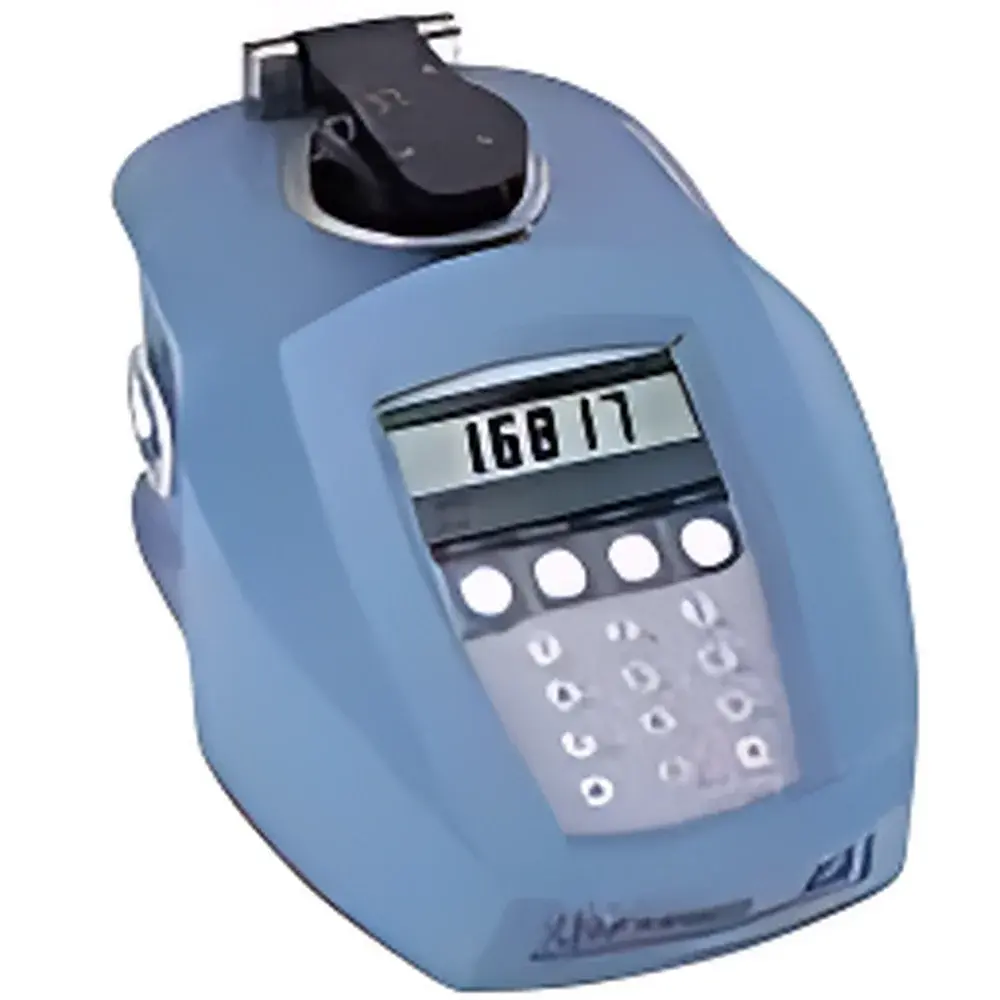
Bellingham + Stanley RFM960-C Benchtop Digital Refractometer
| Brand | Bellingham + Stanley |
|---|---|
| Origin | United Kingdom |
| Model | RFM960-C |
| Type | Benchtop Refractometer |
| Temperature Control | Peltier-based, ±0.03 °C accuracy |
| Display | 4-inch high-resolution color touchscreen |
| Resolution | 0.0001 RI / 0.1 °Brix |
| Measurement Range | 1.3000–1.7000 RI / 0–100 °Brix |
| Data Storage | 4,000 readings with full audit trail |
| Compliance | FDA 21 CFR Part 11, USP/EP/BP/JP, ASTM D2140, HACCP |
| Connectivity | 3× USB-A, 1× USB-B, 1× Ethernet, 1× RS232 |
| Sample Interface | Sapphire prism, 316 stainless steel & PEEK housing, Kalrez® seals |
| Light Source | LED at 589 nm (≥100,000 h lifetime) |
| Temperature Range | 10–80 °C (ambient-dependent), stability detection ±0.02 °C |
| Custom Scales | >20 preloaded (e.g., HFCS-3, Sucrose SG-3, Urea, PHR-MEAN), user-definable via PC software |
Overview
The Bellingham + Stanley RFM960-C is a precision benchtop digital refractometer engineered for high-reproducibility refractive index (RI) and related concentration measurements in regulated and research-intensive environments. It operates on the principle of total internal reflection at the prism–sample interface, where the critical angle of incident light is measured and converted into RI values using calibrated optical path algorithms. The instrument integrates a thermally stabilized sapphire prism assembly with an integrated Peltier temperature control system—enabling precise thermal equilibration of samples within ±0.03 °C across a 10–80 °C operational range. This architecture ensures compliance with pharmacopoeial requirements (USP , EP 2.2.2, JP 2.05, BP Appendix XVII) and supports method-specific validation under GMP/GLP frameworks. Its dual-wavelength-independent 589 nm LED light source eliminates spectral drift and provides long-term photometric stability—critical for extended calibration intervals and inter-laboratory comparability.
Key Features
- Peltier-controlled temperature regulation with real-time stability monitoring: continuous readout enabled only when sample temperature remains within ±0.02 °C of setpoint.
- 4-inch capacitive color touchscreen interface with intuitive icon-driven navigation and multi-language support (English, German, French, Spanish, Chinese).
- Comprehensive data integrity architecture: full electronic audit trail (user actions, parameter changes, measurement events), time-stamped and digitally signed per FDA 21 CFR Part 11 Annex 11 requirements.
- RFID-enabled user authentication: secure role-based access control, automatic log-on/off, and traceable operator identification without manual entry.
- Modular scale management: 20+ pre-validated scales—including PHR-MEAN (for batch mean calculation in pharmaceutical solutions), HFCS-3, Sucrose SG-3, Urea, and custom polynomial or linear TC compensation models.
- Robust mechanical design: sapphire prism surface, 316 stainless steel fluid contact parts, PEEK sample chamber, and Kalrez® chemical-resistant seals for compatibility with aggressive solvents, acids, and caustics.
Sample Compatibility & Compliance
The RFM960-C accommodates liquid, semi-viscous, and low-volatility samples ranging from aqueous sugar solutions to organic solvents, glycols, and API suspensions. Its sealed optical path prevents evaporation artifacts during extended analysis—particularly critical for volatile formulations. The instrument conforms to ISO 17025:2017 general requirements for competence of testing and calibration laboratories, and its firmware implements ALCOA+ (Attributable, Legible, Contemporaneous, Original, Accurate, Complete, Consistent, Enduring, Available) data governance principles. Validation documentation packages—including IQ/OQ/PQ protocols, traceable NIST-calibrated reference standards (certified RI oils), and method-specific verification reports—are available upon request for regulated users in pharmaceutical, food safety, and petrochemical QA/QC labs.
Software & Data Management
Data acquisition, reporting, and system administration are managed through the optional RFM Connect PC software (Windows 10/11 compatible). This application enables remote configuration, method library deployment, PDF report generation (with embedded metadata, signatures, and QR-coded audit trails), and bulk export to LIMS or ELN platforms via CSV, XML, or direct ODBC connection. All stored results include full contextual metadata: operator ID, timestamp, environmental temperature/humidity, calibration status, method version, and raw sensor diagnostics. USB “backup and copy” functionality allows encrypted local archiving of full instrument state—including settings, methods, and history—ensuring continuity during instrument relocation or firmware updates.
Applications
The RFM960-C serves as a primary metrology tool across multiple sectors: quantification of sucrose and fructose concentrations in beverage and confectionery manufacturing; active pharmaceutical ingredient (API) purity verification and excipient blending control; hydrocarbon fraction analysis in refinery process streams; quality release testing of antifreeze glycol mixtures; and R&D-grade characterization of polymer solutions and nanofluids. Its PHR-MEAN mode supports statistical aggregation of up to 20 sequential readings per batch—automatically calculating and certifying mean RI, standard deviation, and confidence intervals aligned with ICH Q2(R2) guidelines. In food safety contexts, it supports HACCP Critical Control Point monitoring for syrup consistency, brine strength, and fermentation endpoint detection.
FAQ
Does the RFM960-C support automated calibration verification?
Yes—via integrated reference oil vials and programmable auto-calibration routines that log verification status, date, operator, and deviation against certified values.
Can custom temperature compensation algorithms be deployed?
Yes—users may define linear or second-order polynomial coefficients for TC correction, either directly on-device or via RFM Connect software.
Is networked operation supported for centralized lab management?
Yes—the built-in Ethernet port enables DHCP/IP assignment, SNMP monitoring, and integration with enterprise IT security policies including LDAP/Active Directory authentication.
What is the expected lifetime of the LED light source?
Rated minimum lifetime exceeds 100,000 hours at nominal drive current, eliminating routine lamp replacement and associated recalibration downtime.
How does the instrument handle viscous or particulate-containing samples?
The wide-aperture sapphire prism and recessed sample well accommodate viscosities up to 10,000 mPa·s; optional ultrasonic cleaning mode mitigates residue buildup without disassembly.




