
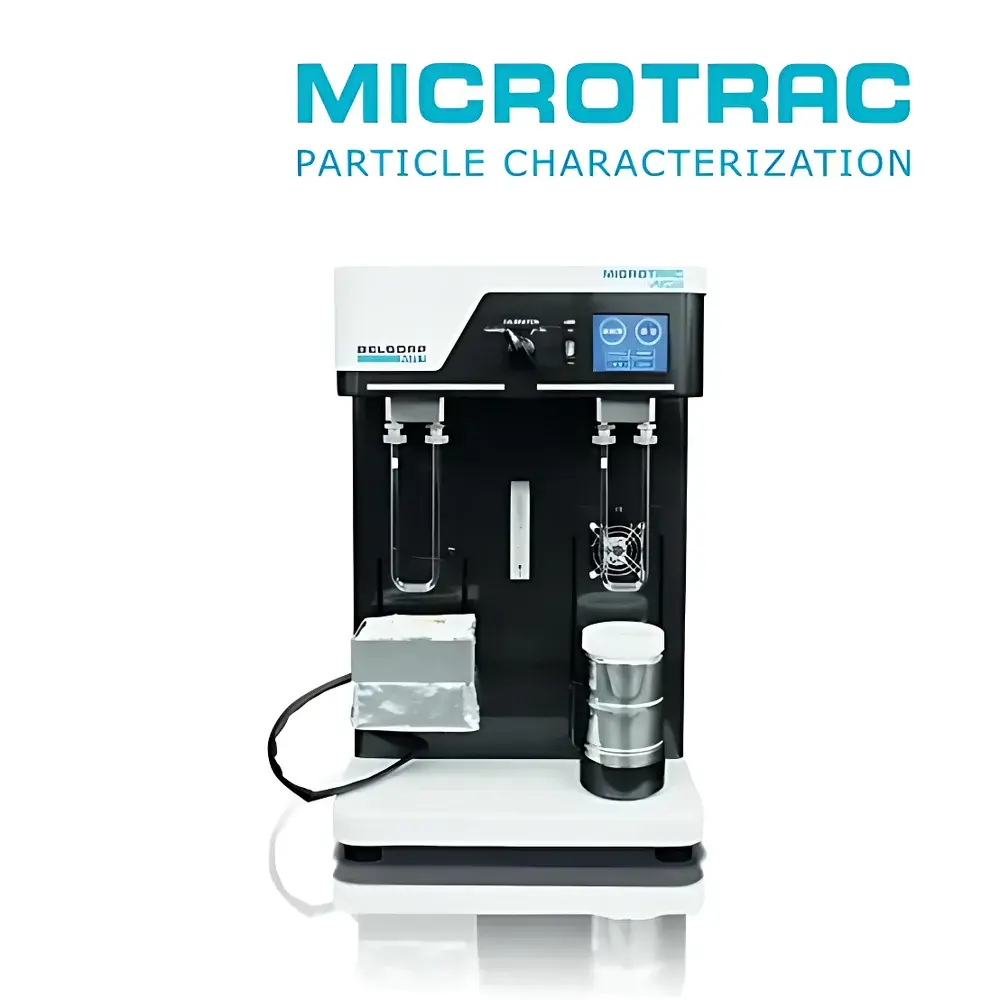
BELSORP MR1 Specific Surface Area and Pore Size Analyzer by Microtrac
| Brand | Microtrac |
|---|---|
| Origin | Japan |
| Model | BELSORP MR1 |
| Instrument Type | Specific Surface Area and Pore Size Analyzer |
| Principle | Dynamic Gas Flow Adsorption Method |
| Analysis Stations | 1 Pre-treatment Station, 1 Analysis Station |
| Surface Area Range | >0.01 m²/g |
| Pressure Range | 0.30 (standard), 0.02–0.9 (upgraded) |
| Adsorptive Gases | He/N₂ or He/Kr mixtures |
| Pretreatment Temperature | Room Temperature to 400 °C |
| Repeatability | <±1% |
| Measurement Time per Sample | ~10 min (analysis only) |
| Compliance Option | FDA 21 CFR Part 11 & 3Q Validation Support |
| Control Interface | Integrated Touchscreen (standalone operation) |
| Dimensions | W350 × D368 × H553 mm |
Overview
The BELSORP MR1 Specific Surface Area and Pore Size Analyzer, engineered and assembled at Microtrac’s Surface Analysis Center in Osaka, Japan, implements the dynamic gas flow adsorption method to determine specific surface area (SSA), BET surface area, and pore size distribution of solid powders and porous materials. Unlike static volumetric systems that rely on equilibrium pressure measurements under vacuum, the MR1 employs continuous, controlled gas flow through a sample bed while monitoring concentration changes via thermal conductivity detection. This principle enables rapid, high-reproducibility analysis with minimal operator intervention and no requirement for external PC connectivity during routine operation. Designed for laboratories requiring robust, ISO-aligned surface characterization without sacrificing throughput, the MR1 delivers traceable, GLP-compatible data across diverse material classes—including catalysts, pharmaceutical excipients, battery electrode materials, metal-organic frameworks (MOFs), and ceramic precursors.
Key Features
- Standalone touchscreen interface enabling full instrument control, method setup, real-time monitoring, and report generation without external computer dependency.
- Dual-station architecture: one dedicated pre-treatment station (heatable up to 400 °C under inert gas purge) and one independent analysis station—enabling parallel conditioning and measurement to maximize lab efficiency.
- Dynamic flow adsorption methodology compliant with ASTM D3663 and ISO 9277 for specific surface area determination, supporting both single-point and multi-point BET analyses (the latter requiring certified He/N₂ or He/Kr mixed-gas cylinders).
- Upgradable pressure sensing module extending relative pressure (P/P₀) range from standard 0.30 to an extended 0.02–0.9, facilitating accurate mesopore and partial micropore characterization per IUPAC recommendations.
- Thermal conductivity detector (TCD) optimized for N₂ and Kr adsorption, ensuring high signal-to-noise ratio and sub-percent repeatability (<±1%) across repeated measurements on homogeneous reference standards such as silica gel or activated carbon.
- Compact benchtop footprint (W350 × D368 × H553 mm) suitable for regulated QC labs, R&D facilities, and university core instrumentation suites with space constraints.
Sample Compatibility & Compliance
The BELSORP MR1 accommodates powdered, granular, and pelletized samples with minimal preparation—typically requiring only degassing prior to analysis. Its pre-treatment station supports programmable temperature ramps and dwell times under helium or vacuum, meeting ASTM D6036 and USP guidelines for pharmaceutical solid-state characterization. Optional 21 CFR Part 11 compliance package includes electronic signature capability, audit trail logging, user access levels, and secure data archiving—fully aligned with GMP/GLP quality systems. All firmware and software modules undergo periodic verification per IQ/OQ/PQ (3Q) protocols, with documentation templates provided for validation execution.
Software & Data Management
Instrument control and data processing are handled by Microtrac’s proprietary MR Series Software, installed locally on the integrated embedded system. The software implements automated baseline correction, dead volume calibration, and linear/nonlinear BET fitting with residual diagnostics. Raw TCD response curves, isotherm plots (P/P₀ vs. adsorbed volume), and derived parameters—including SSA (m²/g), pore volume (cm³/g), and BJH/KJS-based pore size distributions—are exportable in CSV, PDF, and XML formats. Audit trails record all user actions, parameter modifications, and calibration events with timestamps and operator IDs—ensuring full traceability required for regulatory submissions.
Applications
- Quality control of catalyst supports (e.g., γ-Al₂O₃, SiO₂, TiO₂) where surface area directly correlates with activity and lifetime.
- Characterization of lithium-ion battery cathode/anode materials (e.g., NMC, LFP, graphite) to assess coating uniformity and porosity impact on ion transport.
- Pharmaceutical development: quantifying surface area changes induced by milling, spray drying, or amorphous content—critical for dissolution rate prediction per ICH Q5A and Q6A.
- MOF and porous polymer screening for gas storage/separation applications, leveraging Kr adsorption at 77 K for low-surface-area (<1 m²/g) materials.
- Geological and environmental samples (e.g., clays, activated carbons, zeolites) where pore structure governs contaminant adsorption capacity.
FAQ
Does the BELSORP MR1 support both nitrogen and krypton adsorption?
Yes—the system operates with certified He/N₂ or He/Kr binary mixtures; Kr is recommended for materials with surface areas below 1 m²/g due to higher adsorption affinity at 77 K.
Is vacuum required for sample degassing?
No—pre-treatment is performed under flowing helium or argon; vacuum capability is not integrated, aligning with ASTM D6036’s inert-gas purging methodology.
Can the instrument be validated for GMP environments?
Yes—optional 3Q (IQ/OQ/PQ) documentation kits and 21 CFR Part 11-compliant firmware are available upon request.
What is the minimum detectable surface area?
The validated lower limit is >0.01 m²/g, verified using low-area reference materials traceable to NIST SRM 2975 (carbon black) and SRM 1988 (silica).
Is external gas supply regulation needed?
No—the MR1 incorporates integrated mass flow controllers and pressure regulators; only standard-grade cylinder gases (99.999% purity) are required.
Related Products



