
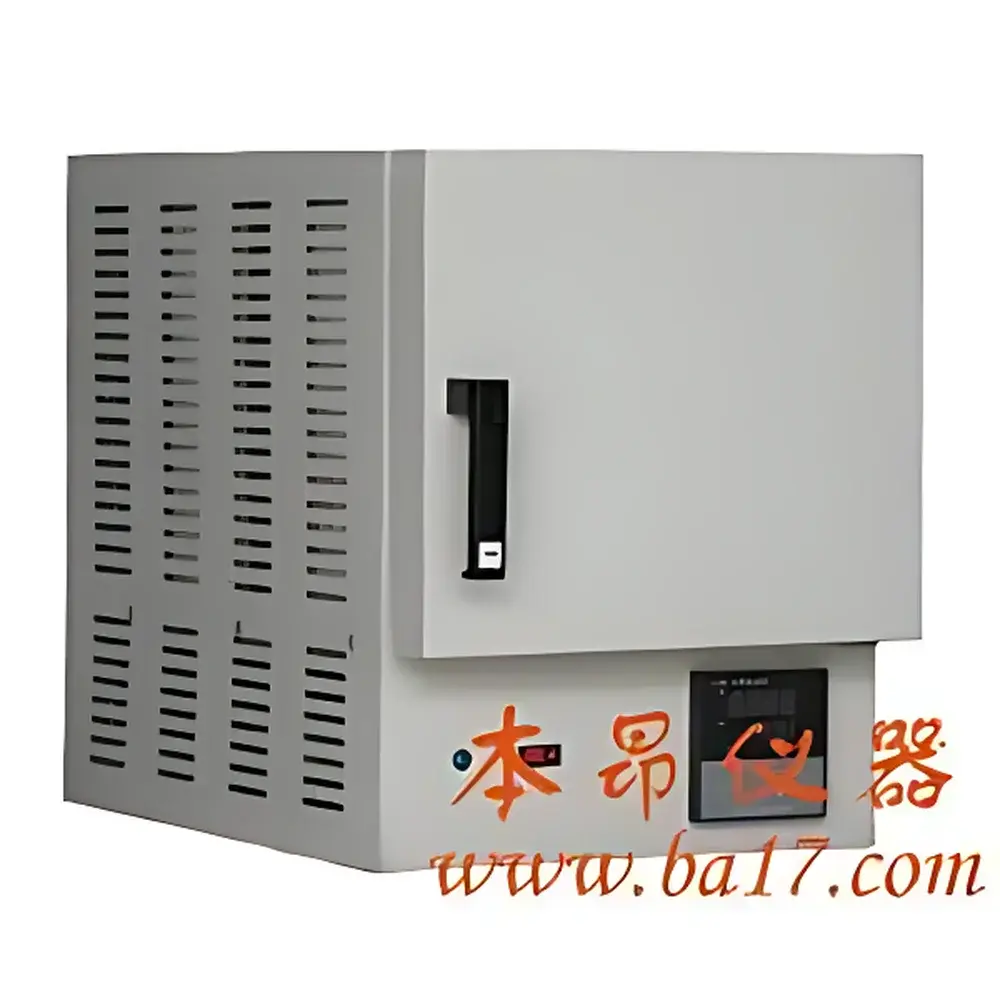
BenAng BA-5-10B Ceramic Fiber Muffle Furnace
| Brand | BenAng |
|---|---|
| Origin | Shanghai, China |
| Manufacturer Type | Authorized Distributor |
| Country of Origin | China |
| Model | BA-5-10B |
| Chamber Dimensions | 400 × 400 × 400 mm |
| Maximum Operating Temperature | 1000 °C |
| Temperature Uniformity | ±1 °C |
| Control System | PID Intelligent Temperature Controller |
| Heating Rate | ≥60 °C/min (to 1000 °C in ≤12 min) |
| Sensor Type | K-type Thermocouple (NiCr–NiSi) |
| Power Supply | AC 220 V, 50/60 Hz |
| Rated Power | 5 kW |
| Insulation | 50 mm High-Purity Alumina-Based Ceramic Fiber (US-sourced) |
| Heating Element | Kanthal® A1 Alloy Resistance Wire (Sweden-sourced) |
Overview
The BenAng BA-5-10B Ceramic Fiber Muffle Furnace is a high-performance benchtop box-type laboratory furnace engineered for rapid thermal processing, precise temperature control, and long-term operational reliability. Designed around the principles of radiant heat transfer and low-thermal-mass insulation, it utilizes high-purity alumina-based ceramic fiber insulation (sourced from the United States) with a total thickness of 50 mm—delivering exceptional thermal retention and minimizing heat loss during ramp-hold-cool cycles. The furnace employs Kanthal® A1 alloy resistance wire (manufactured in Sweden), known for its high resistivity stability, oxidation resistance up to 1400 °C, and mechanical durability under repeated thermal cycling. Unlike traditional brick-lined muffle furnaces, the BA-5-10B achieves 1000 °C in ≤12 minutes with a nominal heating rate of ≥60 °C/min—making it especially suitable for time-sensitive protocols in analytical chemistry, materials science, and quality control laboratories.
Key Features
- Ultra-low thermal mass architecture enables rapid heating and cooling, reducing cycle time by >85% compared to conventional refractory-lined furnaces.
- 50 mm thick high-purity ceramic fiber insulation ensures uniform temperature distribution across the 400 × 400 × 400 mm chamber, with axial and radial uniformity maintained within ±1 °C at 1000 °C.
- Kanthal® A1 heating elements provide stable resistance characteristics over extended service life—minimizing drift, hot-spot formation, and premature failure associated with standard Fe-Cr-Al or Ni-Cr wires.
- PID-integrated intelligent temperature controller with K-type thermocouple feedback delivers setpoint accuracy of ±1 °C and supports programmable ramp-soak profiles (up to 30 segments).
- Comprehensive safety architecture includes door-activated cut-off switch, surface overtemperature protection (triggered at 60 °C external casing temperature), auto-restart prevention after power interruption, and redundant thermal fusing.
- Energy-efficient design consumes approximately 40% less power than equivalent-duty refractory muffle furnaces—verified per IEC 60068-3-5 thermal efficiency test methodology.
Sample Compatibility & Compliance
The BA-5-10B accommodates crucibles, boats, and sample holders made from alumina, quartz, silicon carbide, and stainless steel (up to Grade 310S). It is compatible with ASTM E1131 (Thermogravimetric Analysis), ISO 562 (Determination of Volatile Matter in Coal), ISO 3087 (Ash Content in Solid Mineral Fuels), and USP (Residue on Ignition). The furnace’s inert muffle chamber—free of particulate shedding or fiber attrition—ensures contamination-free ashing, calcination, and pre-treatment of samples for elemental analysis (e.g., ICP-OES, AAS) and XRD phase identification. All electrical components comply with IEC 61010-1:2010 for laboratory equipment safety, and the control system supports audit-trail-ready operation when integrated with validated LIMS environments under GLP/GMP frameworks.
Software & Data Management
While the BA-5-10B operates via standalone PID controller with LED interface, optional RS485 Modbus RTU output enables integration into centralized lab automation systems. When connected to compliant SCADA or ELN platforms, it supports timestamped temperature logging, deviation alerts, and electronic record generation aligned with FDA 21 CFR Part 11 requirements—including user authentication, electronic signatures, and immutable data archiving. Firmware updates are delivered via secure USB interface, and calibration verification logs can be exported in CSV format for internal QA review and external regulatory submission.
Applications
- Pharmaceutical & Biomedical Labs: Residue-on-ignition testing, ash content determination in APIs and excipients, sterilization validation support, and pre-digestion of biological tissues prior to metal analysis.
- Environmental & Water Testing: Total suspended solids (TSS) gravimetric analysis, sulfate ash quantification, and preparation of filter media for EPA Method 1669 compliance.
- Fuel & Energy Research: Proximate analysis (moisture, volatile matter, fixed carbon, ash), fusibility testing of coal ash (ISO 540), and calorific value sample conditioning.
- Materials Science: Sintering trials of advanced ceramics, thermal annealing of thin-film substrates, and controlled oxidation studies of nanomaterials and battery electrode precursors.
- Academic Teaching: Undergraduate and graduate labs in physical chemistry, metallurgy, and geochemistry—supporting reproducible demonstrations of Arrhenius kinetics, phase transformation, and thermal decomposition thermodynamics.
FAQ
What is the maximum recommended continuous operating temperature?
The BA-5-10B is rated for continuous operation at 1000 °C; intermittent use up to 1050 °C is permissible for ≤30 minutes per cycle.
Can this furnace be used for ashing organic tissue samples without contamination?
Yes—the ceramic fiber lining is non-shedding and chemically inert under oxidizing atmospheres; no binder volatilization or fiber fragmentation occurs below 1100 °C.
Is the temperature controller compliant with GLP documentation requirements?
The base unit supports manual log entry; with optional RS485 + validated software, full 21 CFR Part 11-compliant electronic records are achievable.
What maintenance intervals are recommended for the heating elements?
Under normal usage (≤8 hrs/day, ≤500 cycles/year), Kanthal® A1 elements typically exceed 5,000 hours of service life; visual inspection every 6 months is advised.
Does the furnace require external ventilation or exhaust ducting?
For ashing applications involving halogenated or sulfur-containing samples, connection to a certified fume hood or dedicated exhaust manifold is required per OSHA 1910.1200 and local environmental codes.



