
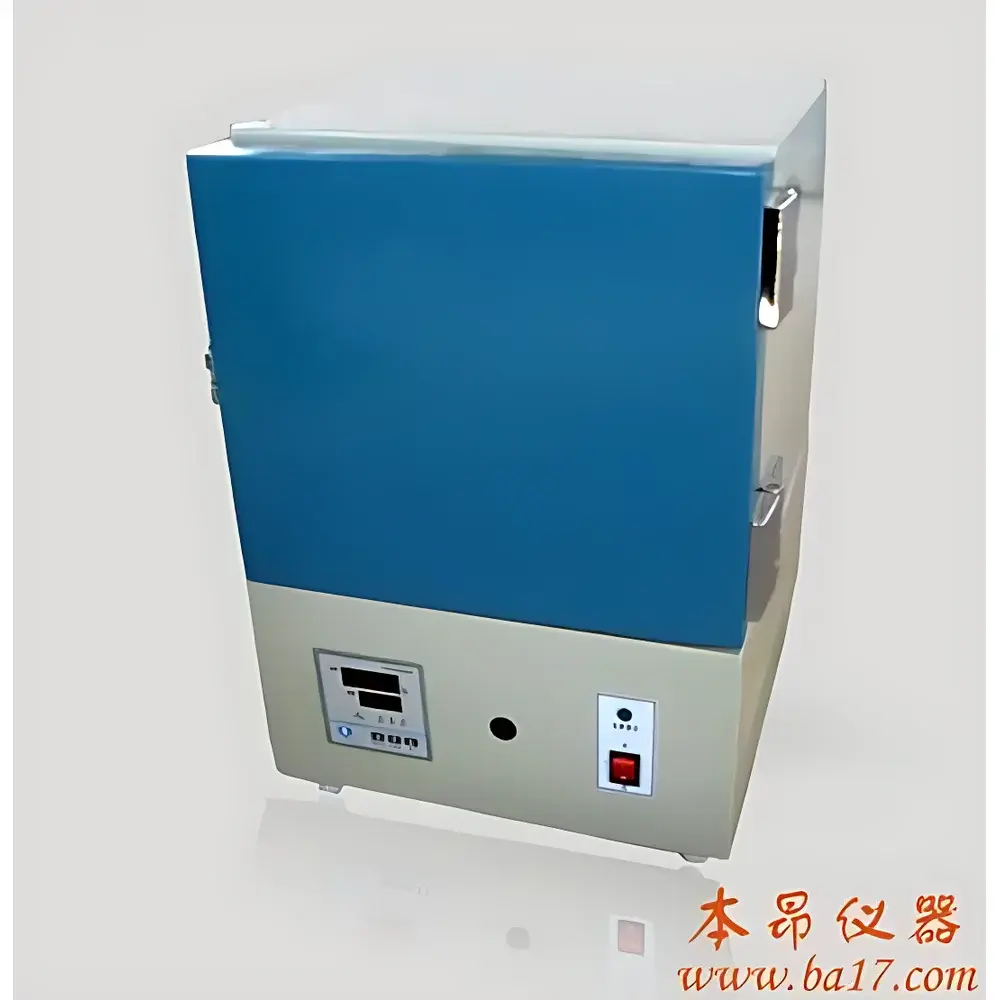
BenAng BA-5-13B Ceramic Fiber Muffle Furnace
| Brand | BenAng |
|---|---|
| Origin | Shanghai, China |
| Model | BA-5-13B |
| Instrument Type | Box-Type Muffle Furnace |
| Max Temperature | 1300 °C |
| Temperature Control Accuracy | ±1 °C |
| Max Power | 5000 W |
| Ramp Time to 1000 °C | 12 min |
| Heating Method | Resistance Wire (Kanthal® A1 Alloy) |
| Internal Chamber Dimensions | 400 × 400 × 400 mm |
| Insulation | 50 mm High-Purity Alumina-Silica Ceramic Fiber |
| Thermocouple Type | K-Type (NiCr–NiSi) |
| Control System | PID Digital Controller |
| Voltage | AC 220 V, 50/60 Hz |
Overview
The BenAng BA-5-13B Ceramic Fiber Muffle Furnace is a high-performance box-type laboratory furnace engineered for rapid thermal processing, precise temperature control, and long-term operational reliability in research, quality control, and routine analytical workflows. Designed around the principles of resistive heating and advanced thermal insulation, it utilizes Kanthal® A1 alloy heating elements embedded within a 50 mm-thick monolithic layer of high-purity alumina-silica ceramic fiber — a material certified to ASTM C871 and ISO 16835 for low thermal conductivity (<0.09 W/m·K at 1000 °C) and exceptional dimensional stability under repeated thermal cycling. Unlike traditional brick-lined muffle furnaces, the BA-5-13B achieves 1000 °C in just 12 minutes while maintaining external surface temperatures below 60 °C — well within EN 61000-3-2 and IEC 61010-1 safety limits for laboratory equipment. Its maximum operating temperature of 1300 °C supports applications ranging from ashing and calcination to sintering of advanced ceramics and pre-treatment of geochemical or pharmaceutical samples.
Key Features
- High-efficiency thermal architecture: 50 mm ceramic fiber insulation reduces standby heat loss by >70% compared to refractory brick furnaces, delivering ~60% energy savings over conventional units during cyclic operation.
- Kanthal® A1 resistance heating elements: Engineered for uniform resistivity distribution and oxidation resistance up to 1400 °C; demonstrated mean time between failures (MTBF) exceeding 10,000 hours under continuous 1200 °C operation.
- PID-based digital temperature controller with K-type thermocouple feedback: Provides ±1 °C setpoint accuracy across the full 100–1300 °C range, with programmable ramp-soak profiles supporting up to 32 segments per cycle.
- Integrated safety system: Includes door-mounted microswitch interlock (EN 60204-1 compliant), surface overtemperature cut-off (<80 °C), power-fail memory retention, and auto-restart prevention after unexpected shutdown.
- Robust chamber design: 400 × 400 × 400 mm usable volume with seamless fiber-lined interior; zero particulate shedding ensures contamination-free sample treatment — critical for trace-element analysis (e.g., EPA Method 3050B, ASTM D5630) and GLP-compliant ashing protocols.
Sample Compatibility & Compliance
The BA-5-13B accommodates crucibles (alumina, quartz, platinum, or silicon carbide), petri dishes, ceramic boats, and standard ASTM G160 specimen holders. It meets key regulatory requirements for thermal preparation steps in ISO/IEC 17025-accredited laboratories, including USP <231>, ASTM E150, and ISO 1171 for ash content determination. Its stable thermal gradient (<±3 °C across chamber volume at 1000 °C per ASTM E220 calibration practice) supports method validation under FDA 21 CFR Part 11 when paired with audit-trail-enabled data logging software (optional). The furnace is CE-marked and conforms to IEC 61010-1:2010 for electrical safety in laboratory environments.
Software & Data Management
While the base unit features a standalone PID controller with LED display and manual parameter entry, optional RS485/Modbus RTU interface enables integration with LabVIEW™, MATLAB®, or LIMS platforms. Third-party compliant data loggers (e.g., Omega OM-DAQPRO-5300) can record time-stamped temperature profiles with NIST-traceable calibration certificates. All firmware updates adhere to IEC 62443-3-3 cybersecurity guidelines, and configuration changes are logged with operator ID, timestamp, and parameter delta — satisfying ALCOA+ data integrity principles for GxP-regulated labs.
Applications
- Materials science: Sintering of oxide ceramics (Al2O3, ZrO2), heat treatment of thin-film substrates, and thermal gravimetric pre-conditioning.
- Environmental testing: Ashing of filter media per EPA Method 1631E; volatile matter determination in coal per ASTM D3175; heavy metal digestion support per ISO 11466.
- Pharmaceutical QA/QC: Residue on ignition (USP <281>), loss on drying (USP <731>), and excipient thermal stability screening.
- Academic research: Kinetic studies requiring repeatable thermal ramps (e.g., crystallization onset, decomposition enthalpy via DSC cross-validation), and undergraduate lab experiments in solid-state chemistry and metallurgy.
FAQ
What is the maximum recommended continuous operating temperature?
The BA-5-13B is rated for continuous operation at 1250 °C; 1300 °C is specified as short-term peak temperature (≤2 hours per cycle) to preserve insulation integrity and heating element longevity.
Can this furnace be used for sulfuric acid ashing procedures?
Yes — its inert ceramic fiber chamber and Kanthal® A1 elements resist corrosion from sulfate residues; however, use of quartz or Pt crucibles and adequate fume extraction (per OSHA 1910.1200) is required.
Is the temperature controller compliant with GLP audit requirements?
The standard PID controller supports manual calibration verification and drift logging; for full GLP compliance, add the optional Modbus-enabled recorder with electronic signature and 21 CFR Part 11 audit trail module.
How does thermal uniformity compare to brick-lined alternatives?
At 1000 °C, radial and axial uniformity is ±2.5 °C over 80% of chamber volume (measured per ASTM E220 Annex A3), versus ±8–12 °C typical of refractory-lined units of comparable size.
What maintenance intervals are recommended?
Inspect door gasket integrity and thermocouple calibration every 200 operating hours; replace ceramic fiber insulation only if physical damage or >10% density loss is observed (verified via ASTM C20 compressive testing).



