
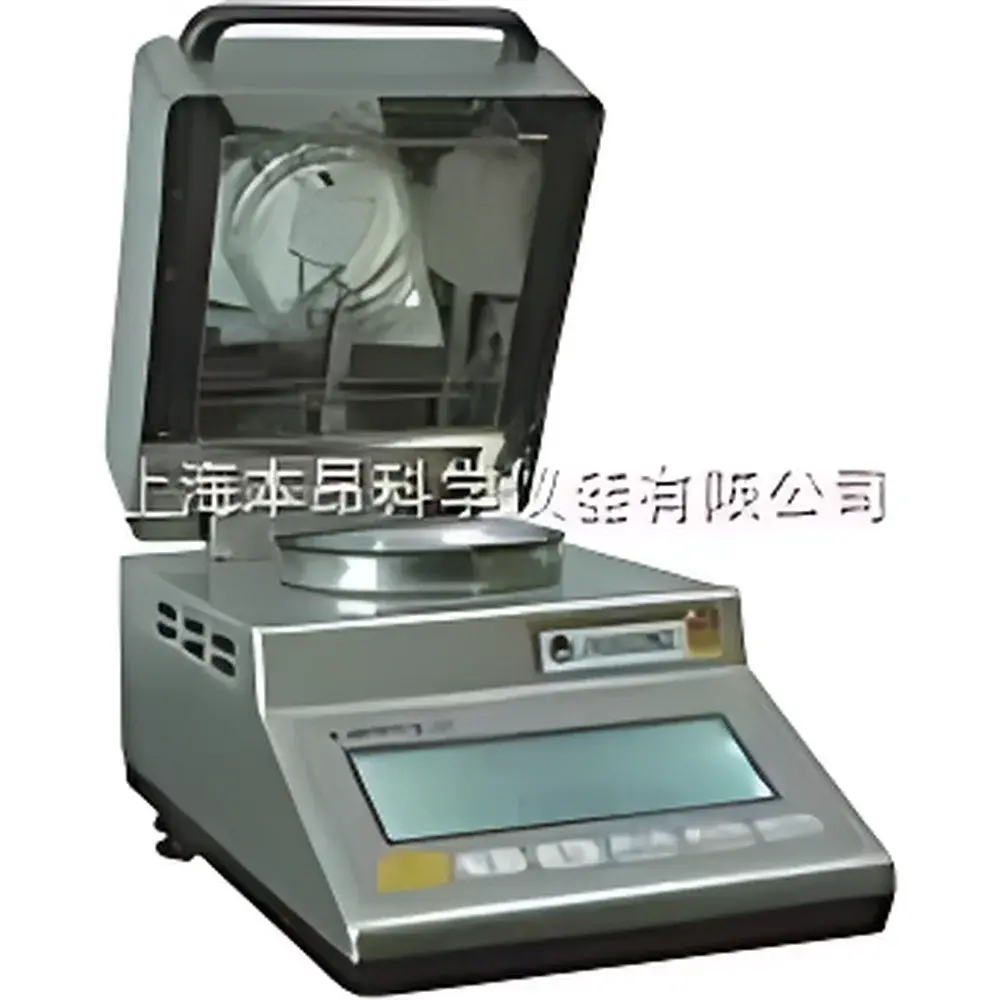
BenAng LHS16-A Halogen Moisture Analyzer
| Brand | BenAng |
|---|---|
| Origin | Shanghai, China |
| Model | LHS16-A |
| Readability | 0.001 g |
| Weighing Range | 0–100 g |
| Temperature Range | Ambient to 160 °C |
| Temperature Control Accuracy | ±1 °C |
| Moisture Content Readability | 0.01% |
| Repeatability (≥2 g sample) | 0.2% |
| Timer Range | 0–120 min |
| Heating Modes | Manual & Automatic |
| Control Method | Programmable Microprocessor |
| Display Parameters | 8 configurable values |
| Sample Pan Diameter | Ø90 mm |
| Dimensions | 325 × 195 × 195 mm |
| Power Supply | 220 V, 50 Hz or 110 V ±11 V, 60 Hz |
Overview
The BenAng LHS16-A Halogen Moisture Analyzer is a precision thermogravimetric instrument engineered for rapid, reliable moisture content determination in solid and semi-solid samples. It operates on the principle of loss-on-drying (LOD), combining high-resolution electromagnetic force compensation weighing with focused halogen lamp heating and precise digital temperature regulation. Unlike traditional oven-drying methods requiring hours, the LHS16-A delivers quantitative moisture results in minutes—typically 3–10 minutes depending on sample type and initial moisture load—by uniformly heating the sample surface and subsurface layers via near-infrared radiation (wavelength peak ~1.2 µm). This method ensures efficient energy transfer, minimal thermal degradation of heat-sensitive materials, and high reproducibility across routine analytical workflows. Designed for integration into QC laboratories, R&D facilities, and production line quality gates, the analyzer meets foundational requirements for method validation under ISO 712, AOAC 952.08, and USP , serving as a validated alternative to classical gravimetric drying where speed, operator consistency, and data traceability are critical.
Key Features
- High-precision electromagnetic balance with 0.001 g readability and 100 g maximum capacity, calibrated internally and externally via single-point calibration routine.
- Halogen heating module delivering rapid, uniform thermal energy across the Ø90 mm stainless-steel sample pan; optimized for consistent surface-to-core drying without charring or crust formation.
- Digital PID temperature control with ±1 °C accuracy over a programmable range from ambient to 160 °C, enabling method-specific thermal profiles for diverse matrices (e.g., pharmaceutical excipients, roasted coffee, polymer pellets).
- Microprocessor-based operation supporting both manual and automatic heating modes, with user-defined time limits (0–120 min) and endpoint detection based on weight stabilization thresholds.
- Configurable display interface showing up to eight real-time parameters—including initial mass, current mass, moisture %, dry mass %, residual mass, heating time, temperature, and drying rate—adjustable per user preference.
- RS232 serial interface compliant with standard laboratory instrumentation protocols, enabling direct connection to thermal printers or LIMS-compatible PCs for automated report generation and raw data export.
Sample Compatibility & Compliance
The LHS16-A accommodates a broad spectrum of non-volatile, non-hygroscopic, and moderately volatile samples, including but not limited to powders (e.g., lactose, starch), granules (e.g., API blends), dried foods (e.g., herbs, cereals), tobacco leaf, polymers, and inorganic salts. Samples ≥2 g are recommended to minimize relative error from environmental drafts and weighing noise. While not intended for solvents or low-boiling volatiles (e.g., ethanol, acetone), it complies with fundamental thermogravimetric measurement principles defined in ASTM E1868 and ISO 15512. Its construction adheres to IEC 61010-1 safety standards for laboratory electrical equipment. Though not inherently 21 CFR Part 11–compliant out-of-the-box, audit-ready data logging and electronic signature support can be implemented via validated third-party software interfacing through the RS232 port—facilitating GLP/GMP-aligned documentation in regulated environments.
Software & Data Management
The LHS16-A operates autonomously without proprietary software; however, its RS232 output transmits ASCII-formatted data packets containing timestamped mass and moisture values at user-selectable intervals. Compatible with generic terminal emulators (e.g., Tera Term, PuTTY) or custom LabVIEW/Python scripts, it supports four configurable output modes: continuous streaming, endpoint-only, interval-sampled, or full-session dump. Each data record includes instrument ID, date/time stamp, method ID, sample ID (user-entered), initial/dry mass, and calculated moisture %—enabling traceable linkage to sample logs and batch records. For enterprise integration, middleware solutions may map this stream into ELN or LIMS platforms, satisfying ALCOA+ (Attributable, Legible, Contemporaneous, Original, Accurate) data integrity expectations when paired with procedural controls.
Applications
- Pharmaceutical manufacturing: Moisture verification of active pharmaceutical ingredients (APIs), excipients, and final dosage forms per USP and EP 2.5.12.
- Food quality assurance: Rapid moisture checks in flour, sugar, dairy powders, spices, and snack products to ensure shelf-life stability and compliance with Codex Alimentarius limits.
- Tobacco processing: In-line monitoring of leaf moisture pre- and post-curing to optimize fermentation and prevent mold growth.
- Chemical industry: Batch release testing of catalysts, desiccants, and hydrated salts where stoichiometric water content affects reactivity.
- Agricultural commodities: Field-lab assessment of grain, feed, and seed moisture to inform storage conditions and prevent mycotoxin development.
FAQ
What is the difference between halogen and infrared moisture analyzers?
Halogen lamps emit broadband near-infrared radiation with higher intensity and faster thermal response than traditional IR quartz tubes, enabling shorter drying cycles and improved repeatability for heterogeneous samples.
Can the LHS16-A measure volatile organic compounds (VOCs)?
No—it quantifies total volatile loss interpreted as moisture under standardized LOD conditions; dedicated headspace-GC or KF titration is required for selective VOC quantification.
Is external calibration required before each analysis?
No; internal calibration is performed automatically on startup, but external verification using certified weights (e.g., 10 g, 50 g Class M2) is recommended daily or per SOP before critical measurements.
Does the instrument support method validation documentation?
Yes—the RS232 output enables full raw data capture, and the timer, temperature, and mass logs satisfy key elements of IQ/OQ/PQ protocols when combined with documented operational procedures.
What maintenance is required for long-term accuracy?
Routine cleaning of the halogen lamp housing and sample pan with lint-free cloth and isopropyl alcohol; annual verification of temperature sensor drift and balance linearity by qualified service technician.






