
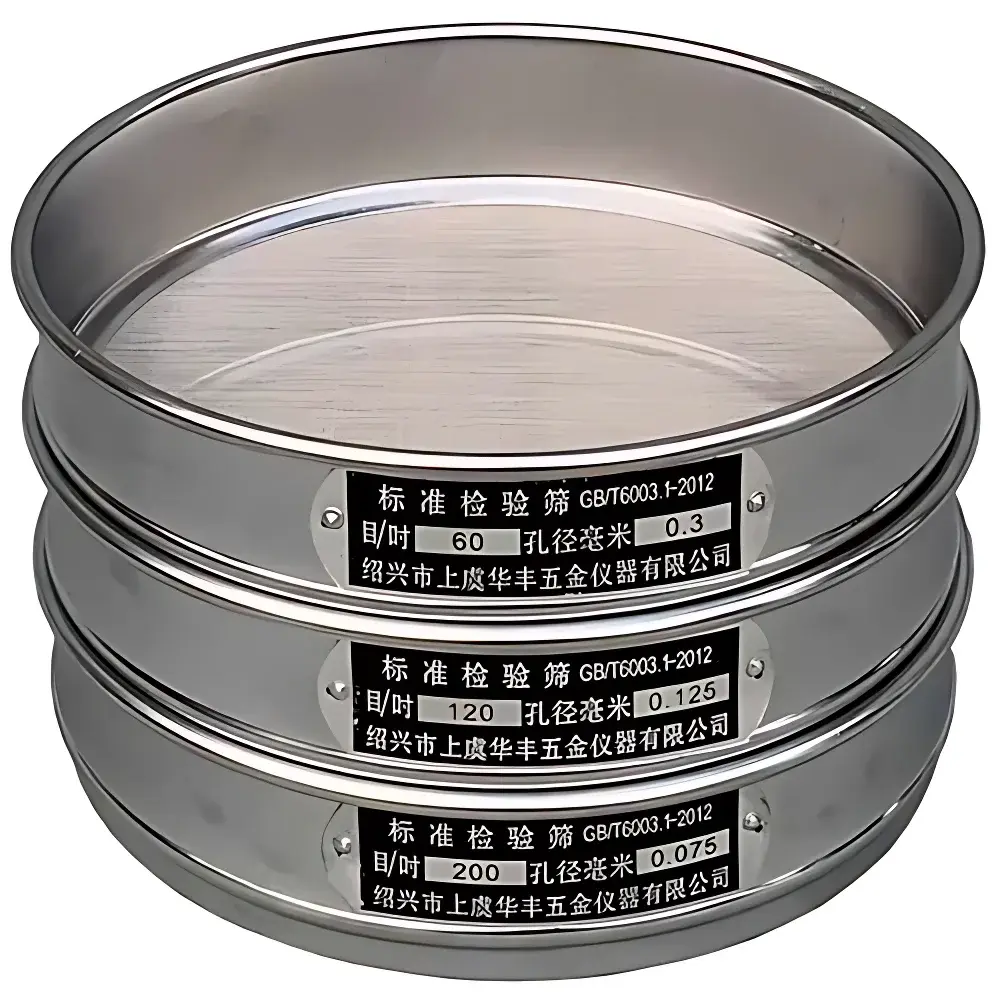
BenChen BC-200 Standard Test Sieves (Pharmacopoeia-Compliant Sieve Sets)
| Brand | BenChen |
|---|---|
| Diameter | 200 mm |
| Material | Dual-layer 304 stainless steel frame and mesh |
| Mesh Range | 10–500 mesh |
| Compliance | GB/T 6003.1–2012, ISO 3310-1:2016, USP <786>, EP 2.9.33 |
| Origin | Hebei, China |
| Manufacturer Type | Direct OEM/ODM Producer |
| Customization | Available for diameter, mesh count, and stack configuration |
Overview
BenChen BC-200 Standard Test Sieves are precision-engineered sieve assemblies designed for reproducible dry or wet sieve analysis of granular and powdered materials in accordance with internationally recognized metrological standards. These sieves operate on the principle of mechanical size separation—particles smaller than the nominal aperture pass through the mesh under controlled agitation, while retained fractions are quantified gravimetrically to generate particle size distribution (PSD) profiles. As defined by ISO 3310-1:2016 and GB/T 6003.1–2012, each BC-200 sieve features certified aperture tolerances, traceable mesh geometry, and strict conformity to nominal mesh designation (e.g., 100 mesh = 150 µm ± tolerance), distinguishing them from generic industrial sieves. The system is fully compatible with both manual hand-sieving protocols and automated sieve shakers (e.g., Retsch AS 200, Endecotts ESSA), supporting regulatory-grade particle characterization workflows in pharmaceutical, chemical, food, and materials R&D laboratories.
Key Features
- 200 mm nominal diameter circular sieve frames constructed from dual-layer 304 stainless steel—ensuring corrosion resistance, dimensional stability, and compliance with USP <786> requirements for pharmaceutical particulate testing
- Precision-woven square-aperture mesh conforming to ISO 3310-1:2016 geometric tolerances: aperture deviation ≤ ±3% for meshes ≥63 µm; wire diameter tolerance ±5 µm
- Full traceability: Each sieve carries a permanent laser-engraved identifier including batch number, nominal aperture (µm), mesh count, and manufacturing date
- Interchangeable stacking design with standardized flange geometry—enables seamless integration into multi-tier sieve nests (up to 8 levels) for cumulative fractionation
- Optional accessories include stainless steel covers and receivers compliant with ASTM E11–22 specifications for sieve assembly integrity
- No tooling required for assembly/disassembly; positive-locking retention ensures zero lateral displacement during mechanical agitation
Sample Compatibility & Compliance
The BC-200 series accommodates dry powders (e.g., APIs, excipients, catalysts, metal powders) and lightly agglomerated granules up to 6 mm nominal top size. It is validated for use in sieve analysis of cohesive, electrostatic, or hygroscopic materials when paired with anti-static brushes or ultrasonic assistance. Regulatory alignment includes full support for pharmacopeial methods: USP <786> (Particle Size Distribution), European Pharmacopoeia 2.9.33 (Sieve Analysis), and Chinese Pharmacopoeia IV (General Chapter 0982). All sieves undergo factory calibration against NIST-traceable reference standards and are supplied with a Certificate of Conformance documenting aperture verification per ISO/IEC 17025-accredited procedures. For GMP environments, optional documentation packages include Equipment Qualification (IQ/OQ) templates aligned with FDA 21 CFR Part 11 data integrity expectations.
Software & Data Management
While the BC-200 is a passive mechanical device, its metrological output integrates directly into LIMS and electronic lab notebook (ELN) platforms via standardized reporting formats. When used with automated sieve shakers equipped with digital timers and amplitude control (e.g., Endecotts Octagon 200), mass retention data per sieve layer can be exported as CSV or PDF reports compliant with ALCOA+ principles. BenChen provides a free Excel-based PSD calculation template preconfigured with Rosin-Rammler and logarithmic probability plotting functions—fully auditable and version-controlled. For regulated labs, the template supports audit trails, user authentication logs, and electronic signature fields compatible with 21 CFR Part 11 Annex 11 requirements.
Applications
- Pharmaceutical quality control: Granule flowability assessment, blend uniformity verification, and final dosage form particle sizing per ICH Q5A and Q6A guidelines
- Materials science: Characterization of additive manufacturing feedstocks (e.g., Ti-6Al-4V, Inconel 718 powders) prior to sintering
- Food safety: Verification of flour fineness, spice particle homogeneity, and allergen cross-contamination thresholds
- Geotechnical engineering: Soil grain-size distribution for AASHTO T 88 and ASTM D422 classification
- Environmental testing: Sediment particle sorting in wastewater sludge and fly ash analysis per EPA Method 1010B
- Research validation: Reference standard for calibrating laser diffraction (LD) and dynamic image analysis (DIA) instruments
FAQ
What does “mesh” mean in relation to aperture size?
Mesh count refers to the number of openings per linear inch; however, actual aperture width (in µm) is governed by wire diameter and weaving geometry—not simply 25,400 ÷ mesh. BC-200 sieves report both nominal mesh and certified aperture (e.g., 200 mesh ≡ 75 µm ±2.3 µm).
Can these sieves be used for wet sieving?
Yes—304 stainless steel construction and welded mesh anchoring allow immersion in deionized water or mild solvents. For aggressive media, optional electropolished finish is available upon request.
Is calibration documentation included?
Each set ships with a printed Certificate of Conformance listing measured apertures, test method (ISO 3310-1 Annex B), and technician signature. Full calibration reports per ISO/IEC 17025 are available as a value-added service.
How often should sieves be re-verified?
Per USP <786>, re-verification is recommended after 500 operational cycles or annually—whichever occurs first. Wear inspection focuses on mesh deformation, wire breakage, and frame flatness (±0.1 mm over 200 mm span).
Related Products



