
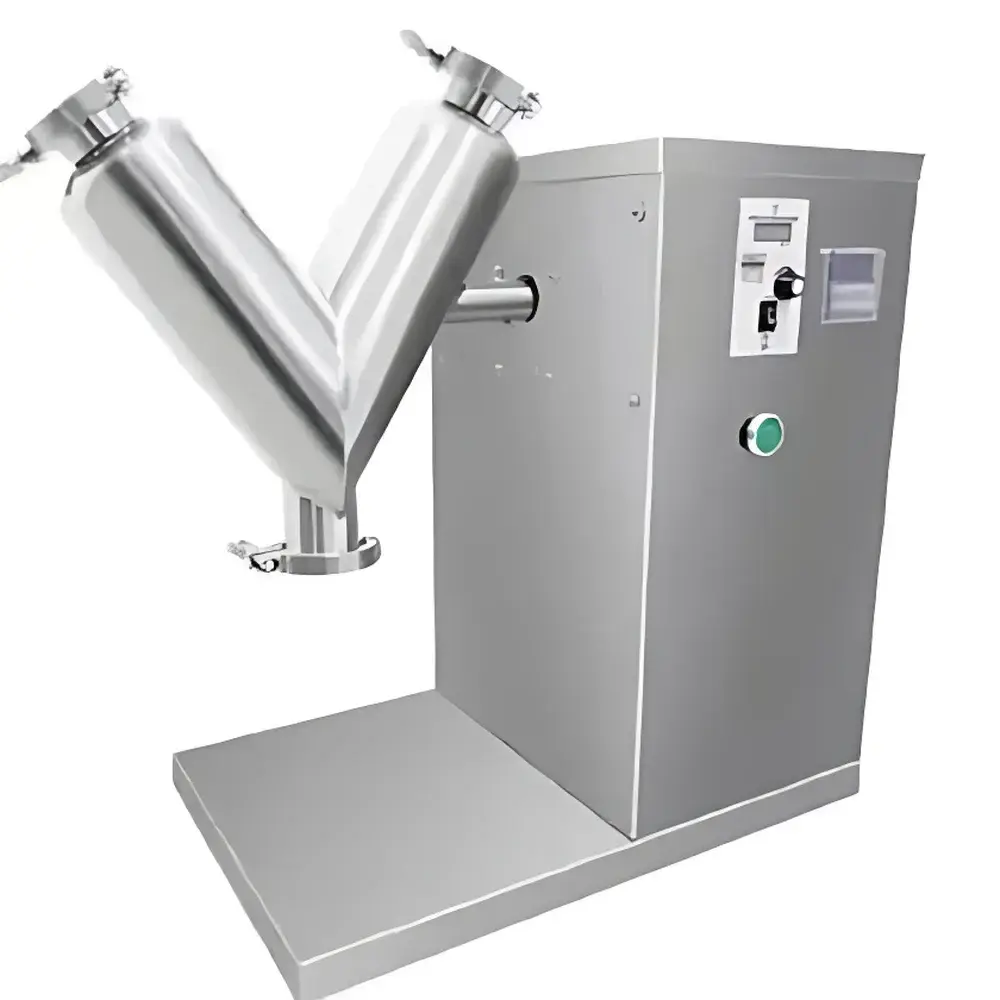
BenChen HV-3 Small-Scale V-Blender for Laboratory and Teaching Applications
| Brand | BenChen |
|---|---|
| Origin | Hebei, China |
| Manufacturer Type | Direct Producer |
| Country of Origin | China |
| Model | HV-3 |
| Total Volume | 3 L |
| Effective Volume | 1.2 L |
| Loading Factor | 40% |
| Max. Batch Weight | 1.2 kg |
| Motor Power | 250 W |
| Speed Range | 0–24 rpm (adjustable) |
| Net Weight | 40 kg |
| Dimensions (W×D×H) | 450 × 260 × 460 mm |
Overview
The BenChen HV-3 Small-Scale V-Blender is a precision-engineered laboratory-grade powder mixer designed specifically for educational laboratories, R&D centers, and pilot-scale process development in chemical engineering curricula. It operates on the fundamental principle of gravitational convective mixing: two asymmetric, symmetrical V-shaped stainless steel cylinders rotate slowly about a central horizontal axis, inducing continuous axial and radial material reorientation. As the vessel rotates at low speed (0–24 rpm), particles undergo repeated splitting, shearing, and recombination under combined mechanical agitation and gravity-driven cascading—enabling homogeneous distribution without segregation or attrition. Its compact footprint (450 × 260 × 460 mm) and 1.2 L effective capacity make it ideal for controlled batch experiments with limited sample volumes, aligning with pedagogical requirements for hands-on unit operations training in mass transfer, particle technology, and solid dosage form development.
Key Features
- Optimized V-geometry with precisely angled twin cylinders to maximize convective flow patterns and minimize dead zones—ensuring complete material turnover within each rotation cycle.
- Electropolished 304 stainless steel construction (interior and exterior) compliant with ISO 8573-1 Class 4 surface roughness standards for cleanability and corrosion resistance.
- Variable-speed AC motor drive (0–24 rpm) with digital speed control and integrated timer (0–99 min) for reproducible process parameter documentation.
- Low-noise, vibration-damped mounting system; operational sound pressure level <62 dB(A) at 1 m distance per ISO 3744.
- Dual discharge configuration: quick-release rotary valve for controlled gravity discharge and optional vacuum-assisted feed port compatible with standard lab-grade vacuum conveyors (–0.06 to –0.08 MPa).
- Modular support frame with non-slip rubber feet and reinforced load-bearing brackets rated for static loads up to 60 kg.
Sample Compatibility & Compliance
The HV-3 is validated for use with free-flowing dry powders and granules exhibiting narrow polydispersity (d50 50–500 µm) and comparable bulk densities (±15% deviation). It is unsuitable for highly cohesive, fibrous, or moisture-sensitive materials without pre-conditioning. In academic settings, it supports ASTM D5727-22 (Standard Practice for Sampling Powder Blends) and aligns with USP <1174> guidelines on uniformity of dosage units for teaching purposes. All electrical components meet CE Low Voltage Directive 2014/35/EU and RoHS 2011/65/EU requirements. The stainless steel contact surfaces comply with FDA CFR Title 21 Part 178.3570 for indirect food additives.
Software & Data Management
While the HV-3 operates as a stand-alone mechanical unit, its analog controls are fully compatible with external data acquisition systems via 0–10 V analog output (optional add-on module). Lab managers may integrate rotational speed and timer signals into LIMS or ELN platforms using standard USB-to-4–20 mA converters. Audit trails for mixing duration and speed settings can be manually logged in accordance with GLP documentation practices. No embedded firmware or cloud connectivity is included—consistent with ISO/IEC 17025:2017 Clause 6.4.7 for equipment used in accredited teaching labs where traceability relies on procedural rigor rather than digital automation.
Applications
This blender serves as a foundational tool in undergraduate and graduate chemical engineering laboratories for studying mixing kinetics, residence time distribution (RTD), and scale-up correlations between lab-scale and industrial V-blenders. Typical instructional experiments include: quantifying blend uniformity via near-infrared spectroscopy (NIR) sampling; evaluating the impact of fill level (30–50% v/v) on homogeneity index (HI); comparing mixing efficiency across particle size distributions using sieve analysis per ASTM E11-22; and modeling shear-induced de-mixing in binary blends. Industry-aligned applications span pharmaceutical excipient blending (e.g., lactose–microcrystalline cellulose), ceramic green body formulation, catalyst precursor mixing, and animal feed premix validation.
FAQ
What is the recommended maximum fill level for optimal mixing performance?
For consistent homogeneity and minimal segregation, operate at 40% total volume (1.2 L / 1.2 kg), as specified by the loading factor design constraint.
Can the HV-3 be used for wet granulation or liquid addition?
No—this unit is strictly intended for dry powder and granule blending. Introduction of liquids requires dedicated high-shear or fluidized-bed equipment.
Is calibration required before each use?
Speed and timer functions are factory-calibrated; periodic verification against a handheld tachometer and stopwatch is recommended every 6 months per institutional QA protocols.
Does the unit support GMP-compliant operation in teaching labs?
Yes—when operated with documented SOPs, maintenance logs, and operator training records, it fulfills Annex 15 and ICH Q5C expectations for educational equipment used in regulated curriculum modules.
What safety certifications does the HV-3 carry?
It bears CE marking for electromagnetic compatibility (EMC Directive 2014/30/EU) and mechanical safety (Machinery Directive 2006/42/EC), with full technical file available upon request from BenChen’s quality department.




