
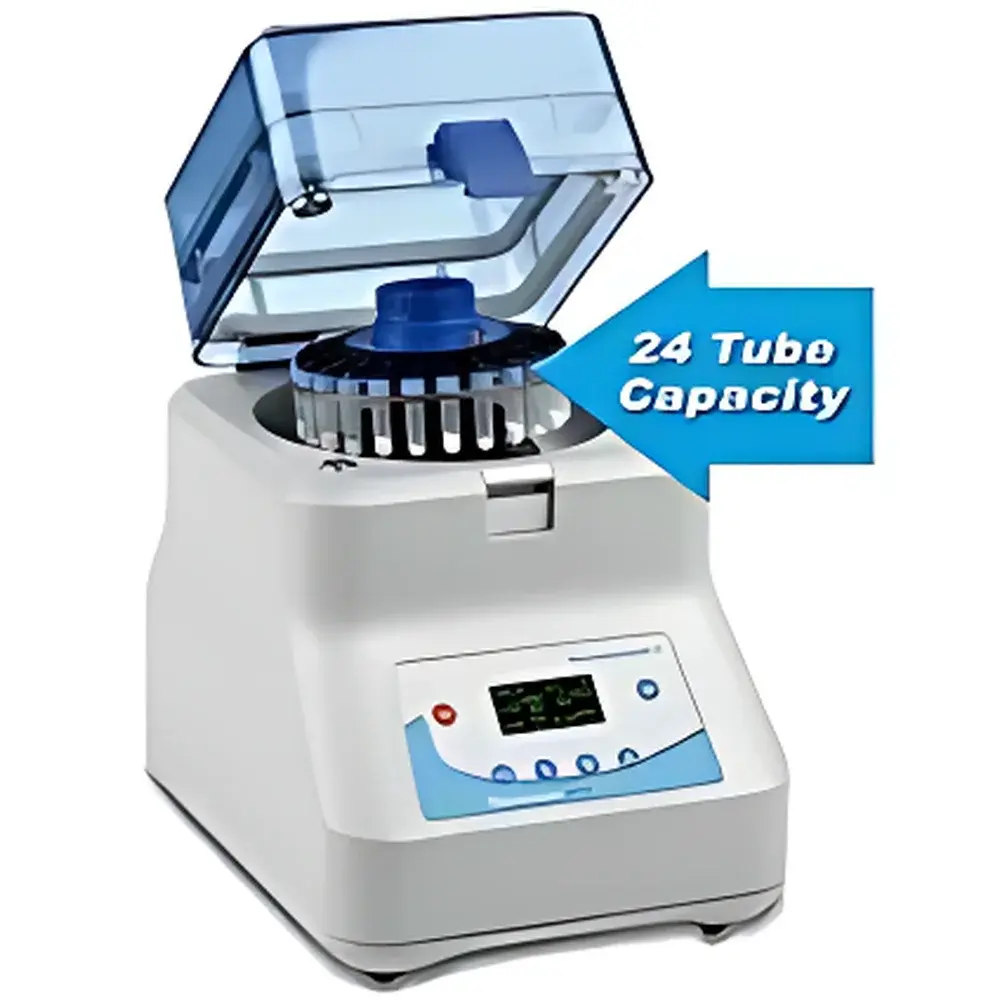
Benchmark BeadBlaster 24 Microtube Homogenizer D2400
| Brand | Benchmark |
|---|---|
| Origin | USA |
| Manufacturer Type | Authorized Distributor |
| Product Category | Imported Instrument |
| Instrument Type | Bead-Based Milling Homogenizer |
| Dimensions (W×D×H) | 280 × 360 × 385 mm |
| Sample Capacity | 24 × 2.0 mL Tubes |
| Operating Speed Range | 4.0–7.0 m/s |
| Cycle Duration | 1–90 s |
| Inter-Cycle Pause | 0–120 s |
| Max Cycles per Program | 10 |
| Stored Programs | Up to 50 |
| Acceleration/Deceleration Time | <2 s |
| Sound Pressure Level | <68 dB(A) |
| Weight | 25 kg |
Overview
The Benchmark BeadBlaster 24 Microtube Homogenizer D2400 is a high-efficiency, benchtop bead-milling homogenizer engineered for rapid and reproducible lysis, disruption, and homogenization of diverse biological samples—including tough tissues, microbial cells, plant material, and fibrous matrices. Utilizing controlled kinetic energy transfer via high-frequency three-dimensional orbital shaking, the instrument accelerates stainless-steel or zirconia beads within sealed microtubes to induce mechanical shear and impact forces sufficient to rupture cellular and subcellular structures. Unlike rotor-stator or ultrasonic systems, this bead-based approach delivers uniform energy distribution across all 24 sample positions simultaneously, minimizing inter-sample variability and eliminating cross-contamination risk when using single-use, pre-filled tubes. Designed for molecular biology, genomics, proteomics, and microbiology workflows, the D2400 operates on a brushless DC motor architecture—ensuring consistent torque delivery, low acoustic emission (<68 dB[A]), and maintenance-free long-term reliability under routine laboratory conditions.
Key Features
- Simultaneous processing of 24 × 2.0 mL microcentrifuge tubes in a single run, with stainless-steel sample holder engineered for structural rigidity and vibration damping.
- Digital interface with intuitive keypad and LCD display for precise control of speed (4.0–7.0 m/s), cycle duration (1–90 s), inter-cycle pause (0–120 s), and multi-step program sequencing.
- Up to 50 user-defined protocols stored in non-volatile memory—each supporting up to 10 discrete cycles with independent timing parameters—enabling optimized lysis for heat-sensitive or shear-labile samples (e.g., RNA, chromatin, membrane proteins).
- Transparent polycarbonate lid with manual locking mechanism ensures operator safety and real-time visual monitoring without interrupting operation.
- Brushless motor drive eliminates carbon brush wear, reduces electromagnetic interference, and extends service life beyond 10,000 operational hours.
- Pre-sterilized, application-specific tube kits available—including zirconia-bead-loaded tubes validated for nucleic acid integrity (no detectable RNase/DNase activity or metal ion leaching per ISO 10993-5 cytotoxicity testing).
Sample Compatibility & Compliance
The BeadBlaster 24 accommodates standard 2.0 mL conical-bottom microcentrifuge tubes (e.g., Eppendorf Safe-Lock, Axygen PCR-200-C) and supports both dry and wet grinding protocols. Compatible sample types include cultured mammalian cells, yeast, bacteria (Gram-positive and Gram-negative), frozen plant tissue, soil suspensions, and clinical specimens (e.g., buccal swabs, blood clots). All pre-filled tube assemblies undergo triple sterilization: nitric acid passivation, dry-heat treatment at 180°C for 2 h, and terminal gamma irradiation (25 kGy). Zirconia beads are certified per ASTM F1877 for biocompatibility and tested for absence of PCR inhibitors (per USP ). The instrument complies with IEC 61000-6-2 (EMC immunity) and IEC 61000-6-4 (EMC emissions), and its operational documentation supports GLP/GMP audit readiness per FDA 21 CFR Part 11 when paired with compliant LIMS integration.
Software & Data Management
While the D2400 operates as a standalone unit with embedded firmware, its programmable architecture supports traceable workflow execution through optional RS-232 or USB-to-serial connectivity. When interfaced with laboratory information management systems (LIMS) or electronic lab notebooks (ELN), each executed protocol logs timestamp, cycle count, speed setting, and user ID—enabling full audit trail generation for regulatory submissions. All stored programs are retained during power loss due to EEPROM-backed memory. Firmware updates are delivered via secure encrypted .bin files and verified using SHA-256 checksums prior to installation.
Applications
- Routine DNA/RNA extraction from fibrous or polysaccharide-rich plant tissues where enzymatic digestion fails.
- High-yield bacterial lysate preparation for recombinant protein purification under native or denaturing conditions.
- Microbial community disruption in metagenomic studies requiring unbiased cell lysis across phylogenetically diverse taxa.
- Pre-analytical sample homogenization for LC-MS/MS-based metabolomics, ensuring complete dissolution of intracellular metabolites.
- Standardized tissue pulverization for FFPE block sectioning or cryo-embedding protocols.
FAQ
Can the BeadBlaster 24 process samples in tubes larger than 2.0 mL?
No—the instrument is mechanically calibrated for 2.0 mL microcentrifuge tubes only; use of oversized tubes compromises orbital dynamics, increases vibration amplitude, and voids warranty.
Is the zirconia bead option suitable for downstream qPCR applications?
Yes—zirconia beads are inert, non-pyrogenic, and demonstrate no amplification inhibition in TaqMan assays at concentrations up to 10⁶ copies/µL, as verified by internal QC per ISO/IEC 17025.
Does the device support remote start/stop via external trigger signals?
Not natively—but TTL-level digital I/O expansion modules (sold separately) enable hardware-triggered initiation synchronized with autosamplers or environmental chambers.
What maintenance is required beyond routine cleaning of the sample chamber?
None—brushless motor design eliminates scheduled brush replacement; only periodic inspection of lid latch integrity and tube holder alignment is recommended every 6 months.
Can programs be exported or backed up externally?
Program data cannot be exported directly from the unit; however, configuration templates may be documented manually or via screen capture for SOP archiving and cross-instrument replication.
Related Products



