
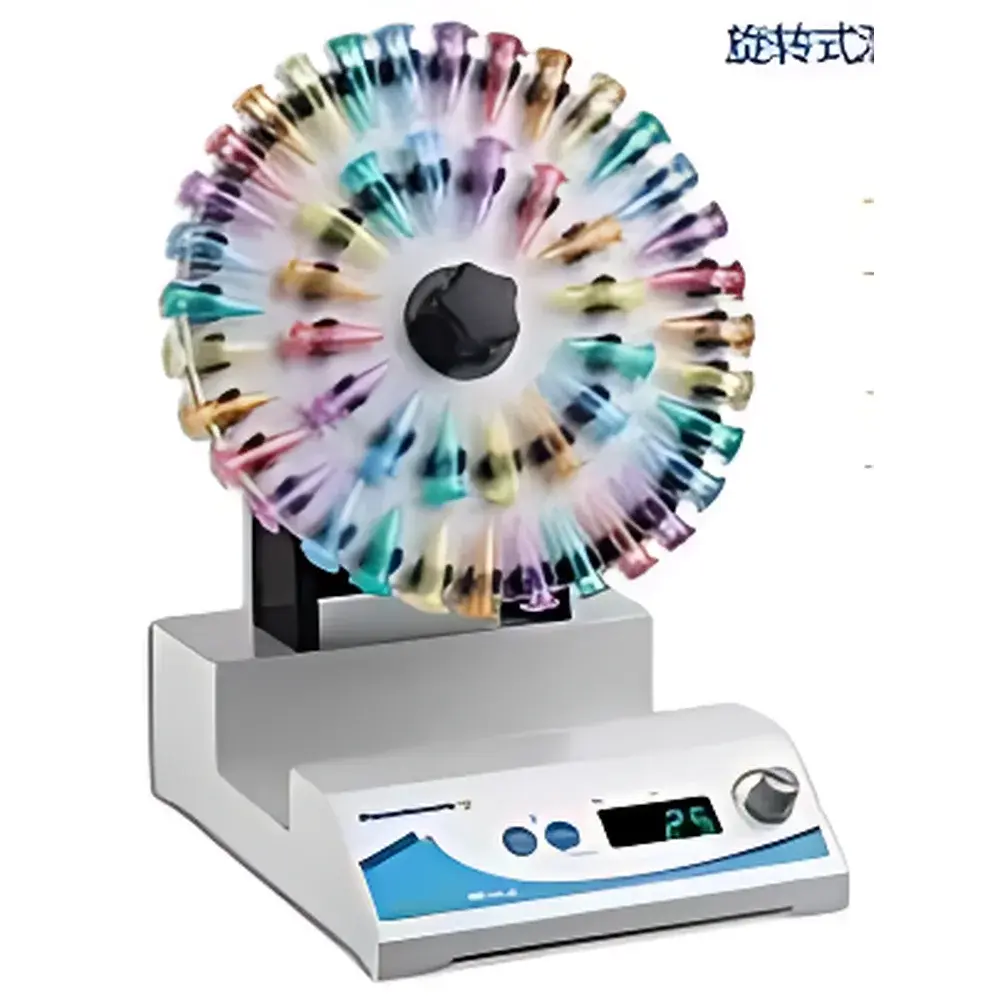
Benchmark R5010 Advanced Orbital Shaker
| Brand | Benchmark |
|---|---|
| Origin | USA |
| Model | R5010 |
| Speed Range | 1–40 rpm |
| Tilt Angle Adjustment | 0–90° |
| Capacity | 12 × 50 mL tubes |
| Timer | 1 min – 9 h or continuous operation |
| Display | LED speed & time readout |
| Drive Mechanism | Orbital motion with reversible oscillation mode |
| Amplitude | 2 mm |
| Housing Material | Die-cast aluminum alloy chassis with reinforced steel clamping arms |
| Operating Temperature | 4–60 °C |
| Power Supply | 100–240 VAC, 50–60 Hz, 25 W |
| Weight | 3.2 kg |
| Dimensions (W×D×H) | 21 × 27 × 32 cm |
| Sample Tube Fixation | Rubber-coated stainless-steel tube holders |
Overview
The Benchmark R5010 Advanced Orbital Shaker is a precision-engineered laboratory shaker designed for consistent, low-shear orbital mixing of liquid samples across diverse life science and clinical applications. Unlike vortex mixers that rely on high-frequency circular agitation, the R5010 employs controlled orbital motion—where the platform rotates in a horizontal plane around a fixed central axis—generating gentle yet effective fluid circulation ideal for cell suspension, reagent resuspension, immunoassay plate incubation, and pre-homogenization sample preparation. Its adjustable tilt angle (0–90°) enables optimization of mixing efficiency for viscous or sediment-prone samples, while the reversible oscillation mode provides enhanced homogeneity for challenging suspensions without introducing excessive shear stress or foaming. Engineered for long-term reliability in regulated environments, the unit features a robust die-cast aluminum housing, thermally stable motor assembly, and EMI-compliant power electronics suitable for shared lab infrastructure.
Key Features
- Three interchangeable platform configurations support standard tube formats: 12 × 50 mL conical tubes, 20 × 15 mL centrifuge tubes, or 48 × 2.0 mL microcentrifuge tubes—each secured via rubber-coated stainless-steel clamps ensuring zero slippage at maximum operational speed.
- Digitally controlled speed range (1–40 rpm) with ±1 rpm repeatability and real-time LED display for both speed and elapsed/remaining time.
- Programmable tilt-angle adjustment (0–90°) allows users to fine-tune fluid dynamics for optimal mixing of heterogeneous samples such as whole blood, tissue lysates, or polymer solutions.
- Reversible oscillation mode automatically alternates rotational direction after each full 360° cycle—eliminating directional bias and improving particle dispersion uniformity in gravity-settling systems.
- Continuous or timed operation (1 minute to 9 hours) with auto-shutdown and audible alert; memory retention preserves last-used settings after power interruption.
- Low-power consumption (25 W), wide-input universal power supply (100–240 VAC), and operating temperature range of 4–60 °C enable integration into cold rooms, incubators, and ambient lab spaces.
Sample Compatibility & Compliance
The R5010 accommodates common polypropylene, glass, and borosilicate tubes—including screw-cap, snap-cap, and crimp-top variants—without requiring adapters. Its orbital amplitude (2 mm) and speed profile comply with ISO 8573-1 for low-vibration instrumentation and are validated for use in GLP-compliant workflows involving biological sample handling. While not classified as medical device hardware under FDA 21 CFR Part 820, the unit meets IEC 61010-1 safety requirements for laboratory electrical equipment and carries CE marking for EMC and LVD directives. Benchtop placement stability is certified per ISTA 2A for transport integrity, supporting unattended overnight operation.
Software & Data Management
The R5010 operates as a standalone instrument with no embedded firmware or network connectivity. All parameters are set locally via tactile rotary encoder and confirmed through dual-digit LED indicators. For laboratories implementing electronic lab notebooks (ELN) or LIMS integration, manual entry of operational logs—including date/time stamp, speed, tilt angle, duration, and operator ID—is supported by its deterministic control architecture. Audit trails may be maintained externally using standardized SOP documentation aligned with ISO/IEC 17025 clause 7.7 (control of equipment records) and USP guidelines for analytical instrument qualification.
Applications
- Clinical diagnostics: Gentle resuspension of EDTA-anticoagulated whole blood prior to hematocrit measurement or flow cytometry staining.
- Biopharmaceutical QC: Homogenization of protein formulations during stability studies, minimizing air entrapment and aggregation risk.
- Molecular biology: Uniform mixing of PCR master mixes, restriction digests, and affinity purification eluates in multi-well plates or tube arrays.
- Environmental testing: Extraction buffer equilibration for soil/water sample analysis per EPA Method 3540C protocols.
- Academic research: Long-duration incubation-mixing of microbial cultures, enzyme kinetics assays, and ligand-binding equilibrium experiments.
FAQ
Is the R5010 compatible with microplate formats?
No—the R5010 is optimized for tube-based mixing. For microplate shaking, Benchmark offers the R5020 Microplate Orbital Shaker with dedicated plate clamps and variable footprint platforms.
Can the unit operate inside a CO₂ incubator?
Yes, provided internal humidity remains below 80% RH and ambient temperature does not exceed 60 °C. The sealed motor housing and non-corrosive materials ensure safe operation under these conditions.
Does the reversible oscillation mode affect timer accuracy?
No—timer function remains independent of motion direction logic; total elapsed time includes all forward and reverse cycles equally.
What maintenance is required for long-term performance?
Annual inspection of clamp tension and visual verification of drive belt integrity (if applicable); no lubrication or calibration is required due to brushless DC motor design.
Is calibration documentation available?
Benchmark provides a Factory Calibration Certificate (traceable to NIST standards) upon request, detailing speed verification at 10, 20, and 40 rpm under load conditions.



