
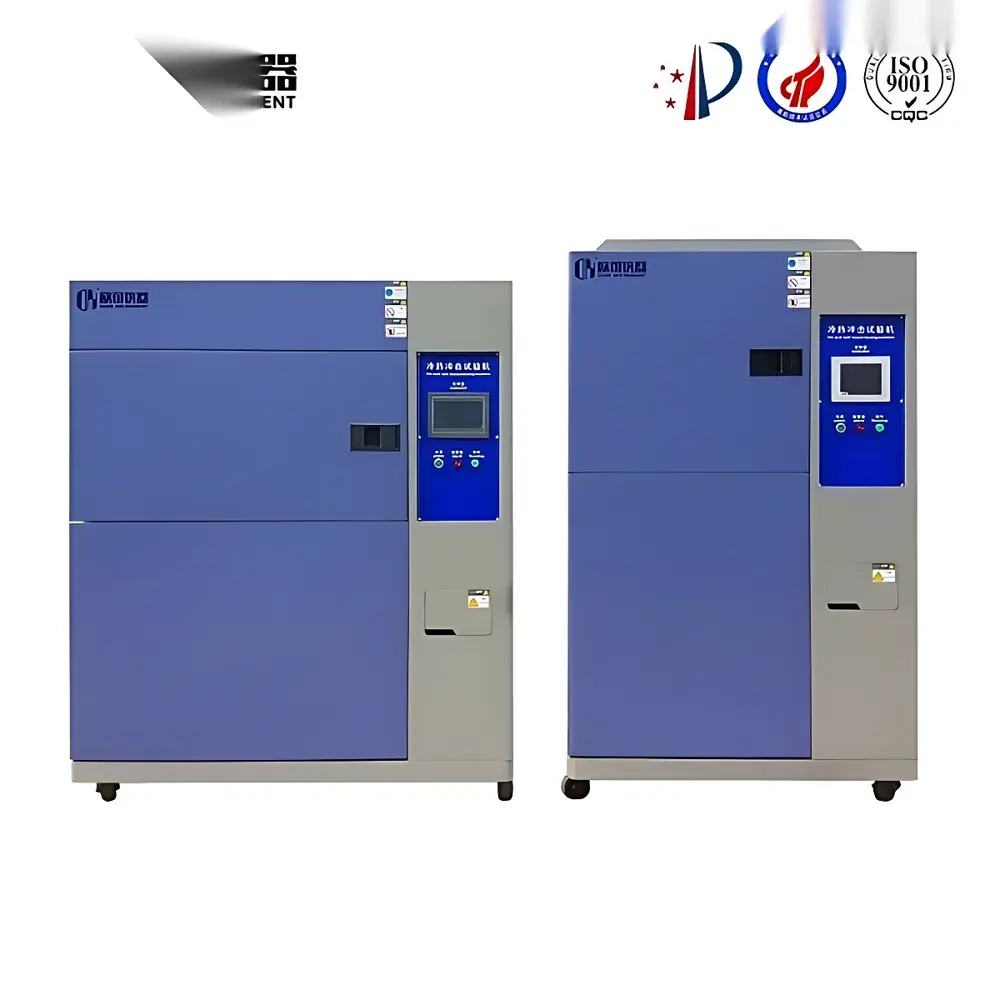
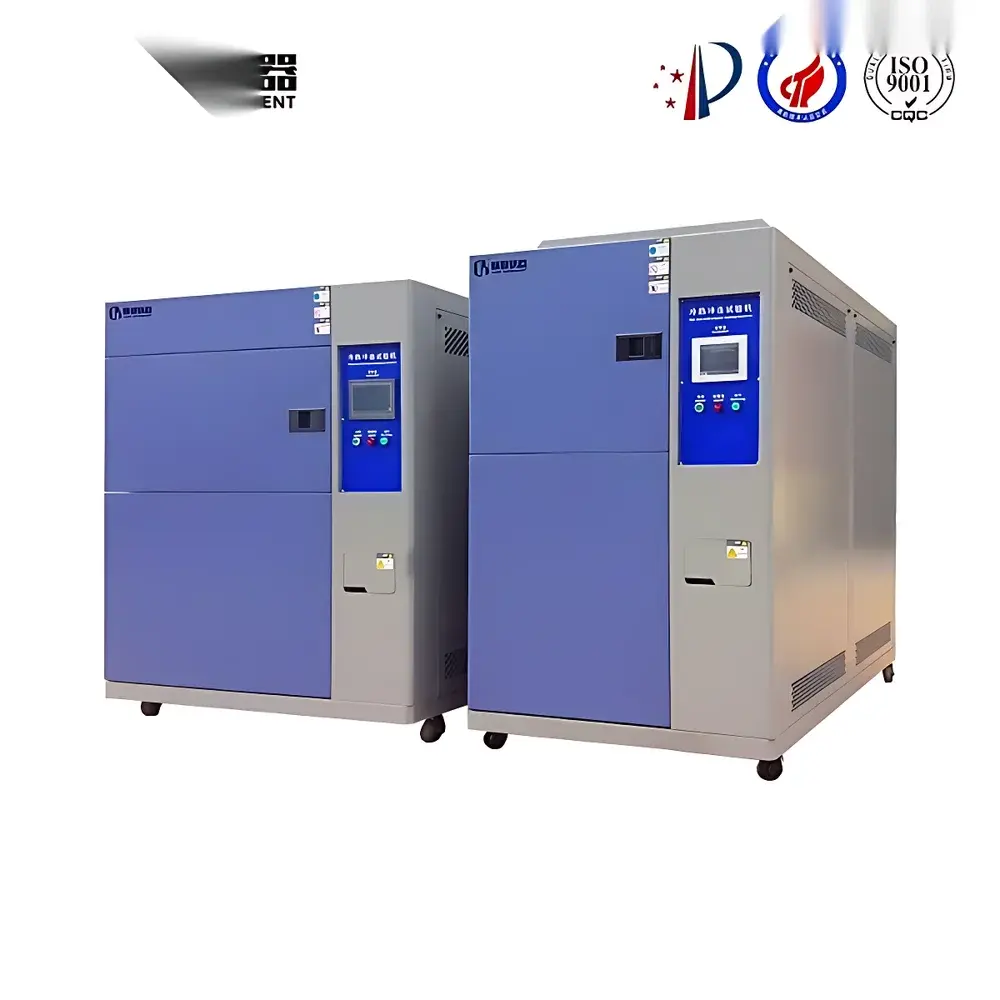
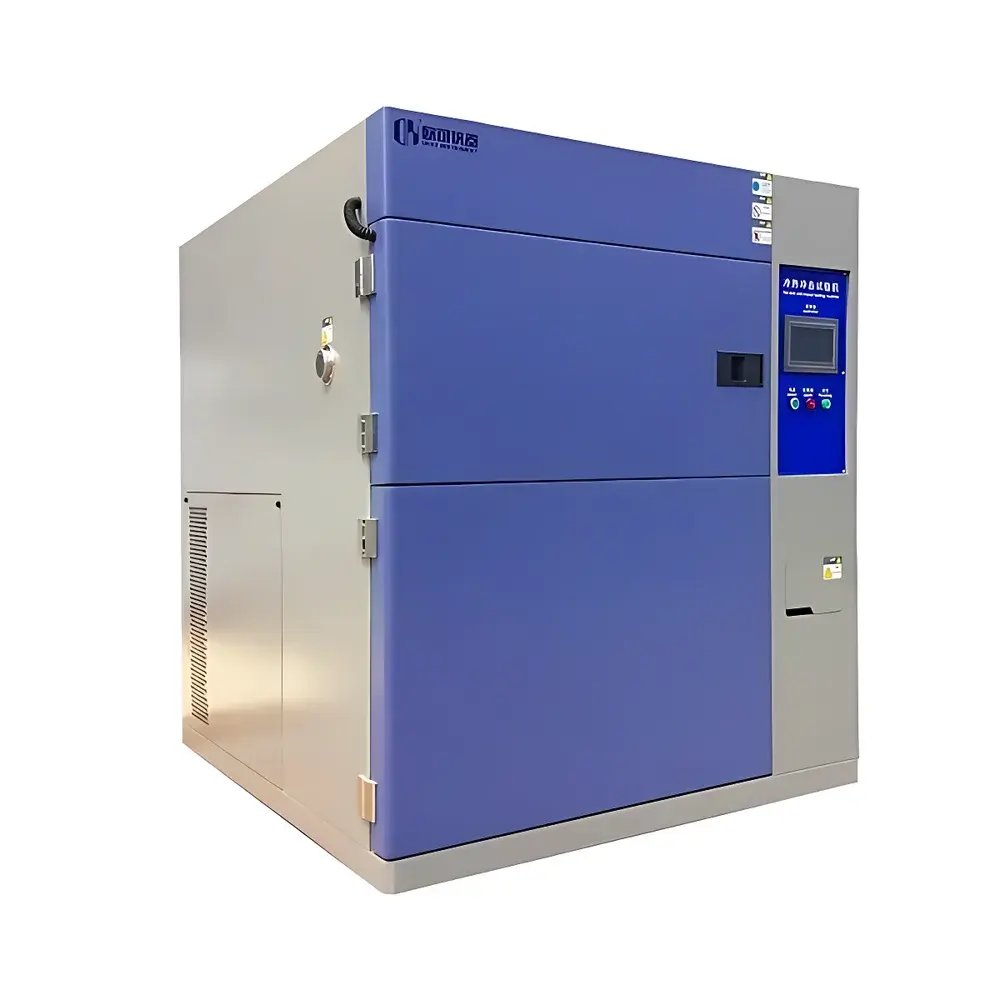
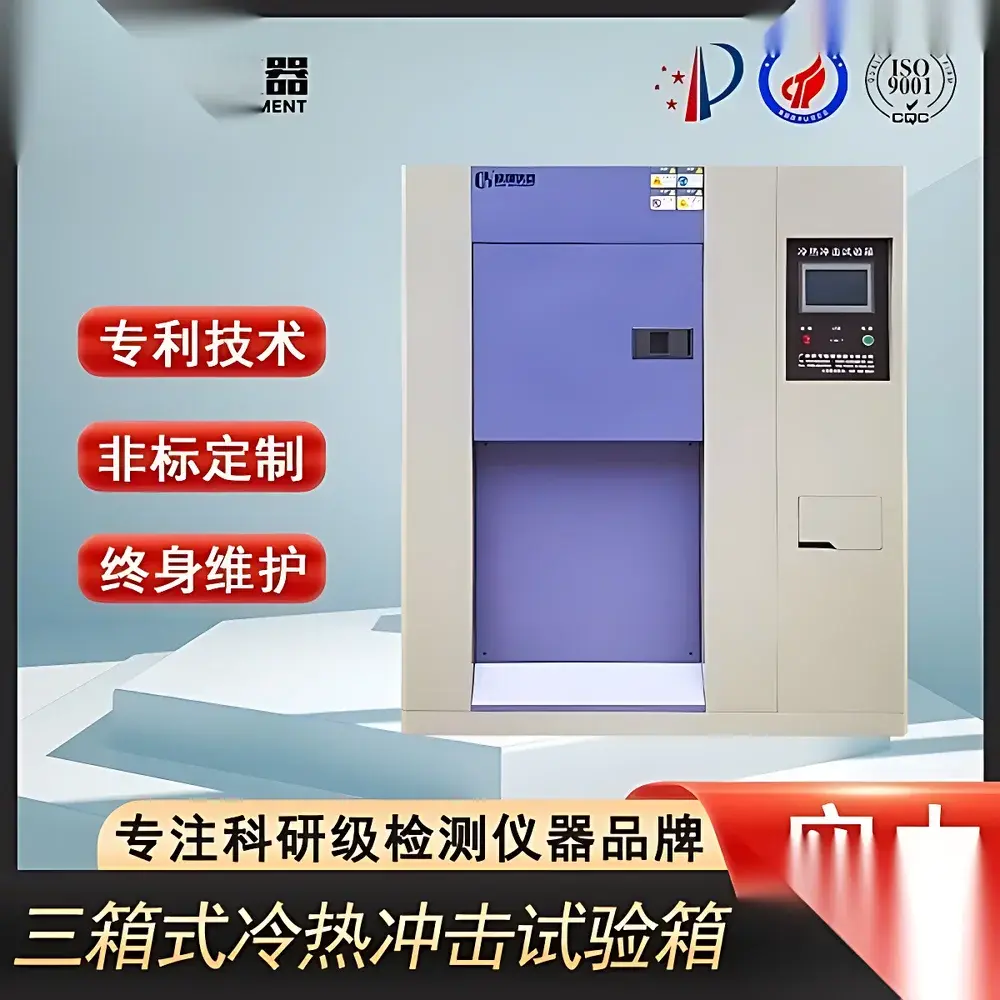
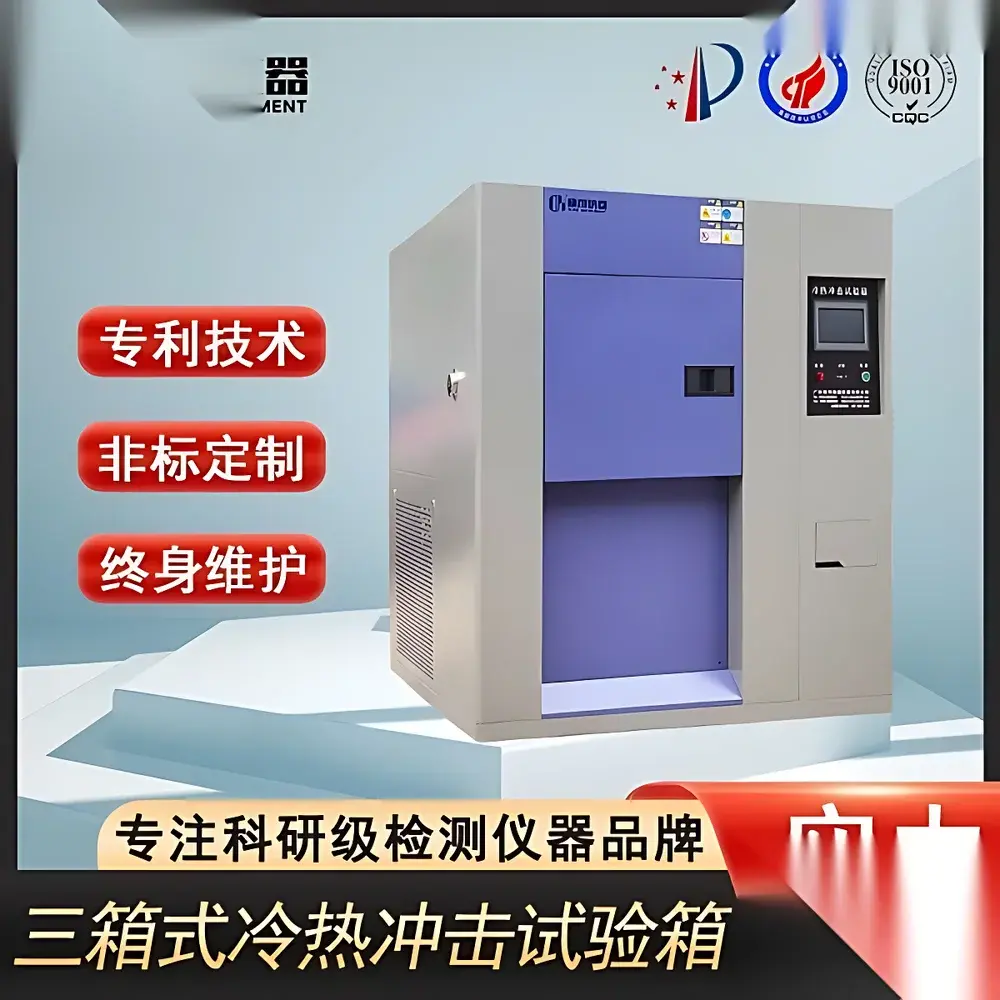
Benchtop Basket-Type Thermal Shock Test Chamber
| Brand | OEM / Custom Brand |
|---|---|
| Origin | Imported |
| Manufacturer Type | Authorized Distributor |
| Pricing | USD 11,200 (FOB) |
| Compliance | GB/T 2423.1, GB/T 2423.2, GB/T 2423.22, GJB 150.5, IEC 60068-2-14, QC/T 17, EIA-364-32 |
| Refrigeration System | Dual-stage cascade refrigeration with imported German semi-hermetic compressors |
| Cooling Method | Water-cooled (external cooling tower required: 10 m³/h capacity) |
| Temperature Transition Rate | ≥10 °C/min (typical, basket transfer mode) |
Overview
The Benchtop Basket-Type Thermal Shock Test Chamber is an engineered environmental stress screening (ESS) system designed to evaluate material integrity and component reliability under rapid, repetitive thermal transitions between extreme high- and low-temperature zones. Unlike single-chamber or air-curtain systems, this basket-type configuration employs a vertically actuated stainless-steel test basket that physically transfers specimens between independently controlled hot and cold chambers—enabling true thermal shock conditions defined by abrupt temperature differentials (typically −65 °C to +150 °C) and transition times ≤5 seconds. The chamber operates on the principle of convective heat transfer acceleration via mechanical displacement, minimizing thermal lag and ensuring reproducible ΔT/dt profiles critical for detecting latent defects such as interfacial delamination, solder joint fatigue, or polymer microcracking. Its architecture conforms to MIL-STD-810G, IEC 60068-2-14 (Test N), and ASTM D5229/D5229M for accelerated thermal cycling validation in aerospace, automotive electronics, and semiconductor packaging qualification.
Key Features
- Two-zone independent temperature control: Hot chamber (up to +150 °C) and cold chamber (down to −65 °C), each equipped with PID-controlled heating elements and forced-air circulation
- High-speed pneumatic basket lift mechanism with position feedback sensors and fail-safe braking—cycle repeatability ±0.3 s
- Dual-stage cascade refrigeration system using environmentally compliant R404A/R23 refrigerant blend; German semi-hermetic compressors ensure stable operation at sub-zero evaporator temperatures
- Water-cooled condenser interface requiring external cooling tower (10 m³/h flow rate, 32 °C inlet max); integrated water flow monitoring with pressure switch interlock
- Insulated chamber walls with vacuum-jacketed stainless-steel inner lining and multi-layer reflective foil barrier to minimize thermal bridging
- Real-time data logging of chamber temperatures, basket position, compressor discharge pressure, and refrigerant saturation points
Sample Compatibility & Compliance
The chamber accommodates standard test specimens up to 300 mm × 300 mm × 250 mm (W×D×H) and supports mounting fixtures for PCB assemblies, MEMS devices, automotive ECUs, and molded plastic housings. All operational parameters comply with mandatory test protocols including IEC 60068-2-14 (Temperature Change), GJB 150.5-2009 (Military Equipment Thermal Shock), and QC/T 17-2019 (Automotive Component Environmental Testing). Calibration traceability follows ISO/IEC 17025 requirements, with optional NIST-traceable sensor verification kits available. The system meets electromagnetic compatibility (EMC) standards per EN 61326-1 and safety requirements under IEC 61010-1 for laboratory equipment.
Software & Data Management
Equipped with embedded Windows-based controller running proprietary thermal profile management software, the system enables programmable multi-step shock sequences—including dwell time, ramp rate, cycle count, and conditional termination logic. Data export supports CSV, XML, and PDF formats with embedded metadata (timestamp, operator ID, chamber serial number). Audit trail functionality complies with FDA 21 CFR Part 11 requirements when configured with user authentication, electronic signatures, and immutable log archiving. Remote monitoring via Ethernet (TCP/IP) allows integration into centralized lab information management systems (LIMS) or MES platforms for automated report generation and SPC analysis.
Applications
This thermal shock chamber is routinely deployed in quality assurance labs for qualification testing of: printed circuit board assemblies (IPC-A-610 Class 3), power semiconductor modules (JEDEC JESD22-A106), lithium-ion battery cells (UN 38.3 Section 38.3.4), optical sensor housings (ISO 16750-4), and medical device enclosures (IEC 60601-1 Clause 11.2). It supports failure mode analysis (FMA) workflows by correlating thermal cycle count with electrical parameter drift (e.g., resistance change, leakage current), enabling predictive lifetime modeling per Arrhenius-based acceleration factors.
FAQ
What is the minimum achievable cold chamber temperature?
The standard configuration achieves −65 °C; optional deep-cold upgrade extends to −75 °C with modified refrigerant charge and enhanced insulation.
Is the system compatible with GLP/GMP documentation requirements?
Yes—when equipped with the full audit trail package, it satisfies GLP (21 CFR Part 58) and GMP (21 CFR Part 211) data integrity criteria for regulated industries.
Can the basket transfer speed be adjusted?
Transfer velocity is fixed at 0.8 m/s for mechanical stability and thermal inertia minimization; however, dwell time in each zone is fully programmable from 1 minute to 999 hours.
Does the system require compressed air?
Yes—a clean, dry, oil-free supply at 0.6 MPa is required for the pneumatic basket actuator and door sealing mechanism.
What maintenance intervals are recommended for the refrigeration system?
Compressor oil analysis every 2,000 operating hours; refrigerant moisture content verification annually; cooling tower water treatment per ASHRAE Guideline 12-2020.



