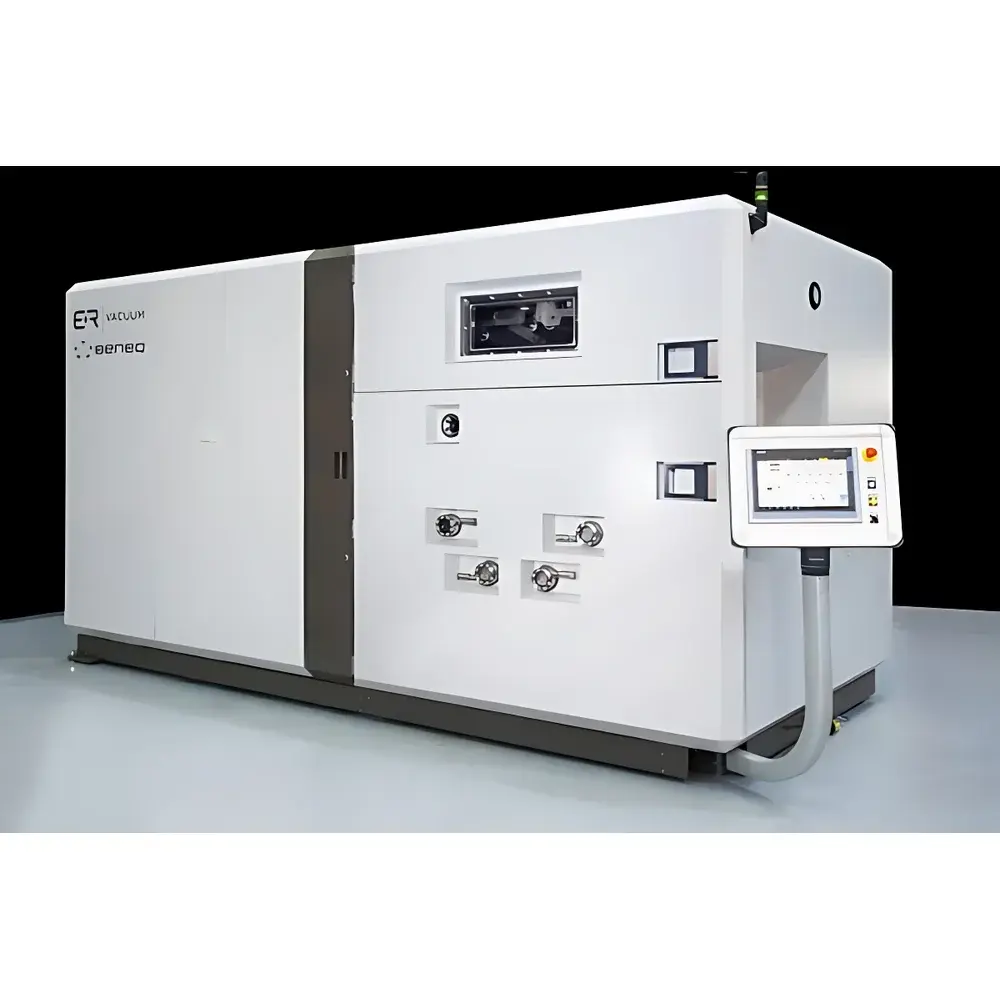
Beneq Genesis ALD Atomic Layer Deposition System
| Origin | Finland |
|---|---|
| Manufacturer Type | Authorized Distributor |
| Origin Category | Imported |
| Model | Genesis ALD |
| Substrate Width | Up to 420 mm |
| Process Temperature | Up to 250 °C |
| Precursor Channels | Configurable (standard ≥4) |
| ALD Film Thickness Range | Up to 100 nm |
| Dynamic Deposition Rate (Al₂O₃) | 10 nm·m/min |
| Uniformity | ≤±1.5% (3σ, across full web width) |
| System Footprint | Customizable per integration requirements |
| Weight | Site-specific (typically 1,200–2,500 kg) |
Overview
The Beneq Genesis ALD Atomic Layer Deposition System is a fully integrated, roll-to-roll (R2R) vacuum-based thin-film processing platform engineered for high-precision, conformal atomic layer deposition on flexible substrates. Leveraging self-limiting surface reactions—where sequential, pulsed exposures of gaseous precursors and reactants enable sub-nanometer thickness control—the Genesis ALD delivers monolayer-level reproducibility across meter-scale webs. Unlike batch-mode ALD tools, this system operates under continuous motion, enabling true industrial-scale throughput while maintaining the stoichiometric fidelity and pinhole-free integrity characteristic of ALD-grown films. Designed specifically for functional coating applications in next-generation energy and flexible electronics, the Genesis ALD bridges the gap between laboratory process development and pilot-line manufacturing.
Key Features
- Roll-to-roll architecture optimized for polymer foils (e.g., PET, PI), metal foils (e.g., Cu, Al), and composite webs—with substrate width configurable up to 420 mm
- Modular precursor delivery system supporting ≥4 independently controlled chemical channels, compatible with metalorganic, halide, and liquid precursors (e.g., TMA, DEZ, TTIP, H₂O, O₃)
- Integrated thermal management ensuring precise, uniform substrate temperature control from ambient to 250 °C ±1.5 °C across full web width
- In-situ real-time monitoring via integrated quartz crystal microbalance (QCM) and optical emission spectroscopy (OES) for process endpoint detection and reaction kinetics validation
- High-vacuum R2R chamber (<1 × 10⁻⁶ mbar base pressure) with differential pumping zones to maintain ALD reaction integrity during continuous web transport
- Robust mechanical design compliant with ISO 14644-1 Class 5 cleanroom integration standards; CE-marked and UL-listed for safe operation in industrial environments
Sample Compatibility & Compliance
The Genesis ALD accommodates substrates ranging from 12 µm polyimide to 25 µm aluminum foil, with tension-controlled unwinding and winding modules maintaining <±0.5 N web tension stability. It supports industry-standard core diameters (76 mm and 152 mm) and accommodates roll diameters up to 600 mm. All wetted components are electropolished stainless steel or ceramic-coated, ensuring compatibility with aggressive precursors and minimizing metallic contamination. The system meets ISO 9001:2015 quality management requirements and is designed to support GLP/GMP documentation workflows—including audit trails, electronic signatures, and user access levels aligned with FDA 21 CFR Part 11 compliance when paired with Beneq’s ALDControl™ software suite.
Software & Data Management
ALDControl™ is a deterministic, deterministic real-time operating system (RTOS)-based platform providing full recipe-driven automation, parameter logging at 100 Hz resolution, and synchronized data acquisition from QCM, thermocouples, pressure transducers, and mass flow controllers. All process data—including precursor pulse durations, purge times, temperature ramps, and web speed—are timestamped and stored in HDF5 format for traceability. The software includes built-in statistical process control (SPC) modules for Cp/Cpk calculation, automated report generation (PDF/CSV), and secure export to LIMS or MES systems via OPC UA or RESTful API. Remote diagnostics and firmware updates are supported over TLS-encrypted connections.
Applications
- Lithium-ion and solid-state battery manufacturing: Ultra-thin Al₂O₃ or TiO₂ coatings on cathode active materials (NMC, LFP) and anode copper foils to suppress interfacial side reactions and improve cycle life
- Flexible photovoltaics: Conformal ZnO electron transport layers and SiO₂ barrier stacks on organic solar cells (OPV) and perovskite modules, achieving WVTR <10⁻⁴ g/m²/day
- Flexible OLED and sensor packaging: Multilayer Al₂O₃/ZnS nanolaminates as moisture and oxygen diffusion barriers on ultra-thin display backplanes
- Functional textiles and smart packaging: Conductive ITO or AZO layers on thermally sensitive fabrics for wearable electronics and RFID antennas
- R&D validation: Rapid screening of novel precursor chemistries and bilayer architectures for emerging electrochemical and optoelectronic devices
FAQ
What substrate materials are compatible with the Genesis ALD?
Polymer films (PET, PEN, PI), metal foils (Cu, Al, Ni), and laminated composites—provided they withstand temperatures up to 250 °C and maintain dimensional stability under vacuum.
Can the system be integrated into an existing pilot line?
Yes. The Genesis ALD is designed for modular integration with upstream coating, drying, and downstream lamination stations via standard SECS/GEM interfaces and mechanical docking frames.
Is remote process monitoring supported?
Yes. ALDControl™ provides secure web-based dashboards with live parameter visualization, alarm notifications, and historical trend analysis accessible via corporate intranet or VPN.
Does Beneq provide application support for new material development?
Yes. Beneq’s Application Engineering Team offers joint development programs—including precursor compatibility testing, film characterization (XRR, XPS, ellipsometry), and lifetime reliability assessment—under NDA.
What maintenance intervals are recommended?
Preventive maintenance is scheduled every 1,000 operational hours or annually (whichever occurs first), covering vacuum pump oil changes, O-ring inspection, and calibration of MFCs and temperature sensors per ISO/IEC 17025 guidelines.