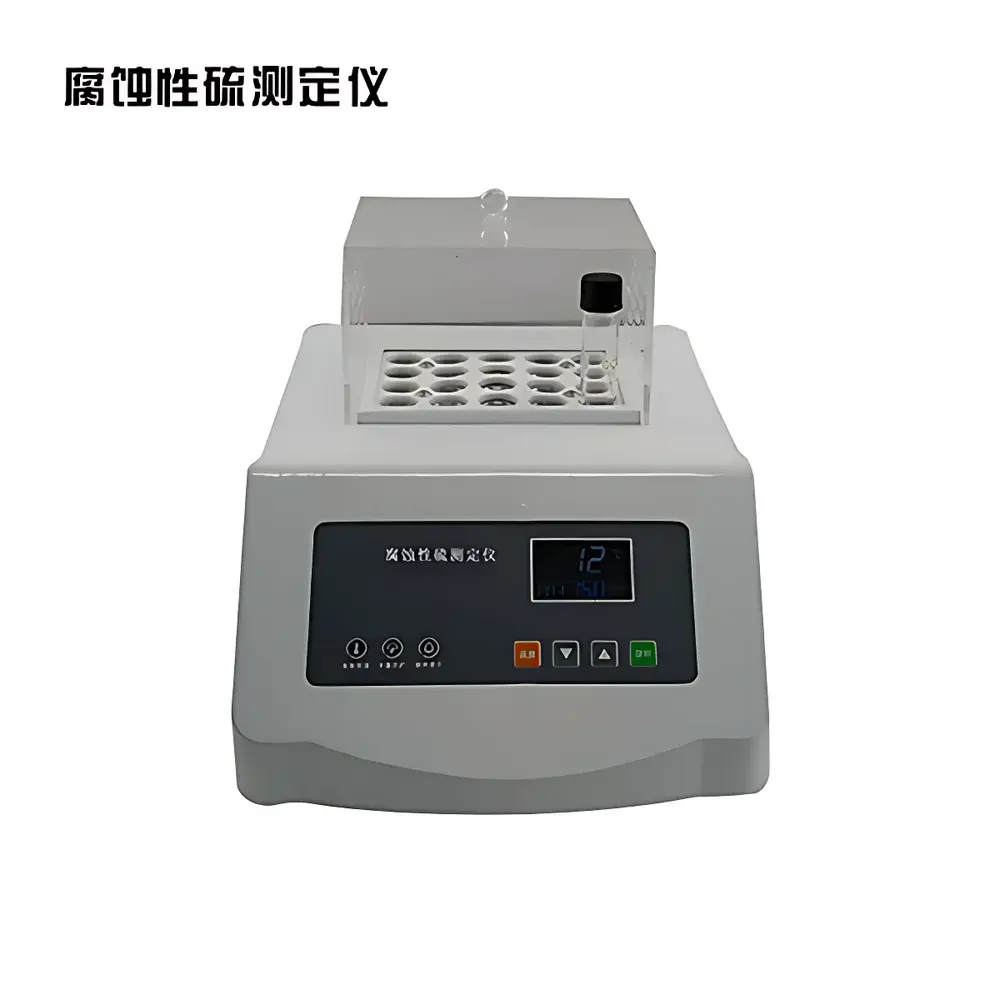
Benteng BT-1240 Corrosive Sulfur Tester for Insulating Oil
| Brand | Benteng |
|---|---|
| Origin | Jilin, China |
| Manufacturer Type | Direct Manufacturer |
| Country of Origin | China |
| Model | BT-1240 |
| Detection Principle | Copper Strip Corrosion Method (ASTM D130 / IEC 62535 compliant) |
| Portability | Benchtop Portable |
| Sample Throughput | 9 samples per run |
| Temperature Range | 35–200 °C |
| Temperature Accuracy | ±0.1 °C |
| Temperature Uniformity | ±1 °C |
| Timing Range | 0.0–999.9 h |
| Alarm Function | Audible/visual end-of-test alert |
| Bath Wells | 12-position oil bath |
| Power Consumption | 500 W |
| Input Voltage | AC 220 V ±10%, 50 Hz |
| Operating Ambient | 5–40 °C, ≤85% RH |
| Dimensions | 320 × 230 × 150 mm |
| Weight | ~8 kg |
Overview
The Benteng BT-1240 Corrosive Sulfur Tester for Insulating Oil is a dedicated benchtop instrument engineered to evaluate the presence and corrosivity of reactive sulfur compounds—particularly mercaptans, sulfides, and elemental sulfur—in electrical insulating oils used in power transformers, circuit breakers, and high-voltage equipment. It operates in strict accordance with the copper strip corrosion test principle defined in ASTM D130 (Standard Test Method for Corrosiveness to Copper from Petroleum Products by Copper Strip Test) and adapted for insulating oils under ASTM D1275B and IEC 62535. The instrument subjects standardized copper strips immersed in oil samples to controlled thermal oxidation within a precision-regulated oil bath, followed by visual or semi-quantitative assessment of strip discoloration against ASTM-compliant color standards. This method remains the globally accepted reference for detecting trace-level corrosive sulfur species that can initiate copper sulfide deposition, leading to insulation degradation, partial discharge, and catastrophic failure in critical power infrastructure.
Key Features
- 12-position thermostatically controlled oil bath with independent thermal zoning to ensure uniform temperature distribution (±1 °C) across all wells
- Dual digital displays: real-time bath temperature (0.1 °C resolution) and elapsed oxidation time (0.1 min resolution)
- Automated ramp-and-hold temperature control with PID algorithm; achieves setpoint stability within ±0.1 °C
- Simultaneous processing of up to 9 samples per test cycle—ideal for routine QC labs in substations and transformer manufacturing facilities
- Programmable timing module with audible and visual alarm upon completion; supports extended aging tests up to 999.9 hours
- Compact footprint (320 × 230 × 150 mm) and lightweight design (~8 kg) enabling deployment in mobile labs, field service vehicles, or constrained utility maintenance bays
- Robust stainless-steel bath housing and corrosion-resistant heating elements optimized for long-term exposure to mineral and synthetic insulating oils
Sample Compatibility & Compliance
The BT-1240 accepts standard ASTM D130 copper strips (12.5 × 75 × 1.5 mm) and accommodates sample volumes of 30 mL per vial. It is validated for use with mineral-based, naphthenic, paraffinic, and silicone-based insulating oils, as well as ester fluids meeting IEC 62770 specifications. All operational parameters—including temperature ramp rate, dwell time, and ambient calibration intervals—align with the procedural requirements of ASTM D1275B Annex A1 and IEC 62535 Annex B. The instrument supports GLP-compliant documentation when paired with external lab notebooks or LIMS-integrated reporting workflows. While not inherently 21 CFR Part 11 compliant (as it lacks electronic signature capability), its deterministic analog-digital control architecture ensures full auditability of test conditions and operator inputs.
Software & Data Management
The BT-1240 is a hardware-only system with no embedded firmware or proprietary software. Temperature and timing data are displayed locally via high-contrast LED indicators and retained only during active operation. For traceability, users are advised to record bath setpoint, actual measured temperature, start/end times, and observed copper strip ratings manually—or integrate with third-party data acquisition systems via optional RS-232 or analog voltage output modules (available as OEM add-ons). Calibration certificates for the integrated PT100 sensor and timer module are provided with each unit and remain valid for 12 months under normal usage conditions. Annual recalibration against NIST-traceable references is recommended to maintain compliance with ISO/IEC 17025 internal audit requirements.
Applications
- Routine quality control of new insulating oil prior to transformer filling (per IEEE C57.106)
- Condition monitoring of in-service oils during preventive maintenance outages
- Root cause analysis of copper sulfide deposits observed during transformer internal inspections
- Verification of sulfur passivation treatments applied to reclaimed or reconditioned oils
- Research-grade screening of alternative bio-based or synthetic dielectric fluids for sulfur reactivity
- Compliance testing for grid operators subject to regional reliability standards (e.g., NERC PRC-005, EN 50216)
FAQ
What standards does the BT-1240 directly support?
ASTM D1275B, ASTM D130, and IEC 62535—covering both method execution and pass/fail criteria for corrosive sulfur detection.
Can the instrument be used for non-insulating oil applications?
No. Its thermal profile, bath geometry, and validation are specific to electrical insulating oils; it is not suitable for fuels, lubricants, or crude fractions.
Is the copper strip evaluation automated?
No. Visual rating against ASTM D130 color charts remains manual per standard practice; the BT-1240 provides only precise, reproducible test conditioning.
What maintenance is required?
Monthly cleaning of the oil bath chamber and periodic verification of temperature sensor drift using a calibrated reference thermometer.
Does the unit include copper strips or test vials?
No. ASTM-grade copper strips (Cat. No. D130-STRIP), glass test tubes (13 × 100 mm), and reference color charts must be sourced separately.