
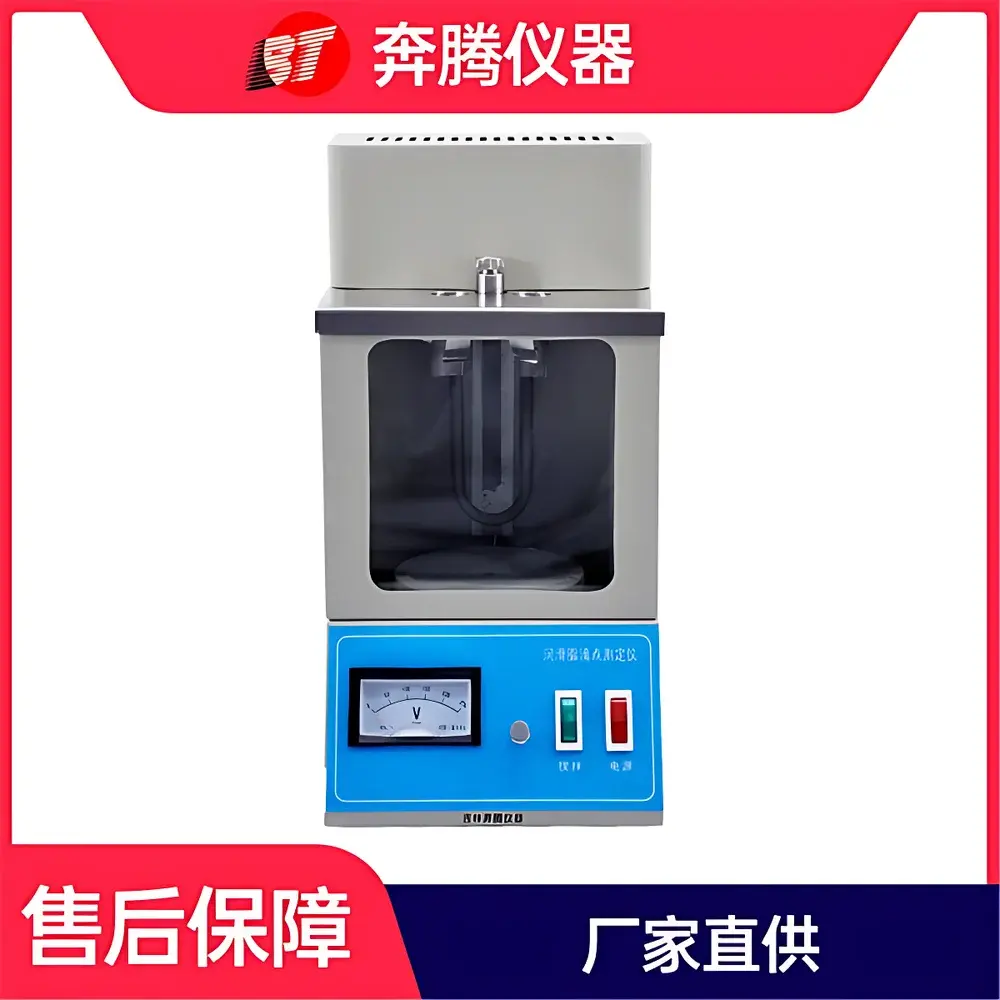
Benteng BT-3011 Grease Dropping Point Tester
| Brand | Benteng |
|---|---|
| Origin | Jilin, China |
| Manufacturer Type | Direct Manufacturer |
| Country of Origin | China |
| Model | BT-3011 |
| Heating Power | 500 W |
| Stirring Motor Power | 3 W |
| Stirring Speed | 100 rpm |
| Dimensions | 180 mm × 200 mm × 360 mm |
| Weight | ~6 kg |
| Total Power Consumption | ≤700 W |
Overview
The Benteng BT-3011 Grease Dropping Point Tester is a benchtop thermal analysis instrument engineered for precise determination of the dropping point of lubricating greases and semi-solid petroleum products in accordance with internationally recognized standard test methods—including ASTM D566 and GB/T 4929. The dropping point is defined as the temperature at which the grease transitions from a semi-solid to a liquid state under standardized heating and gravitational conditions; it serves as a critical indicator of thermal stability, consistency classification, and upper service temperature limits. The BT-3011 employs a controlled oil-bath heating system with integrated mechanical stirring and real-time voltage monitoring to ensure reproducible thermal ramping and uniform heat distribution across the sample cup. Its compact footprint and robust architecture make it suitable for routine quality control laboratories, R&D facilities, and third-party testing centers operating under ISO/IEC 17025 or GLP-compliant environments.
Key Features
- Explosion-resistant transparent safety shield with built-in LED illumination—enables unobstructed visual observation of drop formation while maintaining operator protection during high-temperature operation.
- Submerged tubular heating element immersed directly in the silicone oil bath—minimizes thermal lag and improves temperature uniformity and stability (±0.5 °C typical over the operational range).
- Analog voltage meter coupled with precision wire-wound potentiometer and solid-state voltage regulator—provides continuous, stepless adjustment of heating power for fine-grained control over thermal ramp rate.
- Low-power, high-torque stirring motor (3 W, 100 rpm) ensures consistent convection within the oil bath without introducing mechanical vibration or thermal disturbance to the sample cup assembly.
- Compact monolithic chassis (180 × 200 × 360 mm) constructed from corrosion-resistant anodized aluminum and stainless steel components—designed for long-term durability and ease of cleaning in industrial lab settings.
Sample Compatibility & Compliance
The BT-3011 accommodates standard ASTM D566 sample cups (12.7 mm diameter × 12.7 mm depth) and supports both lithium-based, calcium-sulfonate, polyurea, and clay-thickened greases. It is compatible with common heat-transfer media including silicone oil (up to 300 °C) and high-flash-point mineral oils. The instrument conforms to the mechanical and procedural requirements of ASTM D566–22, GB/T 4929–2014, and IP 132. While the BT-3011 itself does not provide digital data logging or electronic audit trails, its analog control architecture meets basic regulatory expectations for manual QC testing in non-GxP environments. For labs requiring 21 CFR Part 11 compliance, external digital thermometers with calibrated RTD probes and time-stamped recording systems may be integrated per internal SOPs.
Software & Data Management
The BT-3011 operates as a fully manual, analog-controlled instrument with no embedded microprocessor or firmware. Temperature readings are obtained via a separately calibrated laboratory thermometer (not included), inserted into the designated well adjacent to the sample cup. Users record dropping point observations manually in lab notebooks or LIMS-compatible spreadsheets. No proprietary software, drivers, or connectivity interfaces (e.g., USB, RS-232) are provided. This design prioritizes mechanical reliability, electromagnetic immunity, and minimal maintenance—ideal for environments where electromagnetic interference, cybersecurity constraints, or legacy infrastructure limit digital instrumentation deployment.
Applications
- Quality assurance of incoming raw materials and finished lubricating greases in OEM manufacturing facilities.
- Batch release testing in grease compounding plants to verify conformance with specification limits (e.g., NLGI grade correlation).
- Thermal stability screening during formulation development of high-temperature bearing greases.
- Educational use in university tribology and petrochemical engineering laboratories for ASTM method training.
- Third-party certification testing for ISO 6743-9 (lubricants for rolling bearings) and DIN 51805 compliance verification.
FAQ
What standards does the BT-3011 support?
ASTM D566–22, GB/T 4929–2014, and IP 132.
Is the instrument supplied with a thermometer?
No—users must supply a calibrated ASTM E1 thermometer (range –10 to 350 °C, ±0.2 °C accuracy) meeting ASTM D566 Annex A1 requirements.
Can the BT-3011 be used for asphalt or waxes?
No—it is specifically configured for grease-type materials per ASTM D566; alternative methods (e.g., ASTM D36 for asphalt) require different apparatus geometry and cup specifications.
What is the recommended heat-transfer medium?
Silicone oil with flash point ≥320 °C is strongly recommended; mineral oil may be used below 200 °C but requires more frequent replacement due to oxidation.
Does the unit include calibration documentation?
Factory calibration certificates are available upon request; users are responsible for periodic verification of bath temperature uniformity and stirring alignment per internal QA protocols.




