
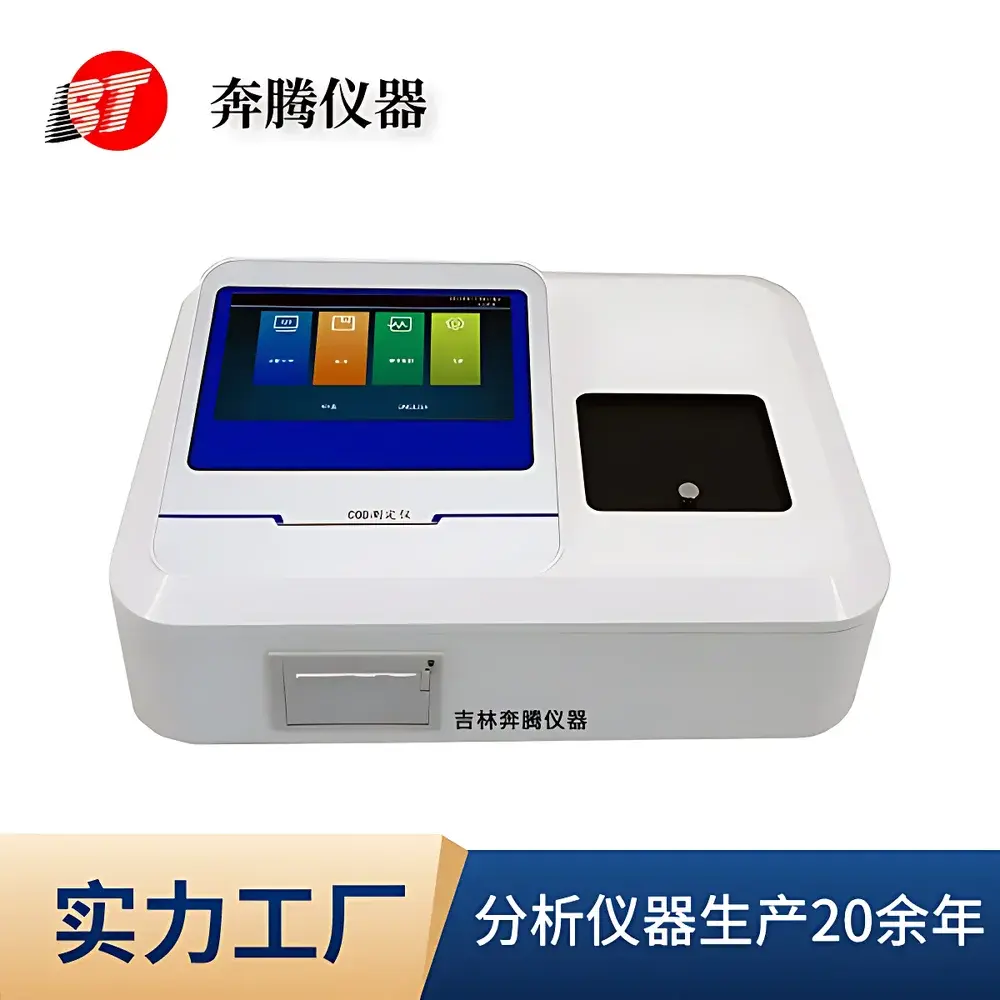
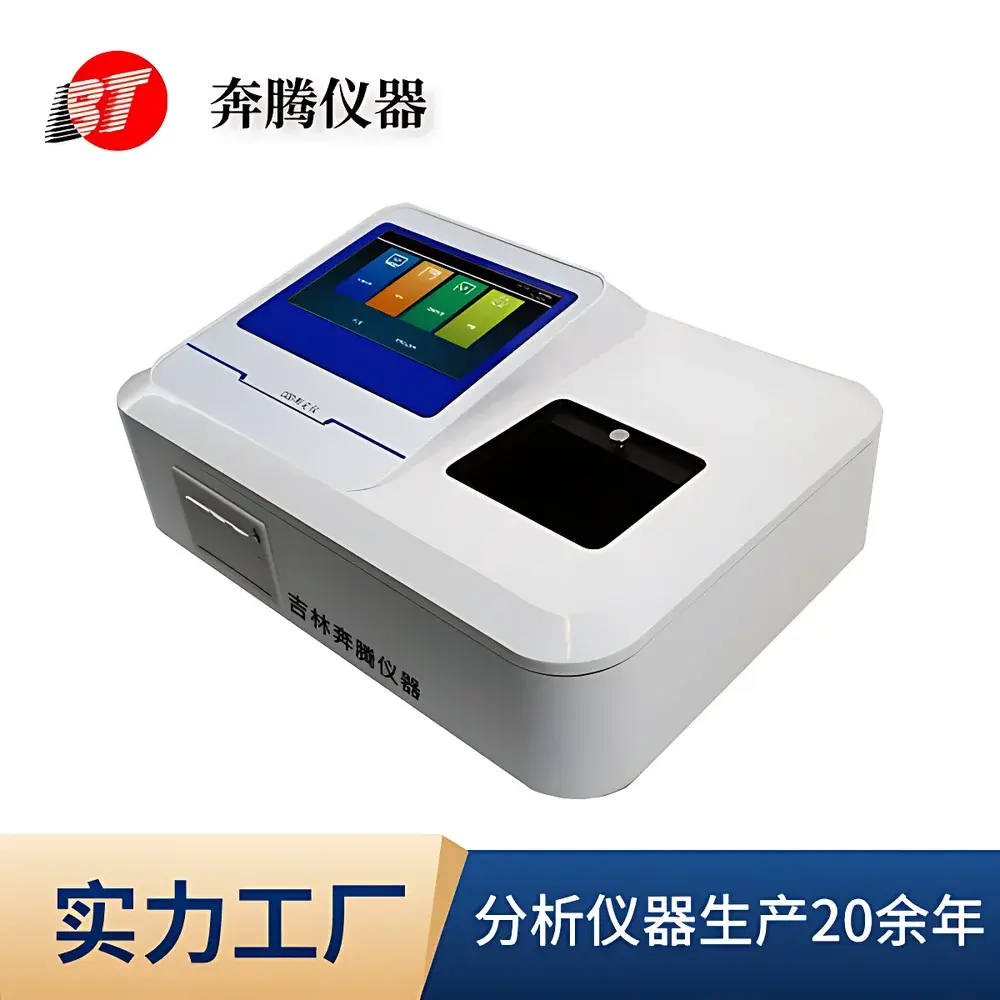
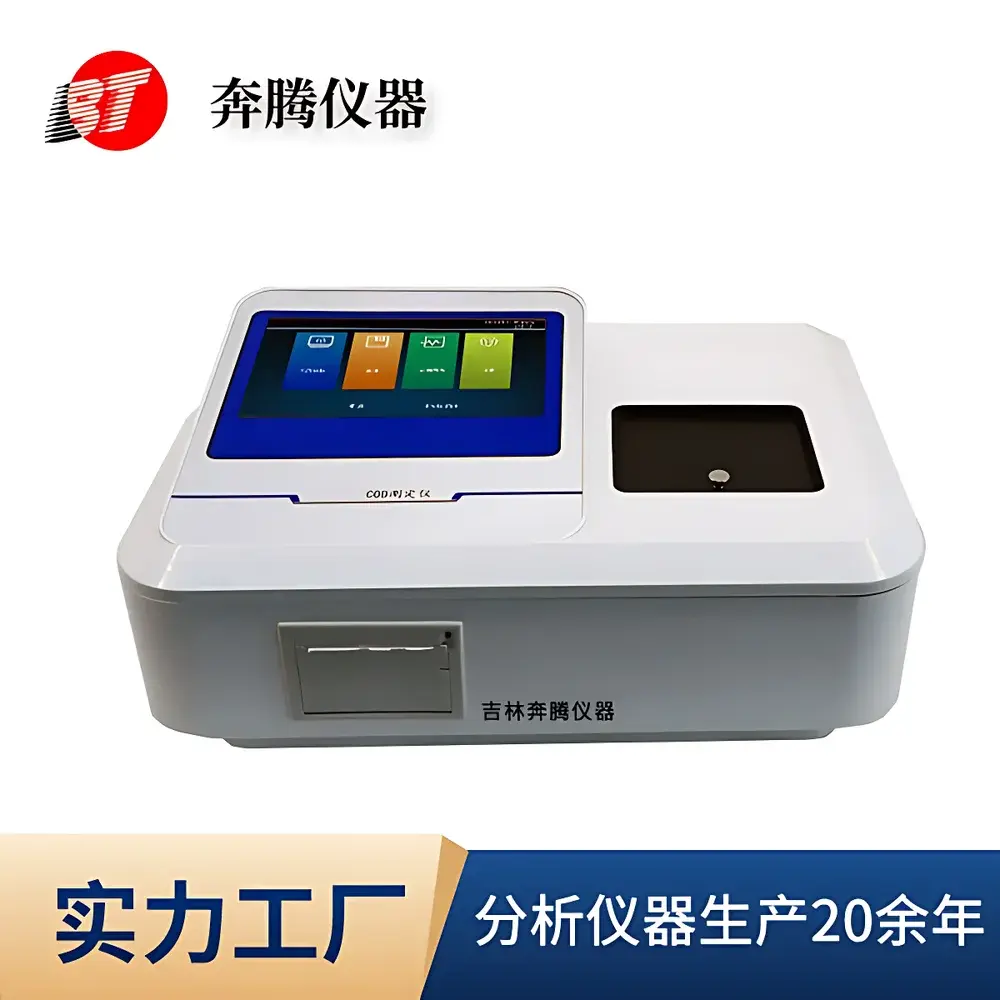
Benteng BTB-1160 Chemical Oxygen Demand (COD) Analyzer
| Brand | Benteng |
|---|---|
| Origin | Jilin, China |
| Manufacturer Type | Direct Manufacturer |
| Product Category | Domestic |
| Model | BTB-1160 |
| Instrument Type | Benchtop Laboratory Analyzer |
| Measurement Principle | Rapid Digestion Spectrophotometry (per HJ/T 399–2007) |
| Detection Limit | 0.1 mg/L |
| Analysis Time | 20 min per batch |
| Sample Throughput | 15 or 30 samples per run |
| Measurement Range | 0–15,000 mg/L (multi-range) |
| Temperature Control Range | Ambient to 120 °C |
| Accuracy | ±5% FS |
| Photometric Drift | <0.005 A within 20 min |
| Repeatability | ≤3% RSD |
| Display | 7-inch IPS capacitive touchscreen |
| Data Export | USB flash drive, Wi-Fi, RJ45 Ethernet |
| Built-in Thermal Printer | Optional auto/manual print |
| Power Supply | AC 220 V ±10%, 50 Hz |
| Power Consumption | 20 W |
| Operating Environment | 5–40 °C, ≤85% RH |
| Dimensions (W×D×H) | 400 × 320 × 150 mm |
| Weight | 6.0 kg |
Overview
The Benteng BTB-1160 Chemical Oxygen Demand (COD) Analyzer is a benchtop laboratory instrument engineered for precise, rapid, and compliant quantification of chemical oxygen demand in aqueous matrices. It implements the standardized rapid digestion spectrophotometric method specified in China’s national standard HJ/T 399–2007—equivalent in principle to ISO 15705:2002 and aligned with core elements of ASTM D1252 (Method B). The system integrates a high-stability, long-life LED light source with optimized optical path design and constant-current drive electronics to ensure photometric consistency across repeated measurements. Unlike traditional dichromate reflux methods requiring 2–4 hours, the BTB-1160 completes full digestion and absorbance measurement in under 20 minutes per batch, significantly accelerating routine water quality surveillance without compromising analytical rigor.
Key Features
- High-fidelity optical architecture: Dual-wavelength LED source (610 nm and 420 nm) coupled with precision-machined quartz cuvette holders ensures minimal inter-sample variability and eliminates lamp aging-related drift.
- Intelligent digestion control: Programmable heating module maintains ±0.5 °C temperature stability from ambient up to 120 °C, enabling reproducible oxidation kinetics across COD concentration ranges (0–15,000 mg/L, segmented calibration).
- Human-centered interface: 7-inch IPS capacitive touchscreen supports multilingual operation (English/Chinese), embedded instructional videos, voice-guided workflows, and real-time graphical display of absorbance kinetics and calibration curves.
- Robust data integrity framework: Internal thermal printer supports timestamped manual or scheduled report generation; all measurement metadata—including date/time stamp, operator ID, digestion parameters, and raw absorbance values—is stored with audit-trail capability.
- Flexible connectivity: Equipped with dual-mode data export: direct USB mass storage mode for .CSV file transfer, plus IEEE 802.11 b/g/n Wi-Fi and 10/100 Mbps RJ45 Ethernet for integration into LIMS or centralized QA/QC dashboards.
- Compliance-ready hardware: Designed to support GLP-compliant operation—features include non-volatile clock (maintains time during power loss), password-protected method editing, and immutable event logging for instrument use and calibration history.
Sample Compatibility & Compliance
The BTB-1160 is validated for use with domestic wastewater, industrial effluents (e.g., petrochemical, pulp & paper, pharmaceutical, metallurgical, and fermentation streams), surface water, and groundwater samples. It accommodates standard 16-mm round glass or quartz cuvettes (10 mm pathlength) and supports both pre-digested and on-instrument digestion protocols. Method performance meets the precision and accuracy requirements outlined in HJ/T 399–2007, including ≤3% repeatability (n=7) and ≤±5% bias against certified reference materials (CRMs) traceable to NIM (National Institute of Metrology, China). While not FDA 21 CFR Part 11-certified out-of-box, its audit log structure, user access controls, and electronic signature readiness enable qualification for GMP-aligned environmental monitoring programs upon site-specific validation.
Software & Data Management
Firmware v3.2+ includes an embedded Linux-based operating system with deterministic real-time scheduling for digestion timing and photometric acquisition. All raw data (absorbance at λ₁/λ₂, temperature profile, digestion duration) are stored in structured SQLite databases with automatic daily backup to internal eMMC. Export formats include CSV (with ISO 8601 timestamps), PDF summary reports (printable or email-enabled), and XML-compatible metadata bundles for LIMS ingestion. Remote firmware updates are supported via HTTPS-secured OTA channels. Optional PC software (BTB-Link Suite) provides advanced statistical tools—including Shewhart control charts, trend analysis across sample batches, and automated outlier detection using Grubbs’ test.
Applications
The BTB-1160 serves as a primary COD quantification platform in municipal wastewater treatment plants for influent/effluent compliance reporting; in industrial QA/QC labs for discharge permit verification (e.g., GB 8978–1996); and in academic and research laboratories conducting kinetic studies of organic pollutant degradation. Its rapid turnaround supports high-frequency monitoring in bioreactor optimization, membrane fouling assessment, and pretreatment efficiency evaluation. Field-deployable variants (not covered by BTB-1160) are available for mobile lab applications, but the BTB-1160 is strictly designed for controlled laboratory environments requiring stable thermal and electrical conditions.
FAQ
Does the BTB-1160 comply with international standards such as ISO or ASTM?
Yes—the underlying rapid digestion spectrophotometric methodology aligns with ISO 15705:2002 and ASTM D1252 Method B. Full equivalence documentation and interlaboratory validation reports are available upon request.
Can the instrument be calibrated using NIST-traceable standards?
Yes—it accepts commercially available COD standard solutions certified to NIST SRM 2630 series or equivalent CRMs from LGC, AccuStandard, or Sigma-Aldrich.
Is method validation support provided for regulatory submissions?
Benteng supplies IQ/OQ documentation templates, system suitability test protocols, and raw data export specifications compatible with EPA, EU Water Framework Directive, and China MEE reporting requirements.
What maintenance is required for long-term photometric stability?
LED source lifetime exceeds 100,000 hours; no lamp replacement is needed. Quarterly verification of cuvette alignment and annual optical path cleaning with isopropanol are recommended.
Can the BTB-1160 integrate with enterprise-level LIMS or SCADA systems?
Yes—via Modbus TCP (RJ45) or RESTful API over Wi-Fi/Ethernet. Custom middleware drivers for LabWare, Thermo Fisher SampleManager, and Siemens Desigo CC are available under NDA.







