
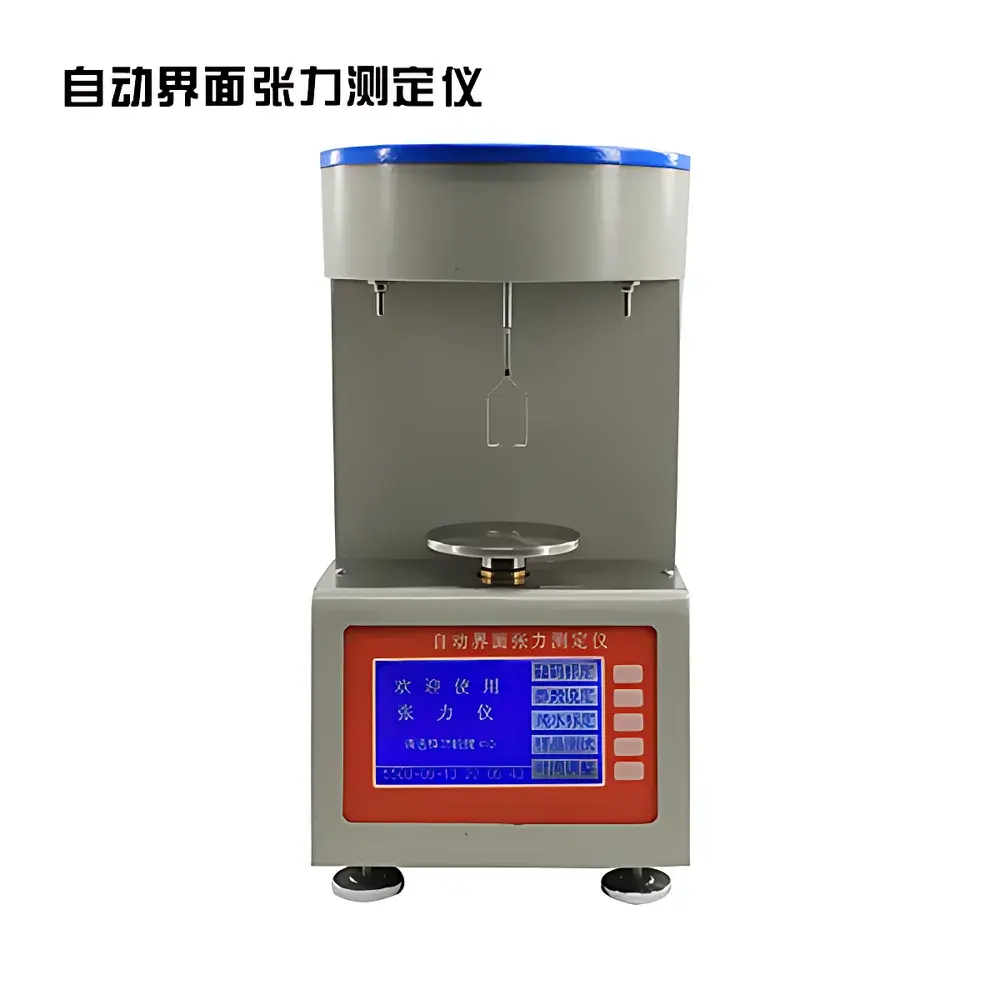
Benteng BZL-6 Automatic Surface & Interfacial Tensiometer
| Brand | Benteng |
|---|---|
| Origin | Jilin, China |
| Manufacturer Type | Direct Manufacturer |
| Region of Origin | Domestic (China) |
| Model | BZL-6 |
| Price Range | USD 1,400–7,000 (est.) |
| Measurement Range | 2–200 mN/m |
| Resolution | 0.1 mN/m |
| Accuracy | ±0.1 mN/m |
| Temperature Display Range | 10–30 °C (typical test temperature: 25 °C) |
| Temperature Display Accuracy | ±0.1% of reading |
| Measurement Method | Du Noüy Ring Method |
| Repeatability | ±0.3% |
| Power Consumption | 20 VA |
| Dimensions (W×D×H) | 185 × 260 × 360 mm |
| Net Weight | 10.3 kg |
| Operating Humidity | 20–75% RH |
| Power Supply | AC 220 V ±5%, 50 Hz |
Overview
The Benteng BZL-6 Automatic Surface & Interfacial Tensiometer is a precision instrument engineered for the quantitative determination of surface tension and interfacial tension of liquids using the standardized Du Noüy ring method—fully compliant with GB/T 6541, the Chinese national standard equivalent to ISO 6295 and ASTM D971 for petroleum products and insulating oils. The instrument operates on the principle of measuring the maximum force required to detach a platinum-iridium ring from the liquid–air or liquid–liquid interface, converting this force into surface or interfacial tension via calibrated geometric and gravitational constants. Designed for routine QC laboratories in petrochemical, lubricant, transformer oil, and specialty chemical industries, the BZL-6 delivers high reproducibility under controlled ambient conditions (10–30 °C, 20–75% RH), with automatic temperature compensation applied in real time to correct for thermal drift in sensor response and liquid density variation.
Key Features
- Proprietary high-response electromagnetic force compensation transducer ensures linearity and stability across the full 2–200 mN/m range, eliminating mechanical hysteresis and reducing calibration complexity.
- Single-point calibration protocol—no zero or span potentiometers required—streamlines daily verification and reduces operator dependency on multi-point reference standards.
- Integrated Pt100-grade temperature sensing circuit enables continuous ambient temperature monitoring and automatic correction of tension values per IUPAC-recommended temperature coefficients (e.g., −0.15 mN/m per °C for water near 25 °C).
- 240 × 128 dot-matrix LCD with bilingual UI (English/Chinese toggle) supports fully guided operation, including on-screen prompts for ring immersion depth, detachment speed control, and pass/fail validation per GB/T 6541 procedural steps.
- Dual-function display shows both real-time equivalent tension value (mN/m) and instantaneous mass reading (g), enabling concurrent use as a precision balance (±0.001 g resolution) for sample preparation traceability.
- Onboard non-volatile memory stores up to 255 test records with timestamp, operator ID (optional via RS232 handshake), and raw force/time curve metadata—critical for GLP-compliant audit trails.
- Integrated thermal line printer provides immediate hardcopy output with embedded test ID, date/time stamp, and compliance flag (e.g., “GB/T 6541 Pass”); supports offline printing when disconnected from host PC.
Sample Compatibility & Compliance
The BZL-6 is validated for use with low-to-medium viscosity Newtonian and near-Newtonian liquids, including mineral insulating oils (IEC 60296), transformer oils, hydraulic fluids, surfactant solutions, and crude oil emulsions. It conforms to the geometric and procedural requirements of GB/T 6541 (identical to ISO 6295 Annex A), ensuring data comparability with international interlaboratory studies. While not certified to ISO/IEC 17025, its documented measurement uncertainty budget—based on repeatability (≤0.3%), resolution (0.1 mN/m), and temperature-compensated accuracy (±0.1 mN/m)—supports internal method validation per ASTM E2655 and CNAS-CL01:2018 guidelines. The instrument meets CE-marked EMC and LVD safety directives (2014/30/EU, 2014/35/EU) for laboratory equipment.
Software & Data Management
Data export is supported via standard RS232 serial interface (38.4 kbps, ASCII protocol) compatible with Windows-based lab information systems (LIMS) and custom CSV parsers. Communication includes full command-response handshaking, allowing remote initiation of tests, retrieval of stored records, and firmware version interrogation. The native data packet structure embeds ISO 8601 timestamps, measurement mode flag (surface/interfacial), ring calibration ID, and raw sensor ADC counts—enabling traceable reprocessing. For regulated environments, optional software add-ons provide 21 CFR Part 11-compliant user authentication, electronic signatures, and immutable audit logs—though native firmware does not include cryptographic signing or role-based access control.
Applications
- Quality control of electrical insulating oils per IEC 60296 and DL/T 429.6 specifications.
- Surfactant efficacy screening in enhanced oil recovery (EOR) formulations.
- Stability assessment of oil-in-water and water-in-oil emulsions in food and pharmaceutical excipient development.
- Batch release testing of industrial lubricants where interfacial activity correlates with oxidation resistance.
- Educational labs requiring ISO/ASTM-aligned tensiometry training platforms with intuitive workflow navigation.
FAQ
What standard methods does the BZL-6 support?
It implements the Du Noüy ring method per GB/T 6541, which is technically aligned with ISO 6295 and ASTM D971 for petroleum products. It does not support Wilhelmy plate or pendant drop methods.
Is temperature control built into the instrument?
No—the BZL-6 monitors ambient temperature only and applies algorithmic compensation; it lacks active Peltier or bath-coupled temperature regulation. Users must maintain stable lab conditions within 10–30 °C per specification.
Can the instrument measure interfacial tension between two immiscible liquids?
Yes—when configured with dual-phase sample holders and appropriate ring immersion protocols, it quantifies liquid–liquid interfacial tension, provided the lower phase density exceeds the upper phase by ≥0.1 g/cm³.
How is calibration traceability established?
Calibration uses certified reference standards (e.g., ultra-pure water at 25 °C = 72.0 mN/m, 2-propanol = 21.7 mN/m). The single-point procedure requires only one known standard; no multi-point linear regression is performed or stored.
Does the device meet FDA or EU regulatory requirements for GMP environments?
The base unit satisfies general electrical safety and EMC requirements but lacks out-of-the-box 21 CFR Part 11 or Annex 11 features. Validation packages—including IQ/OQ documentation, uncertainty analysis, and change control logs—are available upon request for qualified users.
Related Products



