
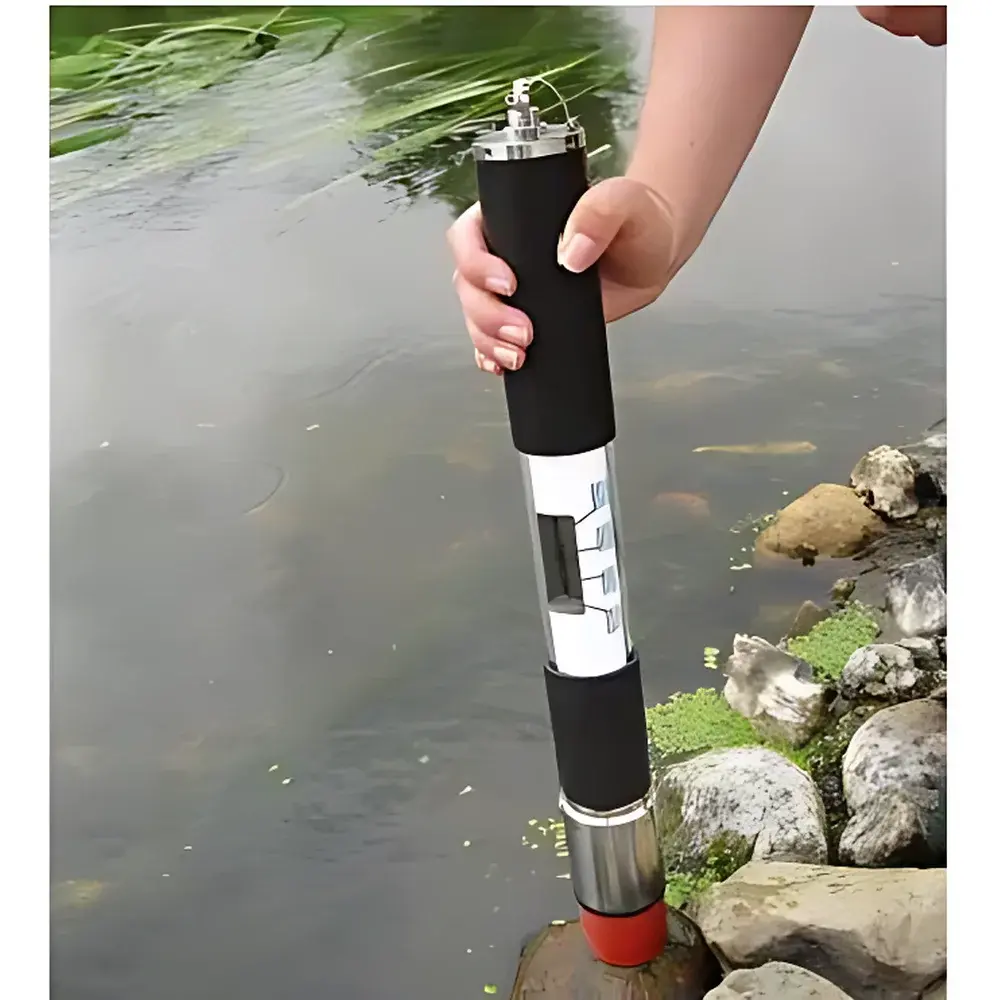
BenthoTorch 10 Portable Benthic Algae Analyzer by BBE Moldaenke
| Brand | BBE Moldaenke |
|---|---|
| Origin | Germany |
| Manufacturer Type | Original Equipment Manufacturer (OEM) |
| Origin Category | Imported |
| Model | BenthoTorch 10 |
| Detection Principle | In-situ chlorophyll-a fluorescence excitation & spectral signature analysis (405 nm LED excitation, 600–800 nm emission detection) |
| Measurement Time | <20 s per measurement |
| Power Supply | Rechargeable Li-ion battery (up to 8 h continuous operation) |
| Weight | 320 g |
| GPS Module | Integrated high-accuracy GNSS receiver (supports WGS84 coordinates, ±2 m CEP) |
| Data Output | CSV, KML, TXT |
| Calibration | Automatic substrate compensation algorithm (patented optical baseline correction) |
Overview
The BenthoTorch 10 is a field-deployable, handheld benthic algae analyzer engineered for rapid, non-destructive quantification and qualitative assessment of photosynthetic biofilms on submerged natural substrates. Unlike traditional lab-based chlorophyll-a extraction methods (e.g., acetone extraction followed by spectrophotometry per ASTM D511–22 or ISO 10260), the BenthoTorch 10 employs in-situ active fluorescence spectroscopy. It delivers real-time, calibrated estimates of chlorophyll-a concentration (µg/cm²) and algal community composition indices—based on characteristic emission spectra induced by 405 nm violet LED excitation. The device operates on the principle that intact photosystem II complexes in living benthic microalgae, diatoms, cyanobacteria, and macroalgal epiphytes emit fluorescence in distinct spectral bands (primarily 685 nm and 740 nm peaks). By analyzing the ratio and amplitude of these bands, the instrument discriminates between functional algal groups—including green algae, diatoms, and cyanobacteria—without sample collection, preservation, or laboratory processing.
Key Features
- True in-situ measurement: No sampling, no solvent extraction, no biomass removal—preserves ecological integrity of benthic surfaces.
- Substrate-independent quantification: Patented automatic baseline correction compensates for variable reflectance from stones, gravel, sediment, concrete, or artificial substrates.
- Integrated GNSS module: Georeferenced data capture with WGS84-compliant coordinates; direct export to KML for visualization in Google Earth or GIS platforms.
- Field-optimized ergonomics: 320 g mass, IP67-rated housing, and intuitive one-button operation enable extended use in humid, splash-prone, or low-light aquatic environments.
- On-device data visualization: Real-time chlorophyll-a concentration overlay on live camera feed; time-series graphs stored internally for up to 10,000 measurements.
- FDA 21 CFR Part 11–compatible audit trail: Timestamped measurements include operator ID, GPS metadata, instrument serial number, and firmware version—supporting GLP/GMP-aligned environmental monitoring programs.
Sample Compatibility & Compliance
The BenthoTorch 10 is validated for direct contact measurement on wet, submerged, or intermittently exposed benthic surfaces—including cobble, bedrock, sand-mat interfaces, artificial substrata (e.g., glass slides, ceramic tiles), and soft sediments with visible biofilm cover. It complies with methodological frameworks referenced in EPA Method 1621 (for algal biofilm screening), ISO 19451:2017 (in-situ fluorescence-based water quality monitoring), and the European Water Framework Directive (WFD) Annex V guidance for phytobenthos assessment. All calibration routines are traceable to NIST-traceable chlorophyll-a reference standards (SRM 1950), and factory calibration certificates are supplied with each unit.
Software & Data Management
Data acquisition and post-processing are managed via the proprietary BenthoTorch Desktop Suite (Windows/macOS), which supports batch import of CSV/KML files, spatial interpolation (IDW), temporal trend analysis, and automated report generation compliant with ISO/IEC 17025 documentation requirements. Raw spectral data (600–800 nm, 1 nm resolution) and processed chlorophyll-a values are stored with full metadata—including GPS position, ambient light intensity (via integrated photodiode), tilt angle, and measurement duration. Export options include PDF reports with embedded georeferenced maps, Excel-compatible spreadsheets, and GIS-ready shapefiles. Audit logs record all user actions, parameter changes, and software updates—ensuring full data provenance for regulatory submissions.
Applications
- Ecological restoration monitoring: Quantifying periphyton recovery rates on reintroduced substrates in river rehabilitation projects.
- Long-term lake and reservoir surveillance: Tracking seasonal shifts in benthic algal assemblages linked to nutrient loading or climate-driven stratification changes.
- Regulatory compliance: Supporting WFD Article 8 reporting and national phytobenthos classification systems (e.g., UK’s RIVPACS, Germany’s ALCOM).
- Academic research: Enabling high-resolution spatial mapping of biofilm heterogeneity across riffle-pool sequences or littoral gradients.
- Education and citizen science: Facilitating undergraduate field labs on primary productivity, eutrophication indicators, and biofilm ecology without requiring laboratory infrastructure.
FAQ
Does the BenthoTorch 10 require periodic recalibration in the field?
No—each measurement applies real-time optical substrate compensation. Factory calibration remains stable for 12 months under normal use; annual verification against certified reference standards is recommended.
Can it distinguish between live and dead algal cells?
Yes—by analyzing the F685/F740 fluorescence ratio, the instrument infers photosynthetic vitality; values below 1.2 indicate reduced PSII functionality consistent with senescence or stress.
Is the device suitable for turbid or highly stained water?
Yes—the measurement occurs at surface contact; suspended solids or dissolved organic matter (CDOM) do not interfere, as excitation and detection occur within the top ~200 µm of the biofilm layer.
What file formats does the software support for third-party integration?
CSV (with header metadata), KML, GeoJSON, and standardized Excel templates aligned with EFSA and EEA data submission guidelines.
How is data security maintained during wireless transfer?
All Bluetooth 5.0 communications use AES-128 encryption; local storage employs write-protected SD card architecture with optional password-protected user profiles.







