
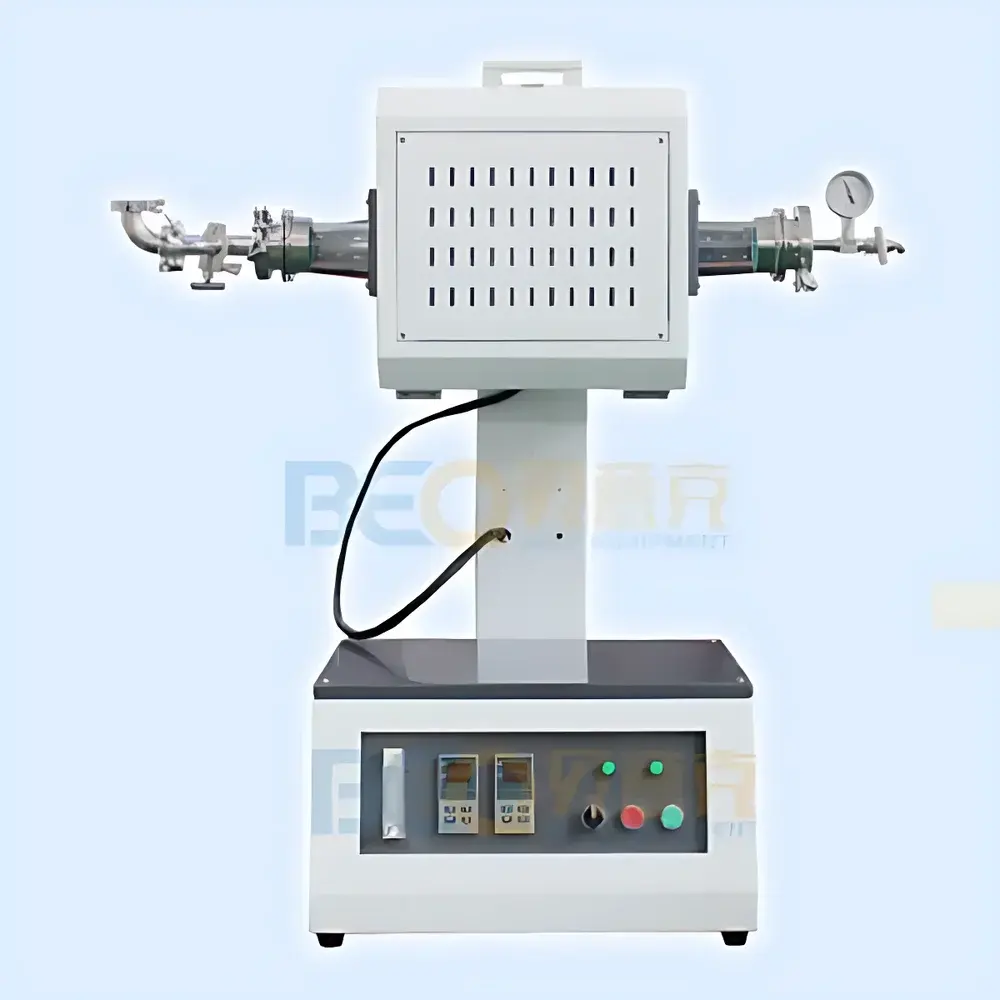
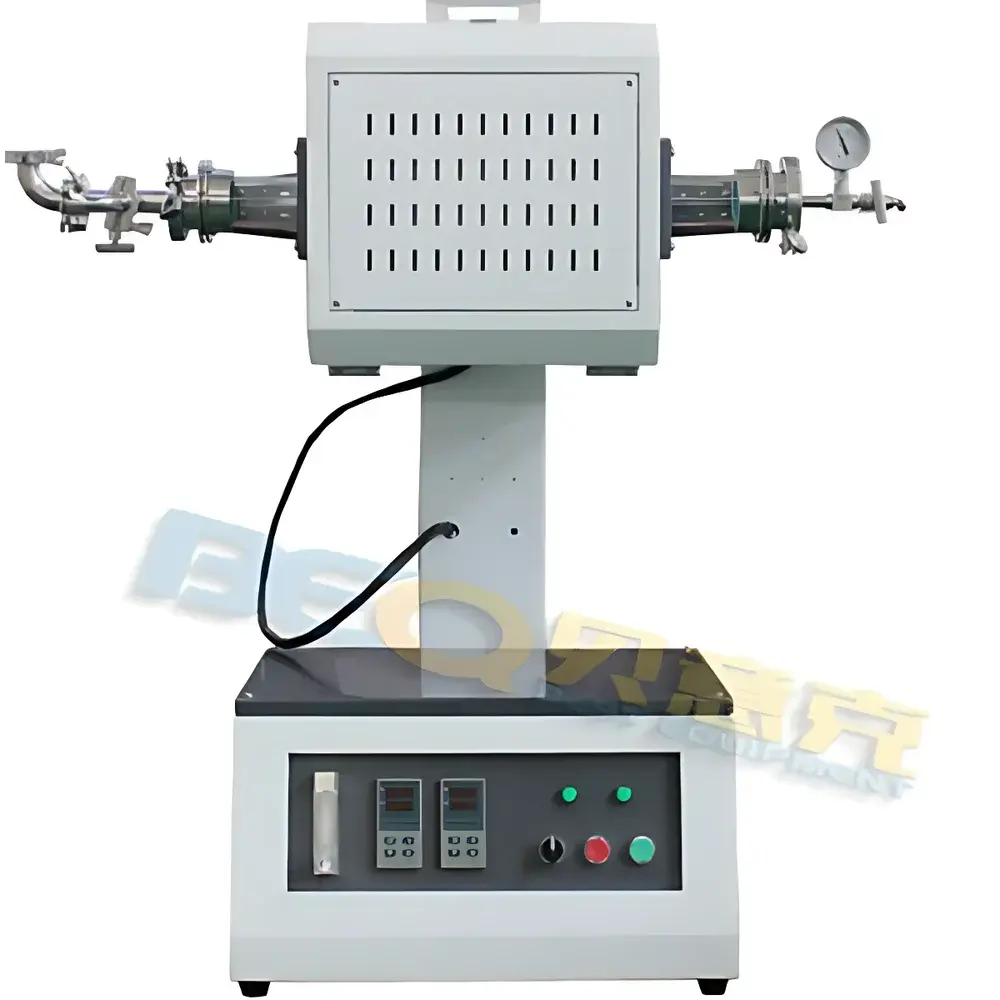
BEQ BTF-1200C-II-S-H-60 Dual-Zone Rotatable Vacuum Tube Furnace with 60 mm Quartz Tube
| Brand | BEQ |
|---|---|
| Origin | Anhui, China |
| Model | BTF-1200C-II-S-H-60 |
| Max Temperature | 1200 °C |
| Operating Temperature Range | ≤1100 °C (continuous) |
| Control Accuracy | ±1 °C |
| Heating Rate (to max temp) | ≤10 °C/min |
| Power Rating | 2.5 kW |
| Voltage | AC 220 V, 50/60 Hz |
| Heating Zone Length | 2 × 100 mm |
| Uniform Temperature Zone Length | 80 mm |
| Tube Diameter | Φ60 mm (quartz) |
| Chamber Dimensions (L×W×H) | 550×450×1100 mm |
| Net Weight | 60 kg |
| Thermocouple Type | K-type |
| Control System | Fuzzy PID with auto-tuning, 30-segment programmable ramp-soak profile |
| Safety Features | Over-temperature & thermocouple break alarms |
| Rotation Capability | 0–180° manual tilt (vertical/horizontal positioning) |
| Gas Flow Control | Manual float meter (16–160 mL/min) |
Overview
The BEQ BTF-1200C-II-S-H-60 is a dual-zone, manually rotatable vacuum tube furnace engineered for high-precision thermal processing of materials under controlled atmospheres. Designed around a horizontal quartz tube (Φ60 mm), the system integrates two independent heating zones—each 100 mm in length—with an 80 mm uniform temperature zone optimized for reproducible sample treatment. Its core architecture employs Mo-doped Fe-Cr-Al resistance wire heating elements, rated for continuous operation up to 1100 °C and intermittent use at 1200 °C. Temperature sensing relies on calibrated K-type thermocouples, interfaced with a microprocessor-based controller featuring fuzzy PID algorithms and self-tuning capability. The furnace supports vacuum, inert, reducing, or oxidizing environments via integrated gas inlet/outlet ports and a manual float flowmeter (16–160 mL/min), enabling precise atmosphere management during thermal synthesis, annealing, sintering, or CVD precursor decomposition.
Key Features
- Dual independent heating zones with synchronized or differential temperature programming for gradient thermal treatments
- Manual 0–180° rotational capability—enabling vertical, horizontal, or angled orientation to accommodate gravity-sensitive reactions (e.g., directional solidification, vapor transport, or powder settling studies)
- 30-segment programmable temperature profile with ramp-soak logic, supporting complex multi-step thermal protocols
- High-stability ±1 °C control accuracy across the full operating range (room temperature to 1200 °C), validated per ASTM E220 calibration practices
- Integrated over-temperature cutoff and thermocouple failure detection—compliant with IEC 61000-6-2 electromagnetic compatibility and basic functional safety requirements
- Front-access manual door with high-integrity ceramic fiber seal, minimizing heat loss and ensuring rapid cooldown between cycles
- Compact footprint (550 × 450 × 1100 mm) and 60 kg net weight—optimized for benchtop integration in ISO Class 5–7 cleanrooms or standard analytical labs
Sample Compatibility & Compliance
The furnace accommodates standard Φ60 mm quartz tubes (supplied separately or optionally configured), suitable for powders, pellets, thin films, nanowires, and small-volume crucibles (e.g., alumina or graphite). Its vacuum-rated construction supports base pressures down to 10−2 mbar when paired with a compatible two-stage rotary vane pump. Atmosphere compatibility includes N2, Ar, H2/Ar mixtures, and forming gas—subject to user-supplied gas train validation. While not certified to UL 746A or CE Machinery Directive Annex I out-of-the-box, the system meets fundamental electrical safety and thermal enclosure requirements for laboratory use under EN 61010-1:2010. Documentation supports GLP-compliant recordkeeping when used with external data loggers meeting FDA 21 CFR Part 11 audit trail specifications.
Software & Data Management
The embedded controller provides local interface via a high-contrast LCD touchscreen with real-time graphing of setpoint, actual temperature, and power output. All 30-segment profiles are stored non-volatilely and exportable via USB port as CSV files for traceability. Optional RS485 Modbus RTU communication enables integration into LabVIEW, MATLAB, or SCADA-based central monitoring systems. Firmware supports time-stamped event logging—including alarm triggers, program starts/stops, and manual overrides—for retrospective analysis in quality-controlled environments.
Applications
- Thermal annealing of transition metal dichalcogenides (TMDs) and perovskite precursors under inert gas
- Controlled oxidation of metallic foils for oxide layer growth kinetics studies
- Carbothermal reduction of metal oxides in argon/hydrogen mixtures
- Vapor-phase transport synthesis of 2D materials (e.g., MoS2, WS2) using dual-zone thermal gradients
- Pre-sintering of ceramic green bodies prior to HIP or SPS processing
- Calibration reference heating for thermogravimetric analyzers (TGA) and differential scanning calorimeters (DSC)
FAQ
What is the maximum recommended continuous operating temperature?
Continuous operation is rated up to 1100 °C; 1200 °C is specified for short-duration (<2 h) process steps only.
Can this furnace be integrated with an automated vacuum system?
Yes—the unit features standard KF-25 vacuum flanges and electrical interlocks compatible with common vacuum controllers and pressure gauges.
Is the quartz tube included with the furnace?
No; the Φ60 mm fused quartz tube is supplied as an optional accessory, selected based on required thermal shock resistance and chemical compatibility.
Does the controller support remote start/stop via digital I/O?
The RS485 interface supports Modbus commands for remote program initiation, pause/resume, and status polling—no additional hardware required.
How is temperature uniformity verified across the 80 mm hot zone?
Uniformity is characterized during factory acceptance testing using a 5-point axial thermocouple array per ISO/IEC 17025-accredited procedures; certificate available upon request.



