
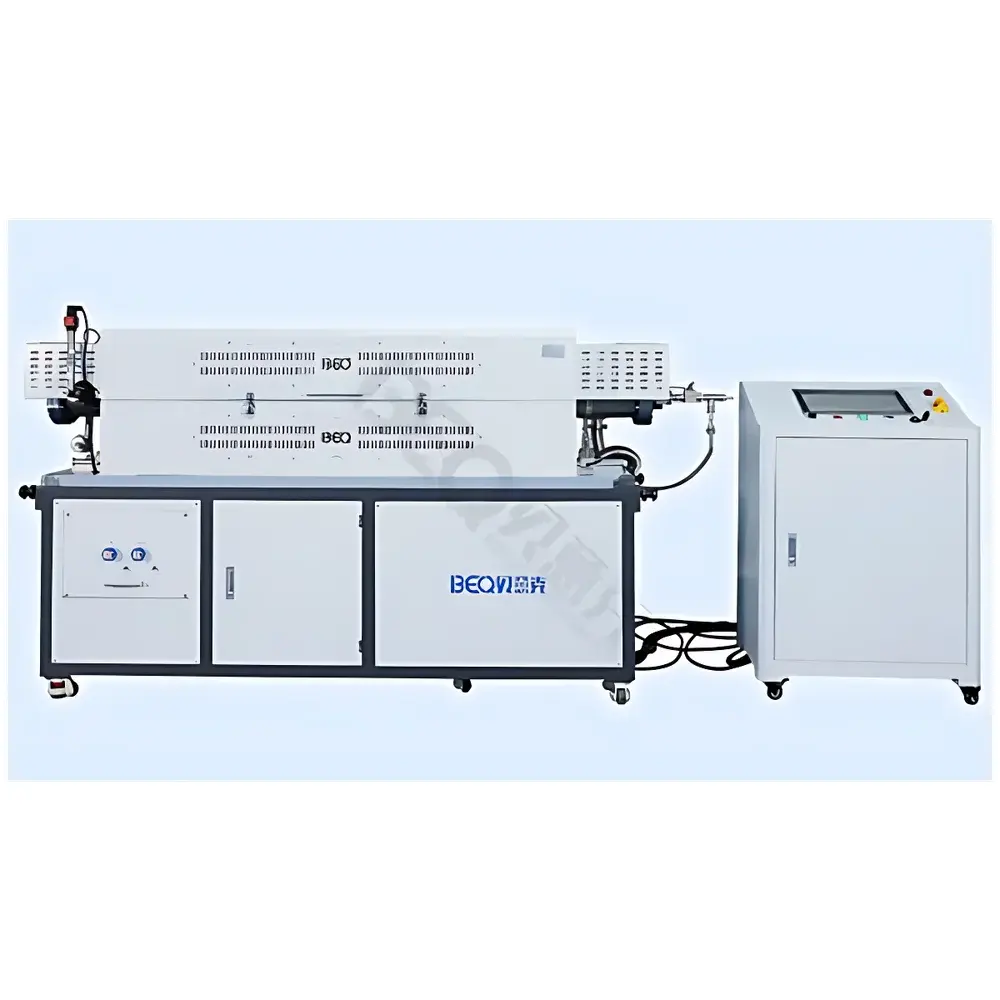
BEQ BTF-1200C-III-HP-132 High-Temperature and High-Pressure Tube Furnace
| Brand | BEQ |
|---|---|
| Origin | Anhui, China |
| Model | BTF-1200C-III-HP-132 |
| Type | Horizontal Tube Furnace |
| Max Temperature | 1200 °C |
| Temperature Control Accuracy | ±1 °C |
| Max Power | 14.5 kW |
| Heating Rate (to Max Temp) | ≤5–10 °C/min |
| Heating Method | Resistance Wire Heating |
| Control System | Fuzzy PID + Self-Tuning Regulation |
| Programmable Stages | 30-segment Intelligent Ramp/Soak |
| Safety Features | Over-Temperature & Thermocouple Break Alarms |
| Pressure Range | 0–10 MPa |
| Tube ID Options | 1–20 inch (customizable) |
| Cooling | Forced Air Cooling |
| Display | 15.7-inch Touchscreen HMI |
| Footprint | 2.66 m² |
Overview
The BEQ BTF-1200C-III-HP-132 is a horizontally oriented, triple-zone high-temperature and high-pressure tube furnace engineered for controlled thermochemical synthesis, material sintering, and gas-phase reaction studies under simultaneous elevated temperature and pressure conditions. Unlike conventional muffle or box-type furnaces, this system integrates a robust quartz or high-purity alumina tube capable of withstanding up to 10 MPa internal pressure while maintaining precise thermal profiles across three independently regulated heating zones — enabling axial temperature gradients, isothermal zone extension, or stepwise thermal processing. The furnace operates on resistive heating via high-stability Kanthal A1 or SiC-based heating elements, coupled with a closed-loop fuzzy PID control architecture that dynamically adjusts power output based on real-time thermocouple feedback and thermal inertia modeling. Its design conforms to fundamental requirements for pressurized thermal processing in materials science, catalysis, and advanced ceramics research, where reproducible control over both thermal and mechanical boundary conditions is essential.
Key Features
- Triple independent heating zones (Zone 1–3), each with dedicated thermocouple input and programmable setpoint control — supporting gradient heating, multi-step annealing, and zone-specific dwell protocols
- Full-range pressure capability from vacuum to 10 MPa, monitored continuously via calibrated piezoresistive pressure transducer with digital compensation
- Integrated safety interlock system comprising electromagnetic pressure relief valve, check valve at inlet/outlet ports, and automatic shutdown on overpressure (>10.5 MPa) or thermocouple failure
- 30-segment programmable controller with ramp/soak logic, user-defined hold times, and auto-tuning functionality for optimal transient response
- 15.7-inch industrial-grade capacitive touchscreen HMI with real-time dual-parameter visualization (temperature vs. time, pressure vs. time), historical trend logging, and USB data export
- Forced-air cooling jacket surrounding the outer furnace shell ensures surface temperature remains below 60 °C during continuous operation at 1200 °C, reducing ambient heat load and enhancing operator safety
- Modular tube interface supports custom diameters (1–20 inch ID) and material selection (quartz, fused silica, alumina, or Inconel-lined variants) to match chemical compatibility and thermal shock requirements
Sample Compatibility & Compliance
The BTF-1200C-III-HP-132 accommodates solid powders, pellets, thin films, and fiber samples placed inside the sealed reaction tube; gaseous reactants (e.g., H₂, NH₃, CO, CH₄, O₂, Ar) may be introduced via mass flow controllers upstream of the inlet valve. The system meets mechanical integrity requirements outlined in ISO 14855-2 (determination of ultimate aerobic biodegradability) and ASTM E2070 (standard test method for determining ignition temperature of solids), when configured with appropriate pressure-rated accessories. All electrical components comply with IEC 61000-6-4 (EMC emission standards) and IEC 61000-6-2 (immunity). For GLP/GMP-regulated environments, optional audit-trail-enabled firmware supports 21 CFR Part 11-compliant electronic records when paired with validated data acquisition software.
Software & Data Management
The embedded controller supports RS485 Modbus RTU and Ethernet TCP/IP communication protocols, enabling integration into centralized lab automation platforms (e.g., LabVIEW, DeltaV, or custom SCADA systems). Optional PC-based software provides remote monitoring, script-driven experiment sequencing, alarm event logging with timestamps, and CSV/TXT export of synchronized temperature–pressure–time datasets. All parameter changes are timestamped and attributed to user login credentials, satisfying traceability requirements for ISO/IEC 17025-accredited laboratories.
Applications
- High-pressure solid-state synthesis of perovskites, MAX phases, and metal hydrides
- Catalytic testing under industrially relevant pressure conditions (e.g., Fischer–Tropsch, ammonia decomposition)
- Thermal stability assessment of battery electrode materials under inert or reactive atmospheres
- Controlled oxidation/nitridation of refractory metals and ceramics
- Gas-solid reaction kinetics studies requiring decoupled axial thermal profiling and uniform pressure distribution
- Pre-sintering and binder burnout stages in powder metallurgy workflows
FAQ
What is the maximum allowable operating pressure for this furnace?
The system is rated for continuous operation up to 10 MPa (1450 psi) with appropriate tube and flange selection; pressure rating is contingent upon tube material, wall thickness, and sealing configuration.
Can the furnace operate under vacuum prior to pressurization?
Yes — the integrated gas handling manifold includes vacuum-rated ball valves and compatible O-ring seals, allowing evacuation to ≤10⁻² mbar before controlled gas introduction.
Is third-party calibration documentation available for temperature and pressure sensors?
Factory calibration certificates (NIST-traceable for Pt100 RTDs and pressure transducers) are provided with each unit; field recalibration services are supported through BEQ-authorized service centers.
How is thermal uniformity maintained across the three zones during high-pressure runs?
Each zone employs separate power regulation and feedback loops; uniformity is optimized via staggered element winding density and ceramic fiber insulation zoning — typical axial uniformity within ±3 °C over 200 mm at 1000 °C.
Does the system support automated pressure ramping synchronized with temperature programs?
While pressure control is currently manual or semi-automated via external MFCs, optional integration with digital pressure controllers enables closed-loop pressure ramping synchronized to temperature profiles via Modbus commands.
Related Products



