
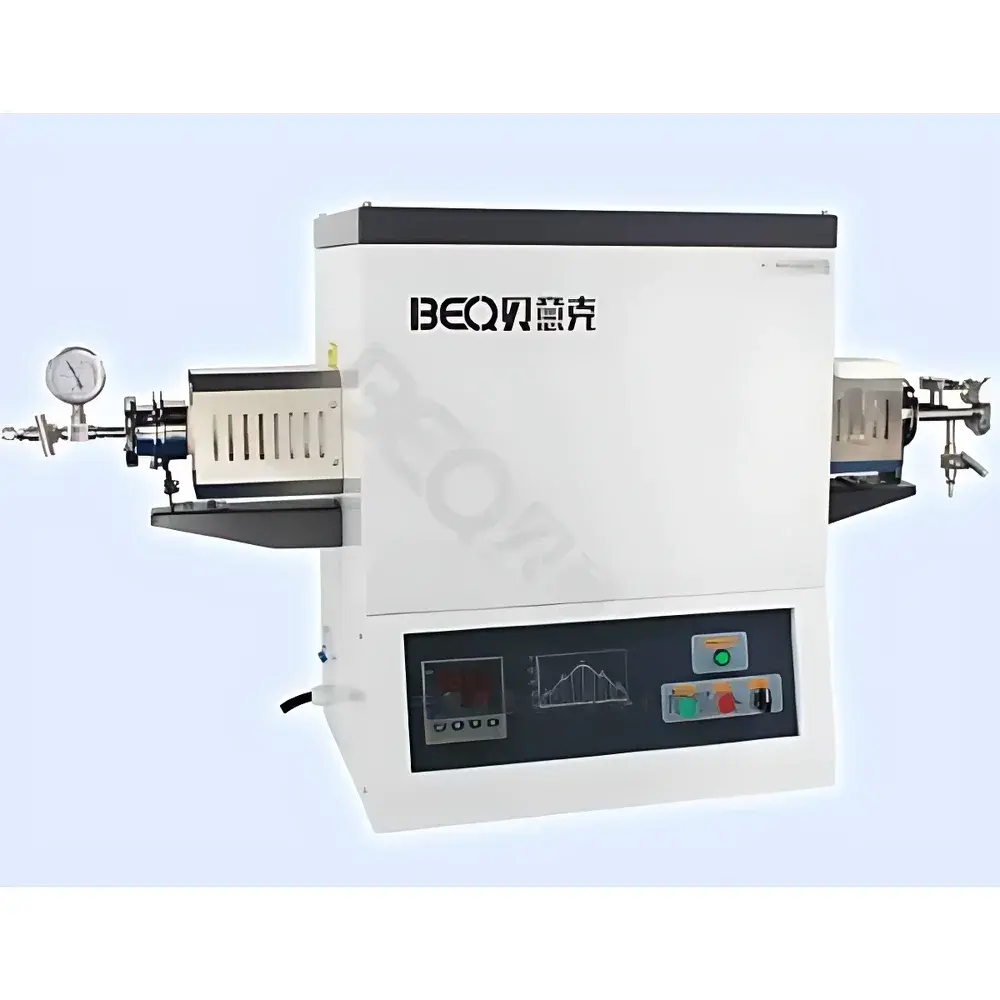
BEQ BTF-1600C High-Temperature Horizontal Tube Furnace
| Brand | BEQ |
|---|---|
| Origin | Anhui, China |
| Equipment Type | Horizontal Tube Furnace |
| Maximum Temperature | 1600 °C |
| Temperature Control Accuracy | ±1 °C |
| Rated Power | 5.2 kW |
| Heating Rate | ≤10 °C/min below 1200 °C, ≤5 °C/min from 1200–1500 °C, ≤2 °C/min above 1500 °C |
| Heating Element | Silicon Molybdenum (MoSi₂) Rods |
| Control System | Fuzzy PID with Auto-Tuning, 30-Stage Programmable Ramp/Soak Profile, Over-Temperature & Thermocouple Break Protection |
| Tube Dimensions | Φ60 mm × 1000 mm or Φ80 mm × 1000 mm |
| Chamber Lining | High-Purity Al₂O₃ Ceramic Tube with US-Imported High-Temperature Al₂O₃ Coating |
| Cooling | Dual-Layer Air-Cooled Steel Housing |
| Structural Support | Adjustable Flange Mounting Bracket |
Overview
The BEQ BTF-1600C is a horizontally oriented, high-temperature tube furnace engineered for precision thermal processing in research laboratories and materials development facilities. It operates on the principle of resistive heating via silicon molybdenum (MoSi₂) rods, delivering stable, uniform temperature distribution along an extended isothermal zone—critical for controlled annealing, sintering, crystal growth, and atmosphere-dependent synthesis (e.g., under inert, reducing, or vacuum conditions). Designed to meet the operational rigor of academic and industrial R&D environments, the furnace achieves a maximum operating temperature of 1600 °C with ±1 °C control stability over extended dwell periods. Its horizontal configuration facilitates easy sample insertion and integration with gas delivery systems or vacuum manifolds, while the robust dual-layer housing with forced-air cooling ensures surface temperatures remain within safe limits during prolonged high-temperature operation.
Key Features
- Uniform axial temperature profile enabled by dense, symmetrical MoSi₂ rod placement—verified by multi-point thermocouple mapping across the 1000 mm hot zone.
- Dual-shell construction with integrated axial air circulation system minimizes external casing temperature rise and enhances operator safety during continuous operation at >1400 °C.
- High-purity α-alumina (99.7% Al₂O₃) ceramic tube liner coated with a proprietary US-sourced high-emissivity alumina-based ceramic layer—improving radiant heat transfer efficiency and extending liner service life under thermal cycling.
- Modular flange mounting bracket system distributes mechanical load away from the quartz or alumina tube ends, reducing stress-induced deformation and seal failure risk during repeated thermal expansion cycles.
- Fuzzy logic PID controller with auto-tuning capability adapts dynamically to thermal load variations, ensuring repeatable ramp/soak performance across diverse sample masses and configurations.
- 30-segment programmable temperature profile memory supports complex thermal protocols—including multi-step heating, controlled cooling, and hold sequences—with non-volatile storage and password-protected parameter editing.
Sample Compatibility & Compliance
The BTF-1600C accommodates standard cylindrical samples up to 58 mm (Φ60 tube) or 78 mm (Φ80 tube) in diameter and 1000 mm in length. Compatible with fused silica, high-purity alumina, and recrystallized alumina tubes, it supports inert (Ar, N₂), reducing (H₂/N₂), and vacuum atmospheres down to 10⁻³ mbar when paired with appropriate sealing hardware. The furnace meets general electrical safety requirements per IEC 61010-1 and complies with electromagnetic compatibility standards EN 61326-1. While not certified to UL or CSA standards out-of-the-box, its architecture permits third-party validation for GLP-compliant thermal process documentation when configured with calibrated Class 1 thermocouples and audit-trail-enabled data logging.
Software & Data Management
The embedded controller provides real-time temperature display, profile execution status, and alarm event logging (including over-temperature triggers and thermocouple open-circuit detection). Optional RS485 Modbus RTU interface enables integration into centralized lab automation platforms (e.g., LabVIEW, MATLAB, or custom SCADA). When connected to BEQ’s optional PC-based ThermalPro software (Windows 10/11 compatible), users gain access to full traceability features—including timestamped setpoint/actual temperature curves, user login tracking, electronic signature support, and export to CSV/PDF for regulatory submission. Data integrity aligns with FDA 21 CFR Part 11 principles when deployed with system-level access controls and audit trail activation.
Applications
- High-temperature solid-state synthesis of oxides, nitrides, and carbides (e.g., LiCoO₂ cathode precursors, SiC powder densification).
- Controlled-atmosphere annealing of thin films and nanostructured substrates for semiconductor and photovoltaic R&D.
- Thermal gravimetric analysis (TGA) pre-conditioning and post-processing of catalysts and battery electrode materials.
- Crystal growth via vertical Bridgman or traveling heater methods using compatible crucible assemblies.
- Calibration reference source for secondary temperature sensors requiring NIST-traceable high-temperature exposure.
FAQ
What tube materials are recommended for use at 1600 °C?
High-purity recrystallized alumina (R-Al₂O₃) or molybdenum disilicide (MoSi₂)-coated alumina tubes are recommended. Fused silica is unsuitable above 1100 °C.
Can the furnace be operated under vacuum without modification?
Yes—when equipped with a vacuum-rated flange, metal gasket, and compatible feedthroughs; base pressure depends on pump selection and seal integrity.
Is the temperature controller compliant with ISO/IEC 17025 calibration requirements?
The controller accepts external calibration inputs; verification requires periodic comparison against a NIST-traceable reference thermometer per ASTM E220.
How often should the MoSi₂ heating elements be inspected?
Visual inspection is recommended every 200 operating hours above 1300 °C; resistance drift exceeding 15% from baseline warrants replacement.
Does the system support ramp-and-soak profiles with cooling segments?
Yes—the 30-stage program includes active cooling control via programmable power reduction, though external forced-air or water-cooled jackets are required for sub-ambient quenching.



