
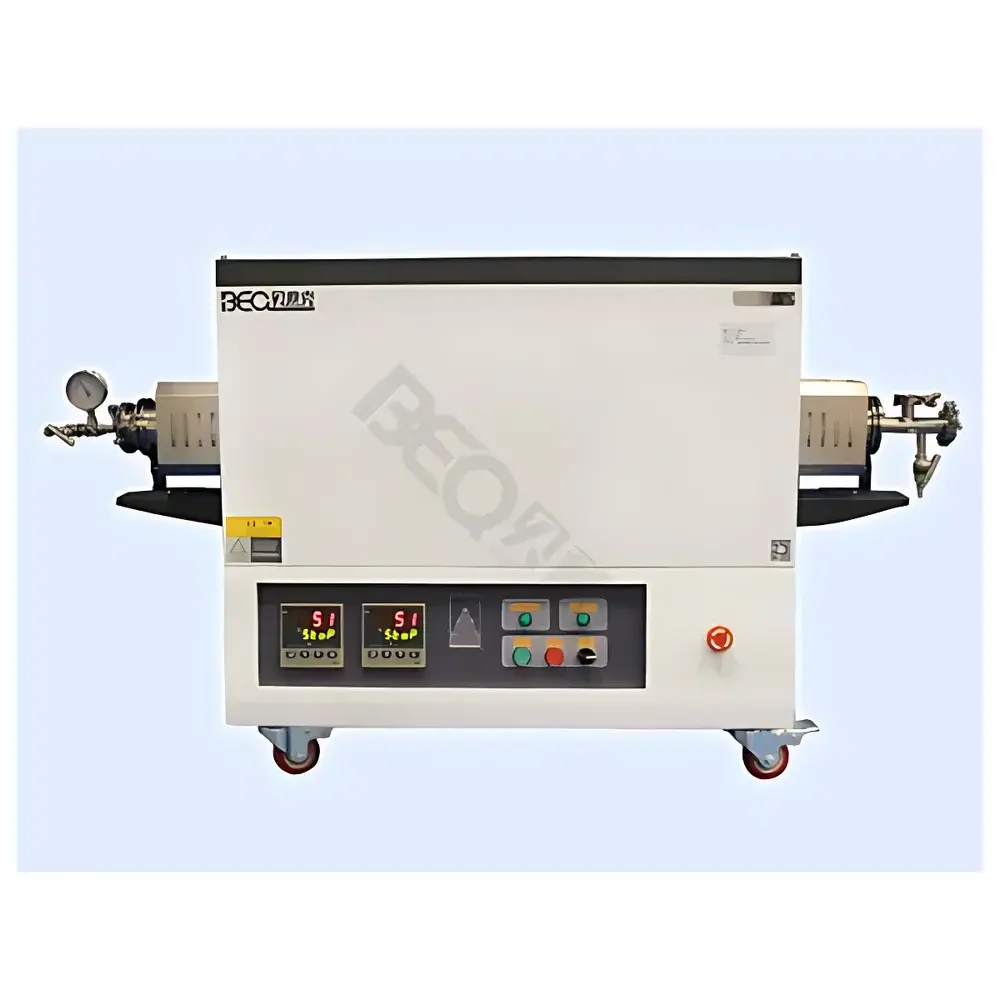
BEQ BTF-1600C-II Dual-Zone High-Temperature Tube Furnace
| Brand | BEQ |
|---|---|
| Origin | Anhui, China |
| Model | BTF-1600C-II |
| Maximum Temperature | 1600 °C |
| Temperature Uniformity | ±1 °C |
| Total Power Rating | 11 kW |
| Heating Rate | ≤10 °C/min up to 1200 °C |
| Heating Element | Silicon Molybdenum (MoSi₂) Rods |
| Control System | Fuzzy PID with auto-tuning, 30-segment programmable temperature profile, over-temperature and thermocouple failure alarm |
| Tube Dimensions | Φ60 mm × 1200 mm or Φ80 mm × 1200 mm |
| Chamber Lining | High-purity Al₂O₃ ceramic tube with US-sourced high-emissivity alumina coating |
| Cooling | Dual-layer air-cooled shell structure |
| Structural Support | Integrated flange support frame for load distribution |
Overview
The BEQ BTF-1600C-II is a precision-engineered dual-zone horizontal tube furnace designed for high-temperature thermal processing in research laboratories and materials development facilities. It operates on the principle of resistive heating via silicon molybdenum (MoSi₂) rods—known for stable performance and extended service life at temperatures up to 1600 °C in oxidizing atmospheres. Unlike single-zone furnaces, its independently controlled dual heating zones enable precise axial temperature gradients across the reaction zone, supporting advanced synthesis protocols such as controlled annealing, crystal growth, CVD precursor decomposition, and multi-step thermal treatments under inert, reducing, or vacuum conditions. The furnace integrates a high-purity alumina (Al₂O₃) tube chamber lined with a proprietary high-emissivity alumina coating sourced from the United States—enhancing radiative heat transfer efficiency and minimizing thermal lag during dynamic ramping cycles.
Key Features
- Dual independent heating zones with separate thermocouple feedback loops and dedicated PID controllers, enabling gradient-controlled thermal profiles along the tube axis
- High-reliability MoSi₂ heating elements arranged in optimized radial and axial configurations for superior temperature uniformity (±1 °C within the 300 mm central isothermal zone)
- Air-cooled double-shell enclosure with integrated forced-air circulation channels—reducing external surface temperature to <60 °C during continuous operation at 1600 °C
- 30-segment programmable controller supporting ramp-hold-cool sequences with user-defined dwell times, rate limits, and safety interlocks
- Robust mechanical design featuring reinforced stainless-steel flange mounts and a load-distributing support frame to minimize tube deflection and thermal stress-induced deformation
- Real-time monitoring of heater status, thermocouple integrity, and zone-specific over-temperature events with audible/visual alarms and automatic power cutoff
Sample Compatibility & Compliance
The BTF-1600C-II accommodates standard quartz or high-purity alumina sample boats and crucibles, compatible with gases including Ar, N₂, H₂, NH₃, and forming gas mixtures when used with optional gas inlet/outlet fittings and pressure-rated end caps. Its construction adheres to IEC 61000-6-3 (EMC emission standards) and meets UL 61010-1 requirements for laboratory electrical equipment safety. While not certified for Class I Div 1 hazardous locations, it is routinely deployed in GLP-compliant labs conducting ASTM E1113 (thermal stability testing), ISO 7888 (high-temperature oxidation studies), and internal R&D workflows requiring traceable temperature control per ISO/IEC 17025 calibration guidelines. Optional data logging modules support audit-ready temperature records compliant with FDA 21 CFR Part 11 requirements when paired with validated software.
Software & Data Management
The furnace’s embedded controller supports RS485 Modbus RTU communication for integration into centralized lab automation systems. Optional PC-based software enables remote configuration, real-time graphing of zone temperatures, event-triggered data capture, and export of time-stamped CSV logs—including ramp rates, hold durations, and alarm timestamps. All temperature setpoints and program steps are stored in non-volatile memory with password-protected access levels for operator, supervisor, and administrator roles. Firmware updates are performed via USB interface, and calibration coefficients can be adjusted using NIST-traceable reference thermocouples—ensuring long-term measurement consistency across instrument lifecycles.
Applications
- Synthesis and post-processing of functional ceramics, including piezoelectrics, ferroelectrics, and solid electrolytes
- Controlled atmosphere annealing of thin-film devices and semiconductor precursors
- Thermal gravimetric analysis (TGA) coupling with mass spectrometry or FTIR gas analyzers
- Graphene and 2D material growth via chemical vapor deposition (CVD) under precise thermal ramping protocols
- Calibration and validation of high-temperature sensors and thermocouples up to Type S (Pt/Pt–10% Rh)
- Accelerated aging studies of refractory composites and aerospace-grade superalloys
FAQ
What tube diameters are supported?
The furnace accepts either a Φ60 mm × 1200 mm or Φ80 mm × 1200 mm high-purity alumina tube—both rated for continuous operation at 1600 °C.
Can this furnace operate under vacuum or reducing atmospheres?
Yes—when equipped with vacuum-rated end flanges and compatible sealing gaskets, it supports pressures down to 10⁻³ mbar and reducing gas flows up to 500 sccm. Quartz tubes are recommended for vacuum use below 1200 °C.
Is the temperature uniformity verified across both zones?
Each zone includes a calibrated Type S thermocouple and undergoes factory verification using a 5-point axial mapping protocol per ASTM E220, with documented uniformity reports provided upon request.
How is thermal insulation optimized to reduce energy consumption?
Multi-layer ceramic fiber insulation (1400 °C grade) combined with reflective aluminum foil barriers minimizes radial heat loss, achieving typical standby power draw of <150 W at 1000 °C.
Does the controller support external trigger inputs for synchronized experiments?
Yes—the rear panel includes TTL-compatible digital I/O ports for start/stop synchronization with external instrumentation such as gas flow controllers or optical spectrometers.



