
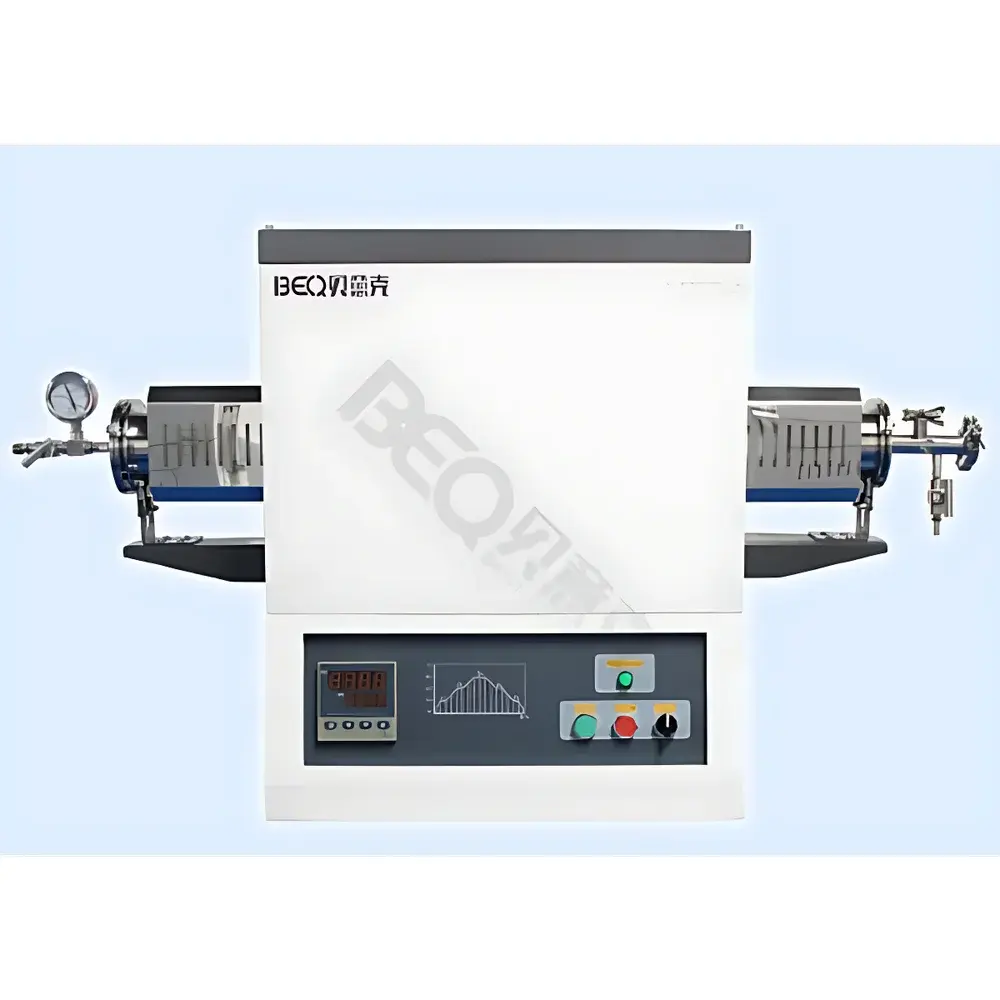
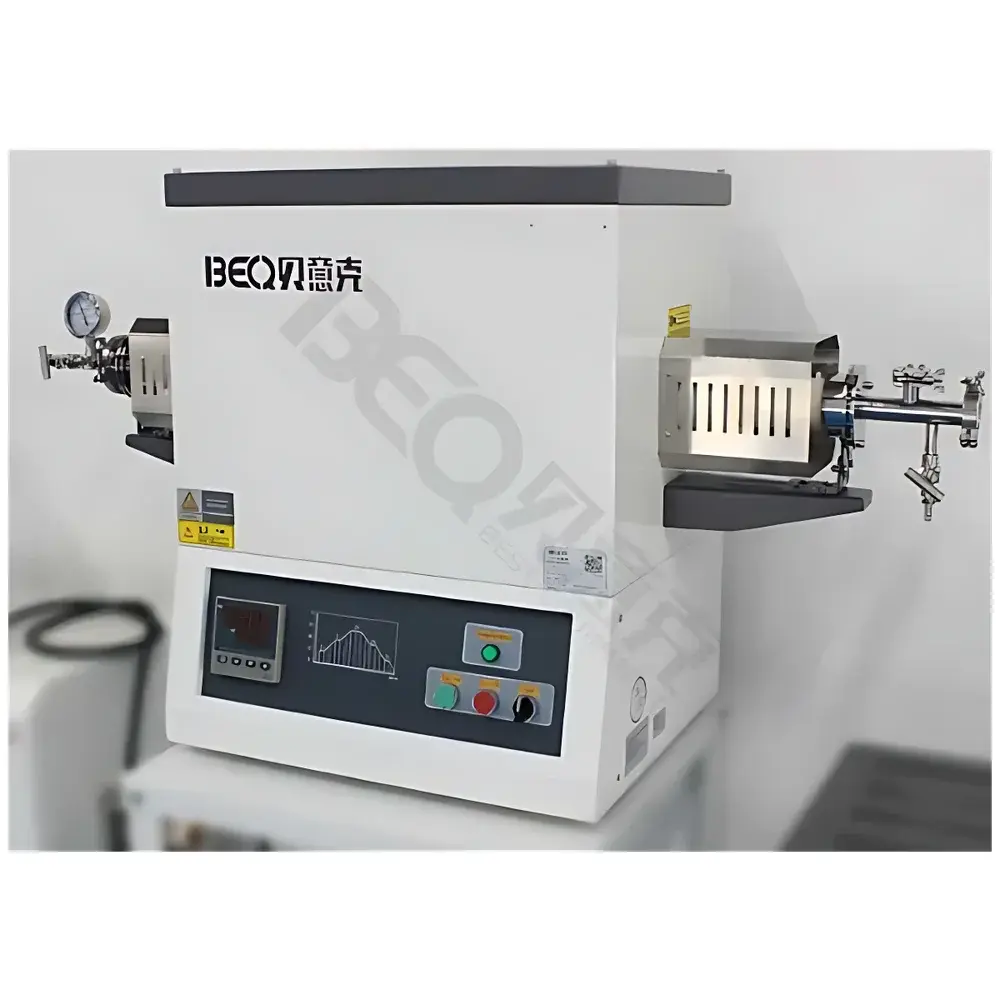
BEQ BTF-1700C High-Temperature Horizontal Tube Furnace
| Brand | BEQ |
|---|---|
| Origin | Anhui, China |
| Model | BTF-1700C |
| Maximum Temperature | 1700 °C |
| Temperature Control Accuracy | ±1 °C |
| Rated Power | 5.2 kW |
| Heating Rate | ≤10 °C/min below 1200 °C, ≤5 °C/min from 1200–1500 °C, ≤2 °C/min above 1500 °C |
| Heating Element | Silicon Molybdenum (MoSi₂) Rods |
| Control System | Fuzzy PID with auto-tuning, 30-segment programmable controller, over-temperature and thermocouple failure alarm |
| Tube Dimensions | Φ60 mm × 1000 mm (ID × effective length) |
| Chamber Lining | High-purity alumina (Al₂O₃) tube with proprietary high-emissivity ceramic coating (imported from USA) |
Overview
The BEQ BTF-1700C is a horizontal high-temperature tube furnace engineered for precise thermal processing in research laboratories and advanced materials development facilities. It operates on the principle of resistive heating via silicon molybdenum (MoSi₂) rods—optimized for stable, oxidation-resistant performance at temperatures up to 1700 °C in air atmospheres. Unlike conventional muffle furnaces, its tubular geometry enables controlled gas flow, uniform axial temperature distribution, and compatibility with vacuum or inert gas environments when paired with appropriate sealing flanges and gas manifolds. The furnace is designed for applications requiring extended dwell times at extreme temperatures, including sintering of refractory ceramics, annealing of high-performance alloys, synthesis of oxide-based functional materials, and solid-state reaction studies under defined thermal profiles.
Key Features
- High-stability MoSi₂ heating elements arranged symmetrically along the furnace length to ensure radial and axial temperature uniformity within ±1.5 °C across a 300 mm active zone at 1700 °C.
- Dual-layer stainless steel housing with integrated forced-air cooling channels, maintaining external surface temperature below 60 °C during continuous operation at maximum setpoint.
- High-purity α-alumina (99.8% Al₂O₃) tube liner with a proprietary high-emissivity ceramic coating applied by plasma-spray technique—enhancing radiative heat transfer efficiency and extending service life beyond 1,200 operational hours at 1600 °C.
- Robust mechanical design incorporating adjustable support stands with load-distributing flange brackets, minimizing thermal stress-induced deformation of quartz or alumina process tubes.
- Advanced 30-segment programmable temperature controller featuring fuzzy logic PID algorithm, real-time auto-tuning, and dual safety layers: independent over-temperature cutoff (hardware-based limit switch) and thermocouple break detection with audible/visual alarm.
Sample Compatibility & Compliance
The BTF-1700C accommodates standard cylindrical samples up to 55 mm in diameter and 900 mm in length, compatible with quartz, high-purity alumina, and recrystallized silicon carbide (R-SiC) process tubes. Its modular flange interface supports ISO-KF, CF, or custom welded connections for integration into glovebox-linked systems or vacuum lines down to 10⁻³ mbar. The furnace meets structural and electrical safety requirements per IEC 61010-1:2010 for laboratory equipment. While not certified for medical device manufacturing, its control architecture—including timestamped event logging, parameter lockout, and non-volatile program storage—supports GLP-compliant documentation practices and aligns with foundational principles of FDA 21 CFR Part 11 for electronic records where local validation protocols are implemented.
Software & Data Management
The embedded controller provides USB and RS485 interfaces for optional PC connectivity. Optional software (sold separately) enables remote monitoring, real-time temperature curve plotting, and export of CSV-formatted data logs with millisecond-level time stamps. All programmed ramps, soaks, and alarms are stored in non-volatile memory with write-protection mode to prevent accidental modification. Audit trails record operator ID (via manual entry), parameter changes, and system fault events—facilitating traceability in quality-controlled workflows.
Applications
- Solid-state synthesis of battery cathode materials (e.g., LiCoO₂, NMC, LiFePO₄) under controlled oxygen partial pressure.
- Thermal treatment of carbon nanotube arrays and graphene oxide reduction in argon or forming gas.
- Crystallization kinetics studies of rare-earth doped phosphors and transparent ceramics.
- High-temperature calibration of thermocouples and radiation pyrometers using fixed-point reference materials (e.g., Pd, Ni, Co-C).
- Pre-oxidation of silicon carbide fibers and interfacial engineering of ceramic matrix composites.
FAQ
What atmosphere types can be used with this furnace?
Air, argon, nitrogen, hydrogen (≤5% in inert carrier), and vacuum (with optional pump and sealing kit). Hydrogen service requires additional safety interlocks and leak-tested fittings.
Is the furnace suitable for long-term operation at 1700 °C?
Yes—rated for continuous operation at 1700 °C with proper ventilation and periodic element inspection. Recommended maximum duty cycle: 8 hours ON / 2 hours OFF for extended component longevity.
Can the tube be replaced independently of the furnace body?
Yes—the alumina tube liner is a field-replaceable consumable; standard dimensions allow sourcing from third-party suppliers meeting ASTM C704 specifications.
Does the controller support ramp-hold programming with conditional branching?
No—it supports linear ramp-soak sequences only. Conditional logic (e.g., “if T > X, then hold for Y minutes”) requires external PLC integration via digital I/O signals.
What thermocouple type is recommended for temperature measurement?
Type S (Pt/Pt–10% Rh) or Type B (Pt–30% Rh / Pt–6% Rh) thermocouples are required above 1300 °C; cold-junction compensation is built-in.
Related Products



