
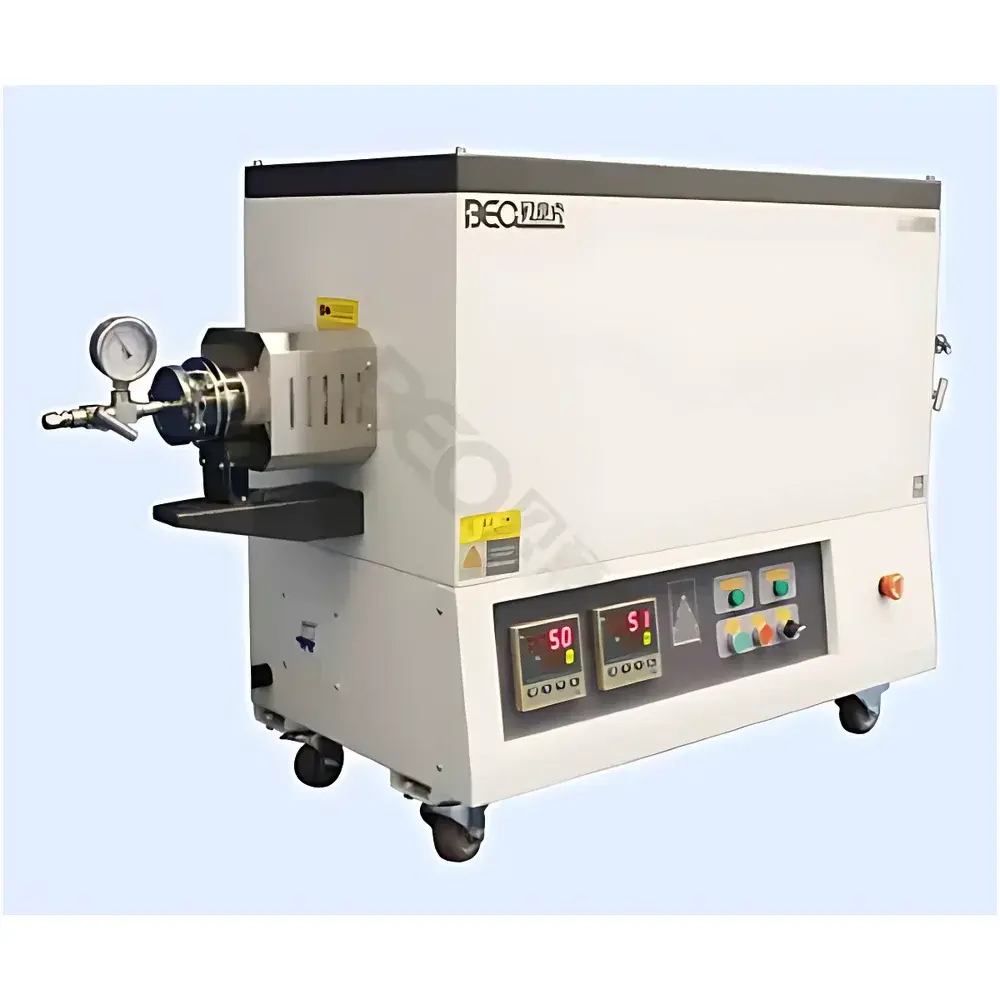
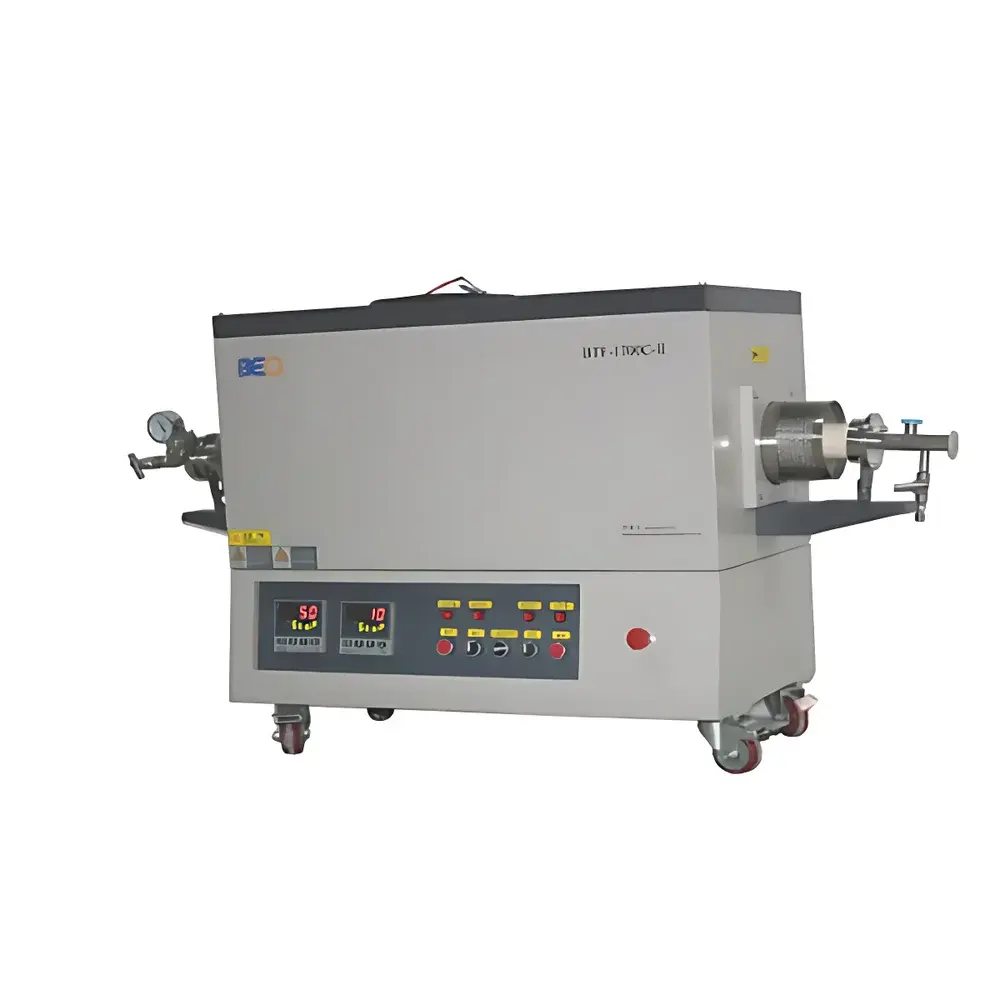
BEQ BTF-1700C-II Dual-Zone High-Temperature Tube Furnace
| Brand | BEQ |
|---|---|
| Origin | Anhui, China |
| Manufacturer Type | Authorized Distributor |
| Product Category | Domestic |
| Model | 1700°C Dual-Zone High-Temperature Tube Furnace |
| Temperature Range | Up to 1700°C |
| Temperature Uniformity | ±1°C (at setpoint, within 100 mm central zone) |
| Maximum Power | 11 kW |
| Heating Rate | ≤10°C/min below 1200°C, ≤5°C/min from 1200–1500°C, ≤2°C/min above 1500°C |
| Heating Element | Silicon Molybdenum (MoSi₂) Rods |
| Control System | Fuzzy PID with Auto-Tuning, 30-Stage Programmable Ramp/Soak Profile, Over-Temperature & Thermocouple Break Protection |
| Tube Dimensions | Φ60 mm × 1000 mm (ID × Length) |
| Chamber Lining | High-Purity Al₂O₃ Ceramic Tube with US-Imported High-Temperature Aluminum Oxide Coating |
| Cooling | Dual-Layer Air-Cooled Steel Housing |
| Structural Support | Integrated Flange Mounting Bracket for Load Distribution |
Overview
The BEQ BTF-1700C-II is a dual-zone high-temperature tube furnace engineered for precise thermal processing in materials science, solid-state chemistry, and advanced ceramics research. Designed around the fundamental principle of resistive heating via silicon molybdenum (MoSi₂) elements, it delivers stable, repeatable temperature profiles across two independently controlled axial zones—enabling gradient annealing, zone refining, and controlled atmosphere synthesis (e.g., CVD, carburization, nitridation). Its operational envelope extends to 1700°C, with thermal stability maintained at ±1°C under steady-state conditions within a 100 mm central uniformity zone. The furnace employs a high-purity alumina (Al₂O₃) reaction tube coated with a proprietary US-sourced high-emissivity aluminum oxide layer, which enhances radiative heat transfer efficiency and mitigates surface degradation during prolonged exposure to oxidizing or inert atmospheres.
Key Features
- Dual independent temperature zones with separate MoSi₂ heating elements and K-type thermocouples, allowing simultaneous or differential thermal profiles (e.g., hot-zone/isothermal zone + cooler inlet/outlet zone).
- Fuzzy PID control algorithm with auto-tuning capability ensures rapid convergence to setpoints and robust disturbance rejection—critical for multi-step thermal protocols involving ramp-hold-cool cycles.
- 30-segment programmable controller supports complex thermal schedules, including dwell times, rate-limited ramps, and conditional logic triggers (e.g., initiate gas purge upon reaching 300°C).
- Robust dual-layer stainless steel housing integrated with forced-air cooling channels maintains external shell temperature below 60°C at maximum operating temperature—reducing lab ambient heat load and improving operator safety.
- Flange-mounted support bracket system distributes mechanical load away from the quartz or alumina tube, minimizing stress-induced deformation or seal failure during repeated thermal cycling.
- Over-temperature cutoff and thermocouple break detection provide hardware-level fail-safe protection compliant with IEC 61000-4-2 ESD immunity and EN 60519-1 safety standards for industrial heating equipment.
Sample Compatibility & Compliance
The Φ60 mm × 1000 mm high-purity alumina tube accommodates standard ceramic crucibles, graphite boats, and custom sample holders up to 55 mm OD. It is compatible with inert (Ar, N₂), reducing (H₂/N₂ mixtures), and vacuum environments (down to 10⁻³ mbar with optional mechanical pump). The furnace meets structural and electrical safety requirements per UL 61010-1 and GB/T 13870.1–2013 (equivalent to IEC 60479-1) for laboratory electrical equipment. Its temperature calibration traceability aligns with ISO/IEC 17025–accredited practices when used with NIST-traceable reference thermocouples and periodic verification procedures.
Software & Data Management
The embedded controller logs real-time temperature, power draw, and alarm status to internal non-volatile memory (retains ≥10,000 data points). Optional RS485 Modbus RTU interface enables integration into centralized LabVIEW, MATLAB, or SCADA systems for automated data acquisition and remote monitoring. All thermal profiles and event logs support CSV export for post-processing in Excel or statistical analysis tools. Audit trail functionality—including user ID, timestamp, parameter change history, and alarm acknowledgments—is available in compliance-ready configurations aligned with FDA 21 CFR Part 11 and GLP documentation requirements.
Applications
- Synthesis of transition metal oxides (e.g., LiCoO₂, Ni-rich NMC cathodes) under controlled oxygen partial pressure.
- Graphitization and thermal reduction of carbon-based precursors (e.g., GO → rGO, MOFs → porous carbons).
- High-temperature sintering of YSZ electrolytes and SOFC anode/cathode composites.
- Thermal annealing of thin-film substrates (SiC, sapphire, quartz) prior to epitaxial growth.
- Calibration of thermocouples and radiation pyrometers against fixed-point references (e.g., Co-C, Pd-C).
- Long-term aging studies of refractory alloys and ceramic matrix composites under isothermal stress.
FAQ
What atmosphere compatibility does the BTF-1700C-II support?
It operates reliably under high-purity argon, nitrogen, hydrogen-containing mixtures (≤5% H₂), and vacuum down to 10⁻³ mbar with appropriate pumping and sealing accessories.
Is the alumina tube included with the furnace?
Yes—the furnace ships with a single Φ60 mm × 1000 mm high-purity Al₂O₃ tube pre-coated with the US-imported high-emissivity aluminum oxide layer.
Can the two zones be operated at different temperatures simultaneously?
Yes—each zone has independent PID control, thermocouple feedback, and programmable setpoints, enabling thermal gradients up to 300°C between zones.
What maintenance is required for the MoSi₂ heating elements?
No routine replacement is needed under normal operation; however, periodic visual inspection for oxidation spalling and resistance drift (≥15% increase indicates end-of-life) is recommended every 200 operating hours.
Does the system support third-party software integration?
Yes—via RS485 Modbus RTU, it integrates with LabVIEW, Python (PyModbus), and commercial MES/LIMS platforms using standard register mapping documentation provided with the unit.



