
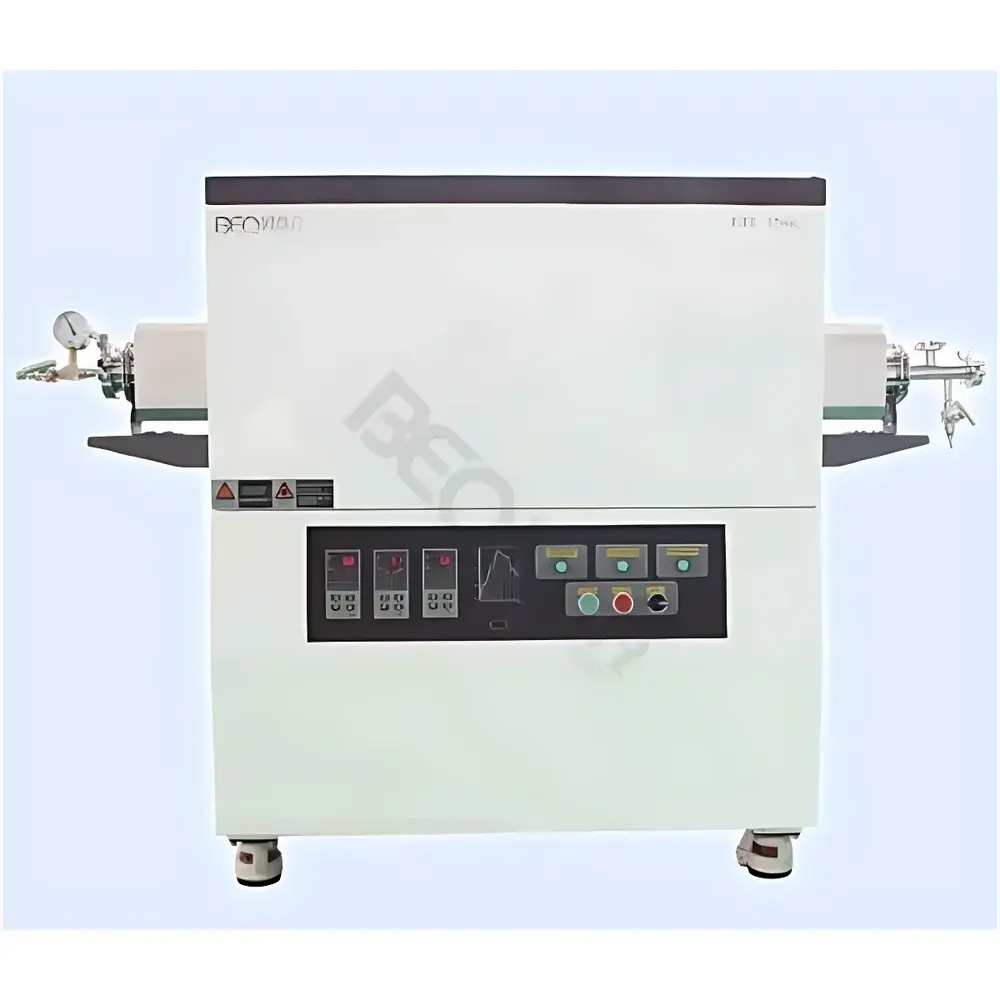
BEQ BTF-1700C-III Triple-Zone High-Temperature Tube Furnace
| Brand | BEQ |
|---|---|
| Origin | Anhui, China |
| Model | BTF-1700C-III |
| Max Temperature | 1700 °C |
| Temperature Uniformity | ±1 °C |
| Max Power | 13 kW |
| Heating Rate | ≤10 °C/min (≤1200 °C), ≤5 °C/min (1200–1500 °C), ≤2 °C/min (>1500 °C) |
| Heating Element | Silicon Molybdenum (MoSi₂) Rods |
| Control System | Fuzzy PID with Auto-Tuning, 30-Stage Programmable Ramp/Soak, Over-Temperature & Thermocouple Break Protection |
| Tube Dimensions | Φ60 mm × 1000 mm (ID × Length) |
| Chamber Lining | High-Purity Al₂O₃ Ceramic Tube with US-Imported High-Temperature Alumina Coating |
| Cooling | Dual-Layer Air-Cooled Shell Structure |
| Structural Support | Integrated Flange Mounting Bracket for Load Distribution |
Overview
The BEQ BTF-1700C-III is a precision-engineered triple-zone high-temperature tube furnace designed for demanding thermal processing applications in materials science, solid-state chemistry, and advanced ceramics research. Unlike single- or dual-zone configurations, its independently controlled three heating zones—each equipped with silicon molybdenum (MoSi₂) heating elements—enable precise axial temperature profiling across the full 1000 mm tube length. This architecture supports gradient thermal treatments such as zone melting, controlled crystal growth, and multi-step annealing protocols under inert, reducing, or vacuum atmospheres (compatible with standard quartz or high-purity alumina tubes). The furnace operates on fundamental resistive heating principles, where MoSi₂ rods generate radiant and convective heat within a high-density alumina fiber insulation matrix, achieving stable operation at 1700 °C with minimal thermal drift. Its design prioritizes long-term dimensional stability and reproducibility—critical for GLP-compliant process development and ISO 17025-accredited laboratory workflows.
Key Features
- Triple independent heating zones with separate thermocouple feedback loops and dedicated PID controllers ensure decoupled thermal management along the tube axis.
- High-purity α-alumina (99.8% Al₂O₃) tube liner coated with proprietary US-sourced high-emissivity alumina ceramic enhances radiative efficiency and extends service life beyond 2000 operational hours at 1600 °C.
- Dual-layer stainless steel shell with integrated forced-air cooling channels maintains external surface temperature below 60 °C during continuous 1700 °C operation—reducing ambient heat load and improving lab safety compliance.
- Fuzzy logic PID algorithm with auto-tuning capability adapts to load mass, gas flow rate, and insulation aging, maintaining ±1 °C setpoint accuracy across 30 programmable ramp/soak segments.
- Robust mechanical design includes a reinforced flange support bracket system that transfers axial and radial loads away from the tube seal interface—minimizing stress-induced microfractures and ensuring repeatable vacuum integrity (<1×10⁻³ mbar).
- Comprehensive safety architecture includes dual-stage over-temperature cutoff (hardware + software), real-time thermocouple continuity monitoring, and automatic power cut-off upon sensor failure.
Sample Compatibility & Compliance
The BTF-1700C-III accommodates cylindrical samples up to 58 mm in diameter and 900 mm in length within its Φ60 mm internal bore. It supports standard ASTM E1113 and ISO 8501-1 sample holders, crucibles (Pt, Al₂O₃, graphite), and gas inlet/outlet configurations for dynamic atmosphere control (e.g., Ar/H₂/N₂ mixtures via mass flow controllers). All electrical components meet IEC 61000-6-3 EMC emission standards and UL 61010-1 safety requirements for laboratory equipment. The control firmware logs timestamped temperature profiles with audit-trail capability—fully compatible with FDA 21 CFR Part 11 data integrity requirements when paired with validated PC-based acquisition software.
Software & Data Management
The furnace integrates seamlessly with BEQ’s optional LabFurnace Control Suite (v4.2+), a Windows-based application supporting remote operation, real-time graphing, and CSV export of full thermocouple traces (T1–T3, chamber, and ambient). All parameter changes are recorded with user ID, timestamp, and reason code—enabling full traceability for GMP batch records. Data files include embedded MD5 checksums and digital signature verification to prevent tampering. Optional OPC UA server module enables integration into centralized MES or SCADA platforms for Industry 4.0-ready lab automation.
Applications
- Synthesis and annealing of transition metal oxides (e.g., LiCoO₂, NMC cathodes) under controlled oxygen partial pressure.
- Graphitization of carbon precursors and high-temperature stabilization of SiC and BN composites.
- Thermal calibration of reference materials per ASTM E1545 and ISO/IEC 17025 calibration procedures.
- High-temperature sintering of yttria-stabilized zirconia (YSZ) electrolytes for SOFC development.
- Controlled oxidation kinetics studies using thermogravimetric coupling (requires optional TGA interface kit).
- Preparation of ultra-high-purity single crystals via vertical Bridgman techniques with axial thermal gradient tuning.
FAQ
What tube materials are compatible with the BTF-1700C-III at 1700 °C?
High-purity fused quartz is limited to 1100 °C; for full-range operation, use recrystallized alumina (Al₂O₃) or molybdenum disilicide (MoSi₂)-coated alumina tubes rated to 1800 °C.
Can the furnace be operated under vacuum or reactive gas environments?
Yes—standard configuration includes CF-63 vacuum flanges and dual-gas inlet ports; optional turbo-molecular pump integration supports pressures down to 1×10⁻⁵ mbar.
Is the 30-stage program stored locally if the PC connection is lost?
Yes—the embedded controller retains all programs and runtime logs in non-volatile flash memory, enabling autonomous execution without host PC dependency.
How often does the furnace require recalibration per ISO/IEC 17025 guidelines?
Annual verification against NIST-traceable reference thermocouples is recommended; BEQ provides certified calibration certificates (ISO 17025-accredited third-party available upon request).
What maintenance intervals are specified for MoSi₂ heating elements?
Under typical cycling conditions (≤3 cycles/day), MoSi₂ rods maintain >95% resistance stability for ≥18 months; visual inspection and resistance measurement are advised every 500 h of operation above 1500 °C.



