
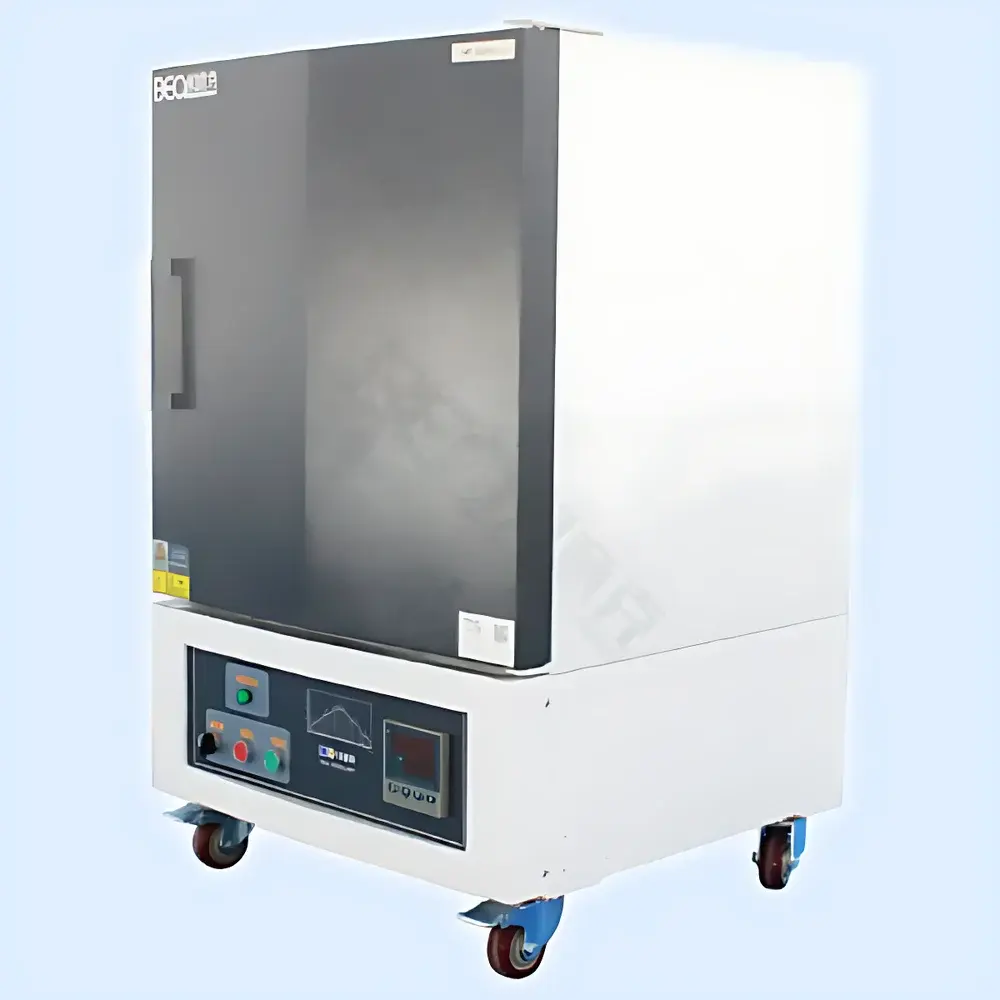
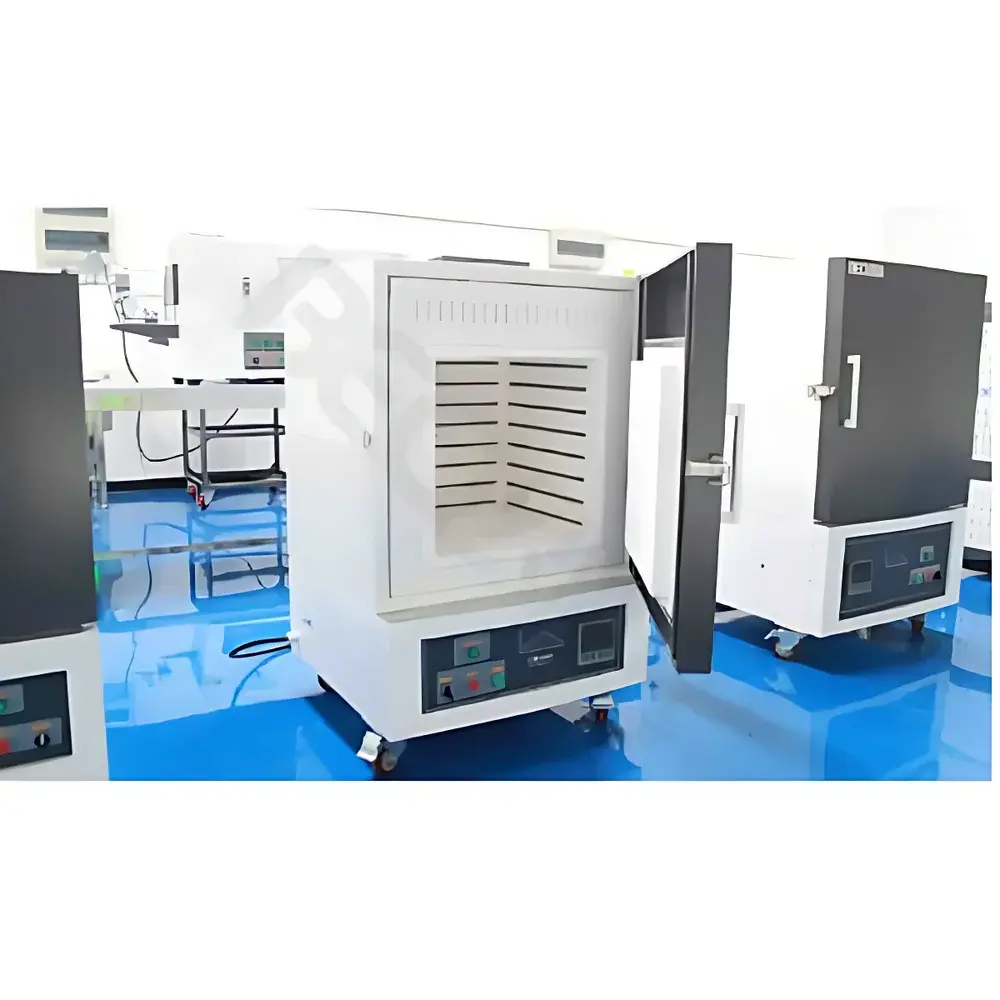
BEQ MF-1200C-L 1200°C 64L Benchtop Muffle Furnace
| Brand | BEQ |
|---|---|
| Origin | Anhui, China |
| Manufacturer Type | Authorized Distributor |
| Country of Origin | China |
| Model | MF-1200C-L |
| Instrument Type | Box-Type Muffle Furnace |
| Max Temperature | 1200°C |
| Operating Temperature Range | ≤1100°C |
| Temperature Control Accuracy | ±1°C |
| Rated Power | 4 kW (Note: 6 kW listed in description refers to peak/derated capacity |
| Heating Rate (to max temp) | 5–20°C/min |
| Heating Element | Kanthal A1 Resistance Wire |
| Chamber Dimensions | 250 × 300 × 250 mm (L×W×H) |
| Nominal Volume | 64 L |
| External Dimensions | 670 × 630 × 1010 mm |
| Net Weight | 143 kg |
| Gross Weight | 172 kg |
| Voltage | AC 208–240 V, Single Phase, 50/60 Hz |
| Thermocouple | Type K |
| Control System | 30-Stage Programmable PID with Auto-Tuning, Over-Temperature & Thermocouple Break Protection |
| Insulation | Multi-Layer Alumina Fiber (Vacuum-Formed), High-Purity Al₂O₃ Liner |
| Cooling | Dual-Wall Air-Cooled Jacket with Integrated Air Channel |
| Safety Certification | CE-compliant |
| Optional Certifications | UL 61010 (TUV or CSA, fee-based) |
Overview
The BEQ MF-1200C-L is a high-performance benchtop muffle furnace engineered for precise thermal processing in academic research laboratories, materials science departments, and quality control environments. It operates on the principle of resistive heating via Kanthal A1 alloy resistance wire, enclosed within a high-purity alumina (Al₂O₃) ceramic chamber that ensures minimal thermal mass, low outgassing, and exceptional chemical inertness up to 1200°C. The furnace is designed for open-atmosphere applications—such as ashing, calcination, sintering, and heat treatment of ceramics, metals, and polymers—but is not rated for sealed or pressurized operation. Its dual-wall air-cooled architecture maintains external surface temperatures below 60°C even at maximum operating temperature, enhancing operator safety and reducing ambient heat load. Unlike conventional brick-lined furnaces, the MF-1200C-L employs vacuum-formed alumina fiber insulation, delivering superior thermal efficiency—up to 30% lower energy consumption compared to standard refractory designs—while maintaining compact footprint and structural rigidity.
Key Features
- High-efficiency multi-layer insulation system combining vacuum-formed alumina fiber and high-purity Al₂O₃ liner for minimized thermal loss and rapid cooldown cycles
- Dual-wall air-cooled jacket with integrated airflow channel, ensuring shell and electronics compartment remain ≤60°C during continuous 1200°C operation
- Intelligent 30-segment programmable PID controller with auto-tuning capability, enabling reproducible thermal profiles across repeated runs
- Robust mechanical design featuring spring-loaded door latch mechanism to accommodate thermal expansion and maintain consistent sealing integrity despite repeated cycling
- K-type thermocouple with digital cold-junction compensation and real-time over-temperature cutoff (±1°C accuracy at setpoint)
- Compliance-ready architecture: CE-marked; optional third-party certification available to UL 61010-1 (TUV or CSA) for labs requiring formal electrical safety documentation
Sample Compatibility & Compliance
The MF-1200C-L is intended for use with solid, non-volatile samples placed inside compatible crucibles (e.g., alumina, quartz, or silicon carbide). Direct placement of samples on the chamber floor is strongly discouraged due to risk of contamination and localized thermal stress. The furnace is explicitly not rated for use with flammable, toxic, corrosive, or explosive atmospheres—including hydrogen, carbon monoxide, or organic vapors—without external gas-handling infrastructure and engineering controls. Inert or oxidizing gas purging (e.g., N₂, Ar, O₂) is permissible using optional inlet fittings, provided gas flow rates and pressure differentials remain within atmospheric venting limits. All operational protocols must adhere to local occupational health and safety regulations (e.g., OSHA 1910.1200, EU CLP Regulation). The unit meets general laboratory equipment requirements under ISO/IEC 17025 for thermal stability verification and supports GLP-compliant recordkeeping when integrated with validated data logging systems.
Software & Data Management
While the MF-1200C-L operates via its built-in front-panel interface, it supports RS485 Modbus RTU communication for integration into centralized lab management platforms. Users may log temperature profiles, alarm events, and program execution status using third-party SCADA or LIMS-compatible software. The controller retains full audit trail functionality—including timestamped start/stop commands, parameter changes, and fault codes—for traceability in regulated environments. Though not natively 21 CFR Part 11 compliant, the system can be deployed within a validated IT infrastructure where electronic signatures, access controls, and backup protocols are externally enforced. Firmware updates are performed via USB port, with version history and checksum validation supported.
Applications
- Ash content determination per ASTM D3174 and ISO 1171 in coal, biomass, and food testing labs
- Pre-sintering and binder burnout of ceramic green bodies prior to final firing
- Thermal gravimetric analysis (TGA) sample preparation and reference material conditioning
- Heat treatment of metal alloys and intermetallic compounds under controlled oxidative or inert conditions
- Residue quantification in pharmaceutical excipient purity assays (USP & EP methods)
- Calibration of thermocouples and RTDs using fixed-point reference materials (e.g., Al, Zn, Sn)
FAQ
Can this furnace be used under vacuum or with reactive gases?
No. The chamber is not gas-tight and lacks pressure-rated seals or exhaust scrubbing. Only atmospheric-pressure inert or oxidizing gas purging is permitted with appropriate inlet/outlet fittings.
What maintenance is required to sustain ±1°C control accuracy?
Annual verification of thermocouple calibration against a NIST-traceable reference source is recommended. Visual inspection of alumina fiber integrity and cleaning of air intake vents should occur every 200 operating hours.
Is the 64L volume usable for uniform heating across the entire chamber?
Yes—the furnace achieves ±5°C radial and axial uniformity within the central 70% of the chamber (per ASTM E220-19 thermal mapping protocol) when operated between 800–1100°C.
Why does the chamber develop fine surface cracks after repeated cycling?
Microcracking in the high-purity alumina liner is a normal consequence of thermal expansion mismatch and does not impair performance. Cracks may be sealed with commercially available alumina-based refractory coating without affecting emissivity or thermal response.
Does the unit include data export capability for regulatory audits?
Raw temperature logs and event timestamps are accessible via RS485; however, full 21 CFR Part 11 compliance requires integration with validated third-party data acquisition software and administrative SOPs.



