
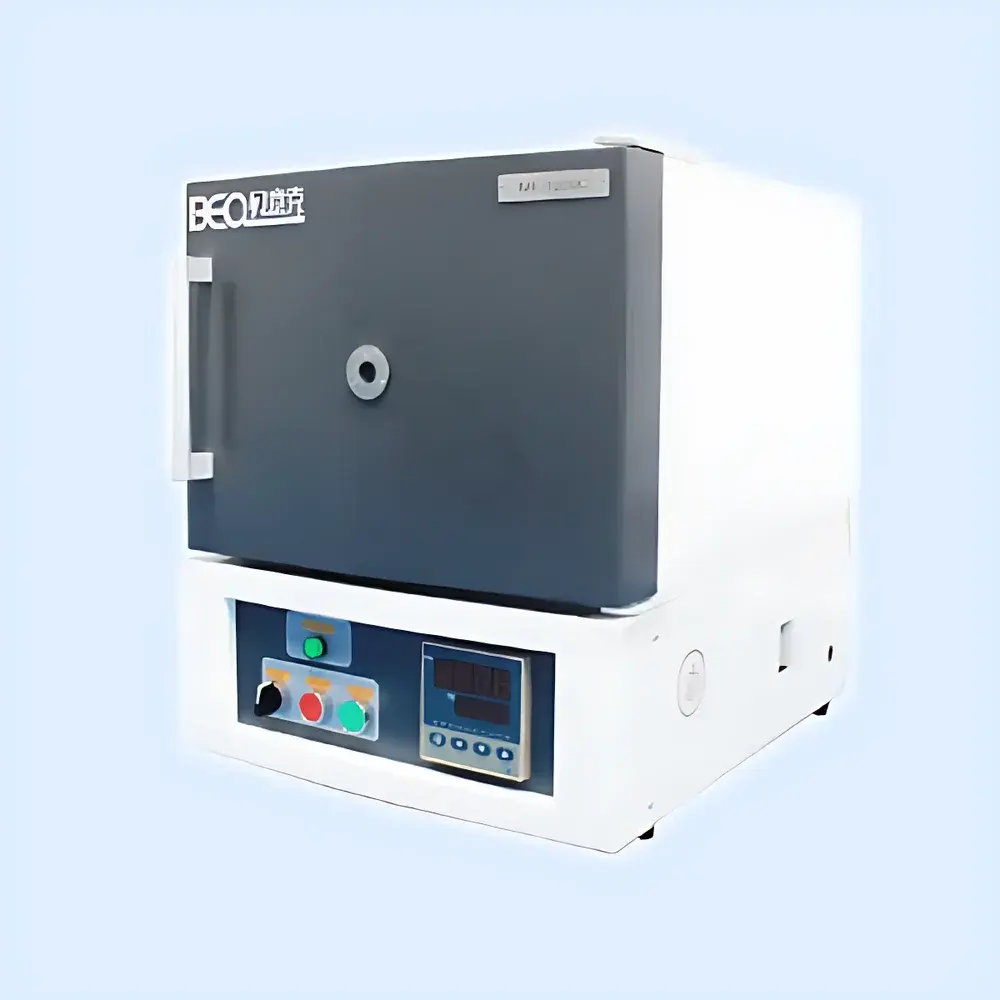
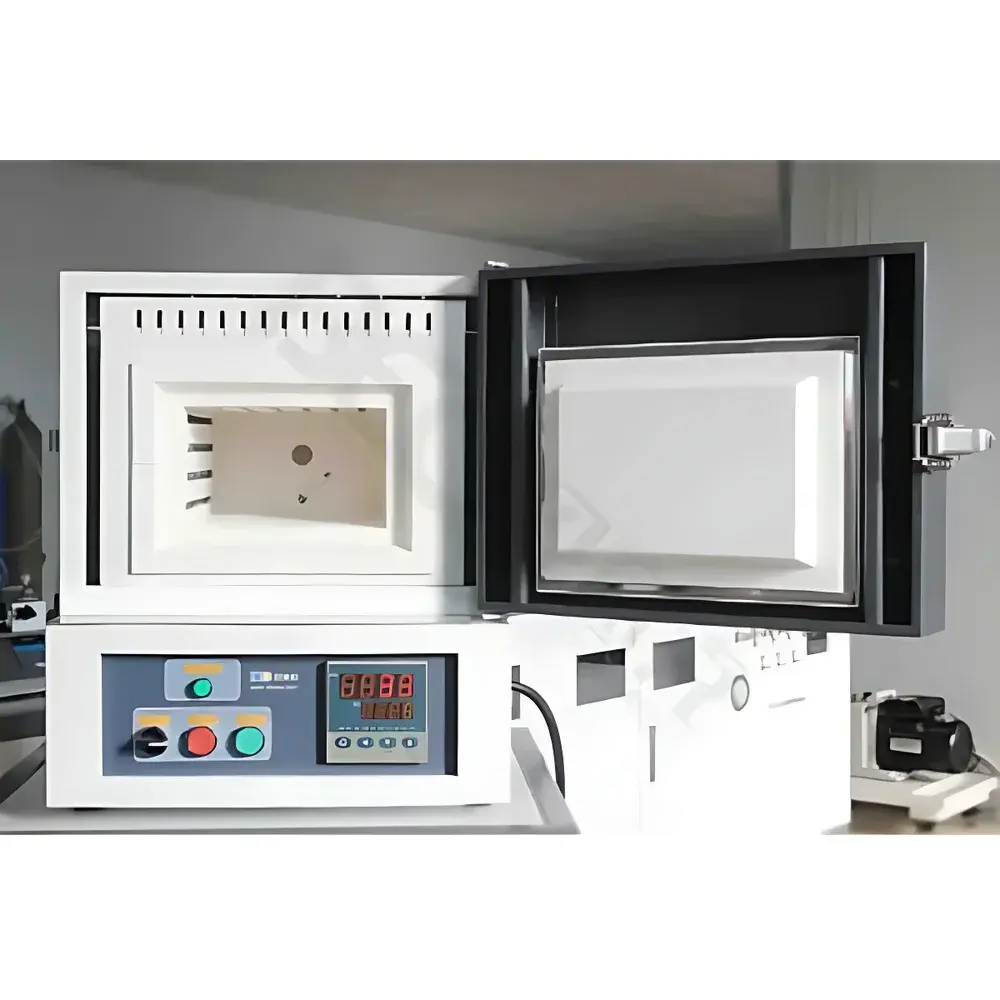
BEQ MF-1200C 1200°C High-Performance Box-Type Muffle Furnace
| Brand | BEQ |
|---|---|
| Origin | Anhui, China |
| Manufacturer Type | Authorized Distributor |
| Country of Origin | China |
| Model | MF-1200C |
| Instrument Type | Box-Type Muffle Furnace |
| Max. Operating Temperature | 1200°C |
| Continuous Service Temperature | 1100°C |
| Temperature Uniformity | ±2°C (within 80×80×80 mm zone at 1100°C) |
| Control Accuracy | ±1°C |
| Max. Heating Rate | 30°C/min |
| Rated Power | 4 kW |
| Internal Chamber Dimensions | 300 × 200 × 120 mm (7.2 L) |
| External Dimensions | 435 × 550 × 540 mm |
| Net Weight | 53 kg |
| Heating Element | Molybdenum-Doped Alloy Resistance Wire |
| Insulation Material | Vacuum-Formed High-Purity Alumina Fiber |
| Cooling System | Dual-Layer Air-Cooled Shell |
| Safety Features | Door-Interlocked Power Cut-off, Dual Mechanical Latches, Over-Temperature & Thermocouple Break Alarms |
| Controller | 30-Stage Programmable PID with Auto-Tuning, RS485 Communication Port (optional LabVIEW integration), Touchscreen Interface (optional upgrade) |
| Certifications | CE Compliant |
| Warranty | 12 months full unit coverage |
Overview
The BEQ MF-1200C is a precision-engineered box-type muffle furnace designed for demanding high-temperature thermal processing in academic laboratories, materials research centers, and industrial quality assurance environments. It operates on the principle of resistive heating via molybdenum-doped alloy wire elements embedded within a monolithic, vacuum-formed high-purity alumina fiber insulation chamber. This architecture enables stable, repeatable operation up to 1200°C—suitable for sintering ceramic compacts, annealing metallic alloys, ashing organic samples per ASTM D3174 or ISO 1171, and conducting thermal stability assessments under controlled atmospheric conditions. The furnace maintains a continuous service temperature of 1100°C with exceptional thermal uniformity (±2°C across an 80×80×80 mm effective hot zone), ensuring reproducible material transformations critical for GLP-compliant testing protocols.
Key Features
- Monolithic alumina fiber furnace chamber—vacuum-formed for structural integrity, low thermal mass, and rapid thermal response
- Dual-layer air-cooled outer shell design limits external surface temperature to ≤60°C even at maximum operating temperature, enhancing operator safety and reducing ambient heat load
- 30-stage programmable PID controller with auto-tuning capability supports complex thermal profiles including ramp-hold-cool sequences, essential for process development and standard-compliant heat treatments
- Integrated mechanical dual-latch door system and door-activated power interlock meet IEC 61000-6-2 and EN 61000-6-4 requirements for electrical safety and mechanical hazard mitigation
- Φ17 mm fused quartz viewport enables real-time visual monitoring of sample behavior without compromising thermal integrity or atmosphere control
- Optional gas inlet ports (standard NPT 1/4″) allow controlled introduction of inert (N₂, Ar), oxidizing (air, O₂), or reducing (H₂/N₂ mixtures) atmospheres—compatible with ASTM E831 and ISO 11358 thermal analysis workflows
- RS485 communication interface supports integration into centralized lab management systems; optional LabVIEW-based software enables remote temperature curve editing, recipe storage, and time-stamped data logging with audit trail functionality
Sample Compatibility & Compliance
The MF-1200C accommodates standard crucibles (alumina, quartz, silicon carbide) and sample boats up to 300×200×120 mm internal volume. Its non-vacuum-rated chamber prohibits use with explosive, highly toxic, or corrosive gases (e.g., Cl₂, HF, NH₃); operation with such media voids warranty and violates CE safety directives. The furnace complies with CE marking requirements under the Low Voltage Directive (2014/35/EU) and Electromagnetic Compatibility Directive (2014/30/EU). While not intrinsically rated for hazardous locations, its design aligns with general laboratory safety best practices outlined in ANSI Z9.5 and ISO/IEC 17025 Annex A.3 for equipment used in accredited testing laboratories.
Software & Data Management
The standard controller provides local setpoint adjustment, real-time temperature display, and alarm history. For regulated environments, the optional RS485-enabled LabVIEW driver delivers FDA 21 CFR Part 11–compliant features: user-level access control, electronic signature support, immutable audit trails for all parameter changes, and encrypted export of temperature vs. time datasets in CSV or TDMS format. All thermal cycles are timestamped and associated with operator ID and batch metadata—facilitating traceability in GMP or ISO 13485 quality systems. Touchscreen upgrades include multi-language UI, trend graph overlays, and USB export of calibration logs and maintenance records.
Applications
- Sintering of oxide ceramics (Al₂O₃, ZrO₂), ferrites, and battery cathode precursors (LiCoO₂, NMC)
- Heat treatment of stainless steels, tool steels, and titanium alloys per ASTM A967 and AMS 2750E pyrometry requirements
- Residue quantification in pharmaceutical excipients (USP ) and polymer additives (ISO 3451)
- Thermal gravimetric pre-conditioning prior to XRD or SEM analysis
- Calibration reference oven for secondary thermocouple verification (per ISO/IEC 17025 Clause 6.4.10)
- Accelerated aging studies of electronic encapsulants and composite matrix resins
FAQ
What is the recommended cooling rate to ensure furnace longevity?
Maximum recommended cooling rate is 10°C/min. Rapid quenching induces thermal shock in the alumina fiber chamber and may accelerate microcracking.
Can this furnace be used under vacuum or reduced pressure?
No. The MF-1200C lacks vacuum sealing capability and is not rated for sub-atmospheric operation. Use only at ambient or positively pressurized inert/oxidizing gas conditions.
Is the thermocouple included with the unit calibrated to NIST-traceable standards?
The integrated K-type thermocouple is factory-calibrated; users must perform periodic verification using a NIST-traceable reference thermometer per ISO/IEC 17025 Section 6.4.6.
What maintenance is required for the alumina fiber chamber?
Surface microcracks are normal after extended cycling. They may be sealed with BEQ-recommended alumina-based refractory coating (Cat. No. AL-SEAL-100) without affecting thermal performance or emissivity.
Does the CE marking indicate compliance with RoHS or REACH?
CE marking covers electromagnetic compatibility and electrical safety. RoHS and REACH compliance documentation is available upon request and applies to all non-heating structural components.



