
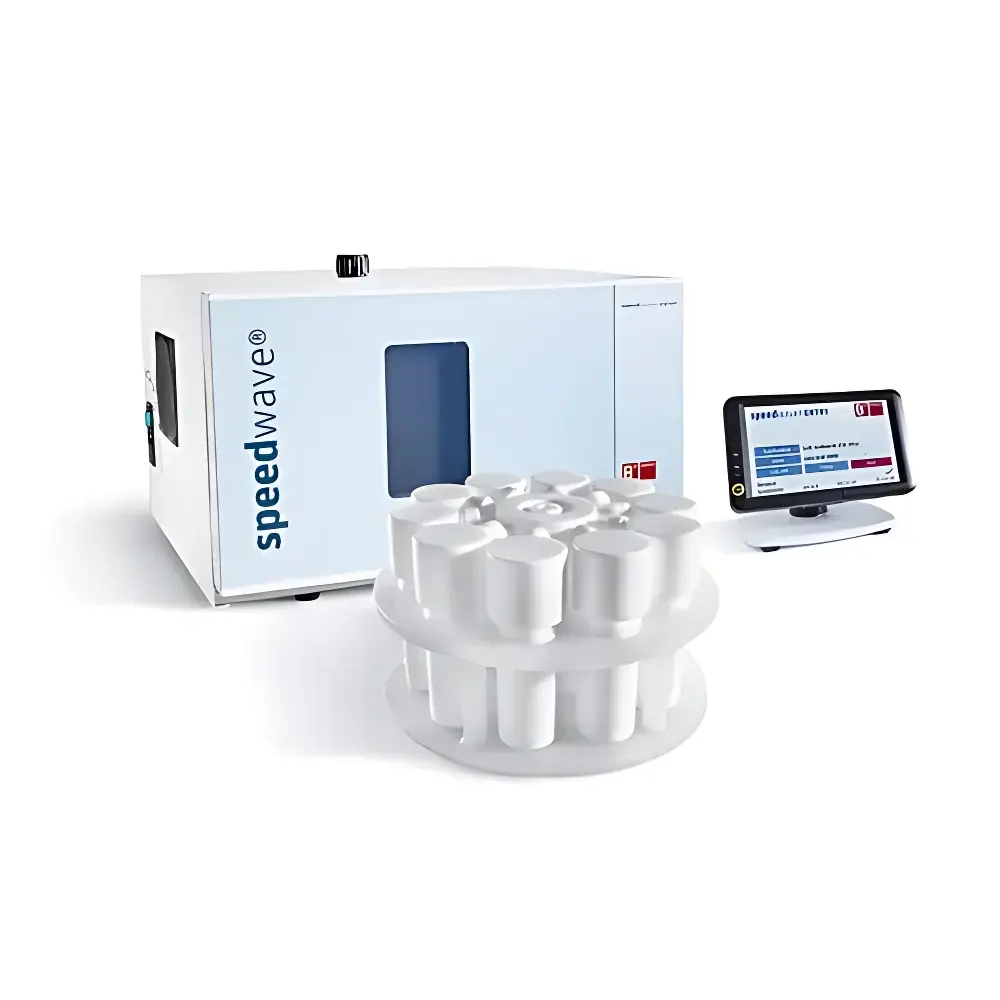
Berghof SW-Entry Microwave Digestion System
| Brand | Berghof |
|---|---|
| Origin | Germany |
| Model | SW-Entry |
| Cavity Class | Industrial-grade |
| Sample Capacity | 24 vessels |
| Microwave Source | Single Magnetron |
| Max Temperature | 230 °C |
| Max Pressure | 75 bar |
Overview
The Berghof SW-Entry Microwave Digestion System is an industrial-grade, single-magnetron benchtop instrument engineered for reproducible, high-throughput sample preparation in trace elemental analysis workflows. Based on closed-vessel microwave-assisted acid digestion—a thermally accelerated process where microwave energy directly couples with polar molecules (e.g., HNO₃, HCl, HF) to generate rapid, uniform heating—the SW-Entry enables complete matrix decomposition under controlled temperature and pressure conditions. Designed for laboratories performing routine digestions prior to atomic absorption spectroscopy (AAS), inductively coupled plasma optical emission spectrometry (ICP-OES), inductively coupled plasma mass spectrometry (ICP-MS), and electrochemical analysis, the system delivers consistent recoveries of analytes—including refractory elements such as Cr, Ni, Pb, Cd, As, and rare earth elements—across diverse sample matrices including soils, sediments, biological tissues, polymers, pharmaceuticals, and foodstuffs. Its compact footprint, intuitive interface, and robust safety architecture make it suitable for QC/QA labs operating under GLP or ISO/IEC 17025 frameworks.
Key Features
- Industrial-grade stainless-steel cavity with reinforced door interlock and multi-point pressure/temperature monitoring for continuous real-time feedback during digestion cycles.
- Single magnetron (2450 MHz) with dynamic power modulation (0–1600 W) ensuring stable energy delivery without hot-spot formation or thermal runaway.
- Proprietary contactless fiber-optic temperature sensing integrated into each vessel position—eliminating the need for reference vessels while maintaining ±1.5 °C accuracy across the full 30–230 °C range.
- Integrated active fume extraction system compliant with EN 14175-3 laboratory hood standards; captures volatile acidic byproducts (e.g., NOₓ, Cl₂, SiF₄) before they reach internal electronics or operator breathing zone.
- LED-lit cavity with wide-angle viewing window and optional camera module (sold separately) for visual verification of vessel integrity and reaction progress.
- Tool-free, one-handed vessel loading/unloading mechanism; sealed rotor accommodates up to 24 PTFE-TFM or quartz digestion vessels (standard 55 mL capacity).
Sample Compatibility & Compliance
The SW-Entry supports digestion protocols aligned with ASTM D5511, EPA Method 3052, ISO 11885, and USP for heavy metal testing. Vessels are chemically resistant to concentrated nitric, hydrochloric, hydrofluoric, and perchloric acids—enabling full digestion of silicate-rich geological samples and high-ash biological materials. All pressure-rated components meet PED 2014/68/EU requirements, and the system includes dual redundant pressure relief mechanisms (mechanical rupture discs + software-controlled venting). Full audit trail logging—including user ID, method name, timestamp, setpoints, actual T/P profiles, and error codes—is available to support FDA 21 CFR Part 11 compliance when paired with validated software configurations.
Software & Data Management
The SW-Entry is operated via a dedicated 7-inch capacitive touchscreen interface running Berghof’s DigEST v3.2 firmware. Preloaded methods include standardized protocols for environmental sludge (EPA 3051A), plant tissue (AOAC 999.10), and polymer ashing (ISO 11885 Annex B). Users may create, duplicate, and password-protect custom methods with up to 5 ramp-hold steps per program. All run data—including real-time T/P curves, power output history, and alarm events—are automatically saved in CSV and PDF formats with embedded digital signatures. Optional Ethernet connectivity enables remote monitoring, centralized method distribution, and integration into LIMS environments via OPC UA or Modbus TCP protocols.
Applications
- Environmental labs: Total metal determination in wastewater solids, fly ash, and contaminated soils per EPA SW-846 methods.
- Food & agriculture: Multi-element screening in cereals, dairy powders, and infant formula for regulatory compliance (EU No. 1881/2006, China GB 5009.268).
- Pharmaceutical QA: Residual catalyst quantification (e.g., Pd, Pt, Rh) in active pharmaceutical ingredients (APIs) following ICH Q2(R2) validation guidelines.
- Materials science: Digestion of battery cathode materials (NMC, LFP), catalysts, and ceramic composites for stoichiometric verification.
- Clinical research: Trace element profiling in serum, whole blood, and hair samples using ICP-MS with detection limits sub-pg/g.
FAQ
Does the SW-Entry require external cooling water or compressed air?
No—thermal management is fully passive via convection-cooled magnetron housing and cavity exhaust ducting; no auxiliary utilities are needed.
Can I use third-party digestion vessels with the SW-Entry rotor?
Only Berghof-certified vessels (TFM-PTFE, quartz, or composite variants) are supported; non-OEM vessels void pressure certification and invalidate warranty coverage.
Is method transfer from older Speedwave models possible?
Yes—DigEST v3.2 includes backward compatibility for method files from Speedwave Xpert and Speedwave Four systems, with automatic parameter scaling for power and hold times.
What maintenance intervals are recommended for routine operation?
Daily visual inspection of door seal integrity; quarterly calibration of fiber-optic sensors using NIST-traceable reference standards; annual preventive maintenance by Berghof-certified service engineers.
How does the system handle over-pressurization events during digestion?
Each vessel incorporates a dual-stage pressure release: first at 80 bar (mechanical disc burst), then secondary venting through the rotor’s integrated gas dispersion manifold into the fume extraction path—ensuring zero uncontrolled release into the lab environment.
Related Products



