
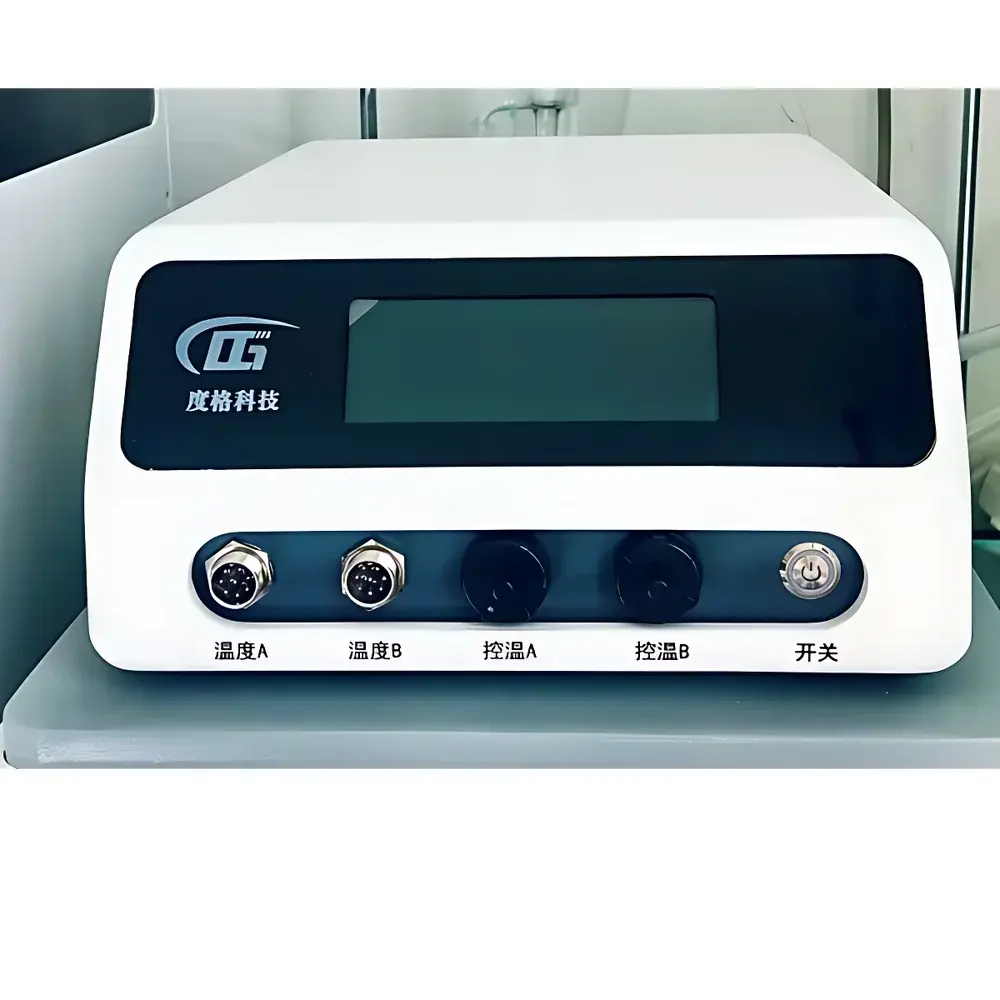
BesBerry BiCellTemp V1 Precision Cell Temperature Control System for Lithium Battery Testing
| Brand | BesBerry |
|---|---|
| Model | BiCellTemp V1 |
| Origin | Beijing, China |
| Dimensions (L×W×H) | 300 mm × 300 mm × 150 mm |
| Weight | 10 kg |
| Power Supply | 220 V / 50 Hz |
| Rated Power | 800 W |
| Temperature Control Range | Ambient −10 °C to Ambient +40 °C |
| Control Accuracy | ±0.2 °C |
| Temperature Resolution | 0.01 °C |
| Cooling Capability | Integrated thermoelectric (Peltier) and forced-air hybrid cooling |
| Heating/Cooling Auto-Switching | Yes |
| Multi-Point Temperature Monitoring | Yes (cell surface + ambient + internal chamber) |
| Real-Time Temperature Output | RS-485 / Modbus RTU protocol |
Overview
The BesBerry BiCellTemp V1 Precision Cell Temperature Control System is an engineered thermal management solution designed specifically for high-fidelity electrochemical testing of lithium-ion battery cells. Unlike conventional environmental chambers or passive thermal fixtures, the BiCellTemp V1 operates as a secondary, embedded precision temperature control module—installed inside standard large-volume climate chambers—to eliminate spatial thermal gradients and enable dynamic, closed-loop regulation of cell surface temperature. It employs a dual-mode thermal actuation architecture combining Peltier-based solid-state heating/cooling with intelligent forced-air convection, enabling rapid thermal response and stable setpoint maintenance during high-rate charge/discharge cycles. Its core measurement principle relies on real-time feedback from multiple calibrated PT100 sensors positioned at critical thermal interfaces: directly on the cell casing, adjacent to the electrode stack region, and within the local micro-chamber volume. This multi-sensor fusion strategy ensures that control is anchored to actual cell surface temperature—not ambient chamber air—thereby addressing a fundamental limitation in battery thermal validation: the decoupling between chamber setpoint and true electrochemical interface temperature.
Key Features
- Embedded micro-chamber design: Integrates seamlessly into existing environmental test chambers (e.g., ESPEC, Weiss, Binder), transforming them into high-resolution localized thermal control platforms.
- Closed-loop surface-temperature control: Uses PID algorithms with adaptive gain scheduling to maintain cell surface temperature within ±0.2 °C under dynamic load conditions (up to 5C discharge).
- Thermal inertia reduction: Achieves thermal equilibrium in 20–30 minutes—versus 60–120 minutes for conventional fixtures—enabling higher throughput in cycle-life and safety testing protocols.
- Active thermal suppression: Implements proprietary discharge-induced temperature rise mitigation logic, dynamically modulating cooling power in response to real-time dT/dt signals to stabilize cell temperature during pulse discharge events.
- Multi-point synchronized logging: Simultaneously records up to four independent temperature channels (cell surface, near-electrode zone, internal chamber air, reference ambient) at 1 Hz resolution with timestamped metadata.
- Industrial-grade communication interface: RS-485 port compliant with Modbus RTU protocol; supports integration with battery cyclers (e.g., Arbin, Bio-Logic, Neware) and LIMS via standard SCPI-like command sets.
Sample Compatibility & Compliance
The BiCellTemp V1 accommodates cylindrical (18650, 21700, 26650), prismatic (up to 200 mm × 150 mm), and pouch cells (with optional custom mounting plates). Its mechanical interface is compatible with standard 4-wire Kelvin probe fixtures and pressure application systems used in EV battery R&D. From a regulatory standpoint, the system supports audit-ready thermal validation workflows aligned with ISO 12405-3 (electric vehicle battery testing), IEC 62660-1 (performance testing), and UN 38.3 thermal preconditioning requirements. All temperature sensors are NIST-traceable and factory-calibrated per ISO/IEC 17025 procedures. Data logging complies with ALCOA+ principles when integrated with validated software environments supporting 21 CFR Part 11 electronic signatures and audit trails.
Software & Data Management
The BiCellTemp V1 operates autonomously but is fully controllable via its native Windows-based configuration utility (BiCellControl Suite), which provides real-time visualization of all sensor channels, manual override modes, and scriptable temperature ramp/soak profiles. Raw temperature data is exported in CSV and HDF5 formats, including embedded calibration coefficients and sensor ID metadata. For enterprise integration, the device supports OPC UA server mode (via optional firmware upgrade), enabling direct ingestion into PI System, Ignition SCADA, or MATLAB-based analysis pipelines. All firmware updates are digitally signed and delivered through secure HTTPS endpoints, ensuring integrity and version traceability across laboratory deployments.
Applications
- High-accuracy thermal characterization during HPPC (Hybrid Pulse Power Characterization) and EIS (Electrochemical Impedance Spectroscopy) testing.
- Accelerated calendar/cycle aging studies requiring strict thermal boundary control per ISO 18561 and SAE J2464 Annex C.
- Safety testing—including nail penetration, overcharge, and thermal runaway propagation—where precise pre-conditioning temperature is critical to reproducibility.
- Development and validation of thermal management algorithms for BMS firmware, using hardware-in-the-loop (HIL) thermal emulation.
- QC/QA verification of thermal interface material (TIM) performance under realistic cell-level loading conditions.
FAQ
Can the BiCellTemp V1 be used outside of a primary environmental chamber?
No—it is engineered exclusively as an embedded subsystem and requires external chamber infrastructure for macro-environmental control (e.g., humidity, base temperature range). Its operating envelope assumes stable chamber ambient conditions.
Does it support cryogenic or high-temperature operation beyond ±40 °C relative to ambient?
No—the thermal actuation system is optimized for the −10 °C to +40 °C offset range. Operation outside this window compromises control stability and sensor linearity.
Is calibration documentation provided with each unit?
Yes—each shipment includes a NIST-traceable calibration certificate covering all installed PT100 sensors and the internal reference thermometer, valid for 12 months from date of manufacture.
How is thermal crosstalk minimized between adjacent cells in multi-cell test configurations?
The BiCellTemp V1 is designed for single-cell thermal isolation. For multi-cell setups, users must deploy physically separated units or implement thermal shielding; shared micro-chambers are not supported.
What maintenance is required for long-term operational reliability?
Annual verification of sensor drift and Peltier module thermal resistance is recommended. No consumables or refrigerants are used; the system has no moving parts other than low-noise DC fans.







