
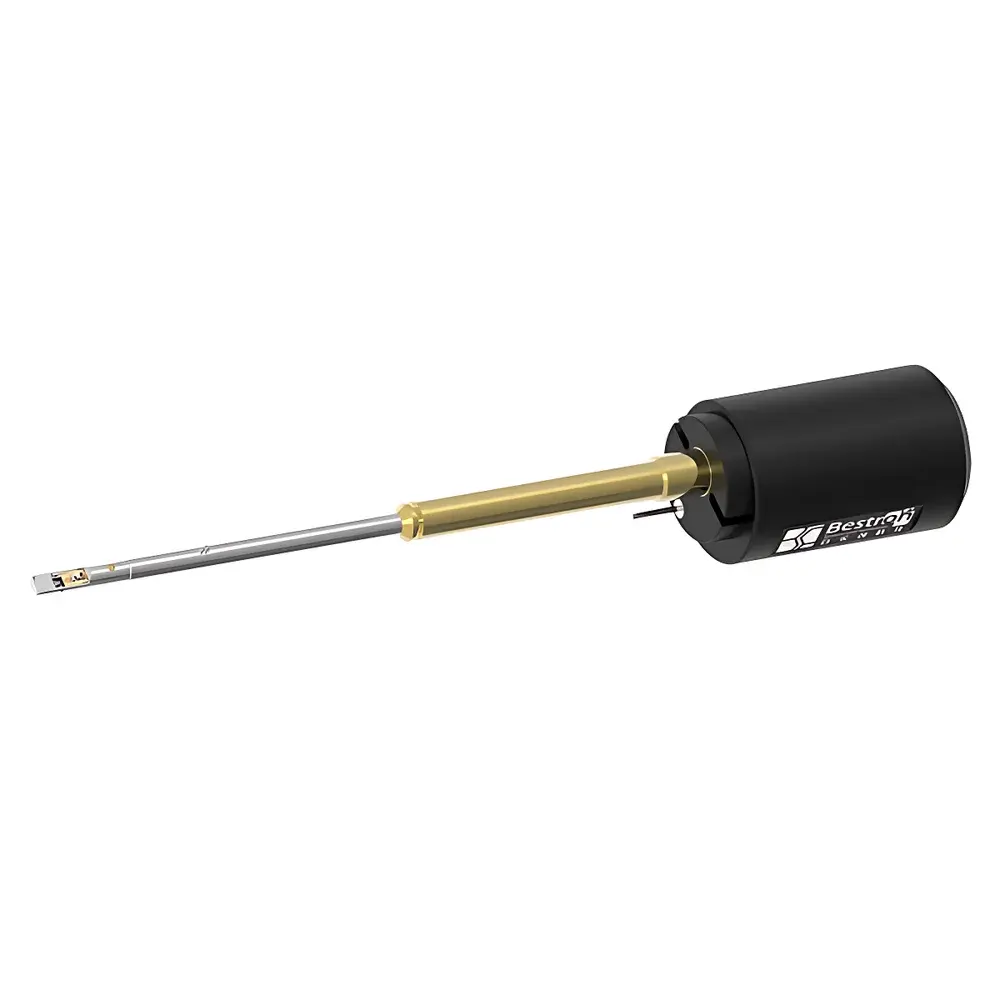
Bestron INSTEMS-ME In Situ Electromechanical TEM Sample Holder
| Brand | Bestron |
|---|---|
| Model | INSTEMS-ME |
| Type | Dual-Axis Tilt Electromechanical In Situ TEM Holder |
| Max Force | 100 mN |
| Max Displacement | 4 µm |
| Force Resolution | < 500 pm |
| Voltage Range | ±50 V |
| Current Range | 1 pA–1 A |
| Temperature Range | RT–1200 °C |
| Temp. Stability | < 0.1 °C |
| α/β Tilt Range | ±25° each |
| Drift Rate | < 50 pm/s |
| Spatial Resolution (TEM-compatible) | ≤0.1 nm |
| EDS-Compatible | Yes |
| Application Domain | Materials Science, Nanodevices, Energy Storage, Ferroelectrics, Piezoelectrics, Flexible Electronics |
Overview
The Bestron INSTEMS-ME is a high-precision dual-axis tilt in situ electromechanical sample holder engineered for transmission electron microscopy (TEM). It enables real-time, atomic-resolution observation of dynamic structural and functional responses under coupled mechanical loading (tension, compression, bending) and electrical stimulation (DC/programmed bias, four-point probe measurement), all while maintaining full compatibility with high-resolution TEM imaging and analytical techniques including energy-dispersive X-ray spectroscopy (EDS). Unlike conventional single-function holders, the INSTEMS-ME integrates piezoelectric actuation, low-noise current/voltage control, and active thermal regulation within a mechanically stable TEM-compatible geometry—making it uniquely suited for correlating nanoscale deformation mechanisms with concurrent electronic transport behavior at the atomic scale.
Key Features
- Dual-axis mechanical tilt capability (α and β axes, ±25° each) preserves standard TEM specimen alignment and tomographic acquisition workflows without compromising in situ functionality.
- Sub-nanometer force actuation system delivers up to 100 mN maximum load with displacement resolution better than 500 pm and closed-loop positional stability supporting quantitative nanomechanical testing.
- Ultra-low-noise electrical subsystem supports programmable voltage sweeps (±50 V), precision current sourcing (1 pA–1 A range), and true four-probe resistivity measurements—minimizing contact artifacts during device-level characterization.
- Integrated high-fidelity heating stage operates from room temperature to 1200 °C with thermal stability better than ±0.1 °C, enabling controlled thermomechanical experiments under simultaneous electrical bias.
- Atomic-scale imaging stability: average sample drift < 50 pm/s under operational conditions, verified under 200–300 kV TEM illumination, ensuring reliable structure–property correlation over extended acquisition times.
- Full EDS compatibility maintained through optimized signal path design and minimized metallic shielding interference—enabling simultaneous compositional mapping during in situ electromechanical testing.
Sample Compatibility & Compliance
The INSTEMS-ME accommodates standard 3 mm diameter TEM grids (including SiN membranes, Au/Pt-coated carbon films, and custom microfabricated devices) and supports both plan-view and cross-sectional specimen geometries. Its mechanical architecture complies with JEOL, Thermo Fisher (FEI), and Hitachi TEM column interfaces (Gatan-style bayonet mount). All electronic subsystems meet IEC 61000-4 electromagnetic compatibility standards; thermal control firmware implements fail-safe overtemperature cutoff per IEC 60950-1. The holder is designed for use in GLP- and GMP-aligned laboratories, with optional audit-trail logging (via external DAQ integration) compliant with FDA 21 CFR Part 11 requirements when paired with validated acquisition software.
Software & Data Management
The INSTEMS-ME operates via a dedicated USB 3.0 interface connected to a Windows-based control suite supporting synchronized triggering with TEM camera acquisition (via TTL or Ethernet). Software modules include: (1) multi-channel waveform generator for arbitrary voltage/current profiles; (2) real-time force–displacement–current–voltage parameter logging at up to 10 kHz sampling; (3) thermal ramp scheduler with hold-and-soak protocols; and (4) tilt trajectory planner for automated tomographic series. Export formats include HDF5, CSV, and MRC—ensuring interoperability with DigitalMicrograph, HyperSpy, and Python-based analysis pipelines (e.g., SciPy, scikit-image). All configuration files and raw logs are timestamped and checksum-verified to support traceable data provenance.
Applications
- Atomic-scale deformation mechanisms in piezoelectric and ferroelectric oxides under electric field and stress coupling.
- In operando evolution of solid–electrolyte interphases (SEI) and electrode fracture in Li-ion battery cathodes/anodes.
- Mechano-electric transduction in 2D material heterostructures and van der Waals devices.
- Thermally activated dislocation nucleation and grain boundary sliding in nanocrystalline metals and alloys.
- Strain-engineered band structure modulation in flexible semiconductor nanomembranes.
- Reliability assessment of MEMS/NEMS switches and nanogenerators under cyclic electromechanical stress.
FAQ
Is the INSTEMS-ME compatible with aberration-corrected TEM systems?
Yes—it maintains mechanical and thermal stability specifications required for sub-Å imaging on Cs-corrected instruments operating at 80–300 kV.
Can the holder be used for cryogenic in situ experiments?
No—the current design is optimized for elevated temperature operation (RT–1200 °C); cryogenic variants are under development and available upon consultation.
Does the system support closed-loop force control during imaging?
Yes—integrated strain gauge feedback enables real-time PID-regulated force maintenance during TEM observation, independent of thermal drift or stage creep.
How is electrical isolation achieved between the sample and TEM column?
All high-voltage and current paths are galvanically isolated using optocoupled drivers and shielded coaxial feedthroughs rated to 1 kV DC, meeting TEM column grounding safety standards.
What calibration documentation is provided?
Each unit ships with NIST-traceable calibration certificates for force actuation, temperature sensing, and current measurement channels, valid for 12 months from date of shipment.




