
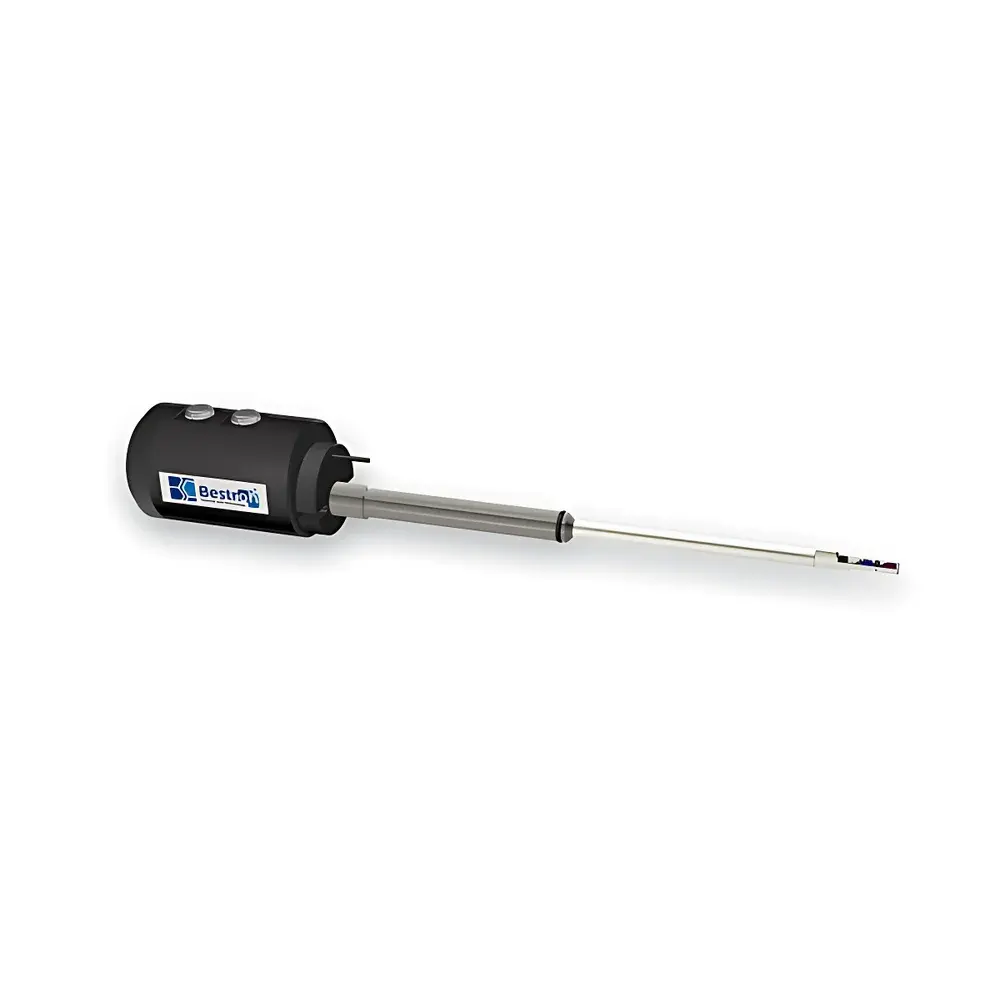
Bestron INSTEMS-TE In Situ Dual-Tilt Electrical-Thermal Coupling Holder for Transmission Electron Microscopy
| Brand | Bestron |
|---|---|
| Model | INSTEMS-ET |
| Type | In Situ Dual-Axis Tilt TEM Sample Holder |
| Heating Range | RT to 1200 °C |
| Electrical Bias Range | 0–150 V |
| Current Range | 0–2 A |
| Dual-Axis Tilt | α ±20°, β ±10° |
| Spatial Resolution (in situ) | ≤0.1 nm |
| Sample Drift | <50 pm/s |
| EDS-Compatible | Yes |
| Heating Accuracy | ≥98% |
| Maximum Heating Rate | >10,000 °C/s |
| Current Measurement Range | 1 pA–1 A |
Overview
The Bestron INSTEMS-TE is a high-precision, dual-axis tilt in situ sample holder engineered for atomic-resolution transmission electron microscopy (TEM) under simultaneous electrical biasing and thermal stimulation. Designed around a robust Cu-based MEMS-heater architecture with integrated microfabricated electrodes, the system enables true thermoelectric coupling experiments at the nanoscale—where localized Joule heating, thermal gradient control, and real-time current-voltage characterization converge within the TEM column. Unlike conventional single-field holders, the INSTEMS-TE supports both uniform thermal field generation (via single-source heating) and programmable thermal gradients (via independently controlled dual heat sources), making it uniquely suited for probing thermoelectric transport, phase transformation kinetics under coupled stimuli, and electromigration-driven defect evolution in functional materials.
Key Features
- Dual-axis mechanical tilt capability: α-axis rotation up to ±20° and β-axis up to ±10°, enabling crystallographic zone-axis alignment and multi-angle tomographic acquisition without holder exchange.
- Atomic-scale stability: Active drift compensation and low-thermal-expansion ceramic housing ensure sample drift <50 pm/s during extended heating and biasing, preserving sub-ångström imaging fidelity.
- Integrated electrical measurement circuitry: On-holder 4-wire sensing with picoampere-level current resolution (1 pA–1 A) and high-voltage tolerance (±150 V), compliant with standard TEM feedthrough configurations.
- High-fidelity thermal control: Rapid-response MEMS heaters deliver heating rates exceeding 10,000 °C/s and stable operation from room temperature to 1200 °C, with closed-loop accuracy ≥98% across the full range.
- Full EDS compatibility: Non-magnetic, low-Z construction minimizes X-ray absorption and fluorescence interference, enabling concurrent energy-dispersive spectroscopy during thermoelectric experiments.
- Modular interface design: Standard Gatan or Protochips-compatible electrical and thermal connectors simplify integration into JEOL, Thermo Fisher, and Hitachi TEM platforms.
Sample Compatibility & Compliance
The INSTEMS-TE accommodates standard 3-mm TEM grids (including SiN, graphene, and holey carbon membranes) and supports plan-view, cross-sectional, and lift-out FIB-prepared specimens. Its vacuum-rated hermetic seal maintains UHV conditions (<1×10⁻⁷ Pa) inside the TEM column during operation. The holder conforms to ISO/IEC 17025 calibration traceability requirements for in situ instrumentation and supports GLP-compliant data logging when paired with validated acquisition software. All electrical insulation meets IEC 61010-1 safety standards for laboratory equipment operating under high-bias conditions.
Software & Data Management
Bestron provides the INSTEMS Control Suite—a platform-independent application supporting synchronized acquisition of temperature, voltage, current, and microscope metadata (e.g., magnification, defocus, camera exposure). The software implements time-stamped audit trails compliant with FDA 21 CFR Part 11 for regulated environments and exports timestamp-aligned datasets in HDF5 format for interoperability with Python-based analysis pipelines (e.g., HyperSpy, PyXEM). Real-time feedback loops enable automated ramp-hold-cool protocols and conditional triggering (e.g., initiate image capture upon reaching target dT/dt or resistance threshold).
Applications
- Thermoelectric material characterization: Direct observation of phonon scattering sites, carrier mobility degradation, and interfacial segregation under thermal gradient + electric field.
- Semiconductor reliability testing: In situ monitoring of electromigration void nucleation, grain boundary sliding, and dielectric breakdown in advanced nodes (e.g., Cu/low-k, 2D heterostructures).
- Phase-change memory (PCM) research: Atomic-scale tracking of crystallization/amorphization transitions driven by pulsed Joule heating.
- Battery electrode degradation: Correlating Li-ion diffusion pathways, solid-electrolyte interphase (SEI) growth, and crack propagation under electrochemical cycling at elevated temperatures.
- Ferroelectric domain dynamics: Visualizing polarization switching kinetics under combined thermal stress and bias, including fatigue-induced imprint shifts.
- High-entropy alloy deformation: Quantifying dislocation–precipitate interactions during simultaneous tensile loading and thermal aging (when used with optional INSTEMS-MT upgrade path).
FAQ
Is the INSTEMS-TE compatible with aberration-corrected TEMs?
Yes—the holder’s mechanical design and thermal expansion profile are optimized for use in Cs-corrected instruments operating at 80–300 kV, maintaining probe coherence and minimizing chromatic aberration contributions.
Can I perform simultaneous EELS and electrical biasing?
Yes—its low-noise signal routing and RF-shielded cabling support high-sensitivity electron energy-loss spectroscopy during active current flow, with minimal electromagnetic interference.
What calibration documentation is provided?
Each unit ships with NIST-traceable calibration certificates for temperature (ITS-90), voltage (DC RMS), and current (pA–A range), plus a full mechanical alignment report verified via nanofiducial imaging.
Does the system support custom waveform programming?
Yes—the Control Suite allows user-defined arbitrary waveforms (sinusoidal, square, sawtooth, pulse trains) with microsecond timing resolution for transient thermoelectric studies.
Is remote operation supported for multi-user facilities?
Yes—TCP/IP-based API access enables integration into facility-wide scheduling systems (e.g., EPICS, LabVIEW) and secure remote control via TLS-encrypted connections.



