
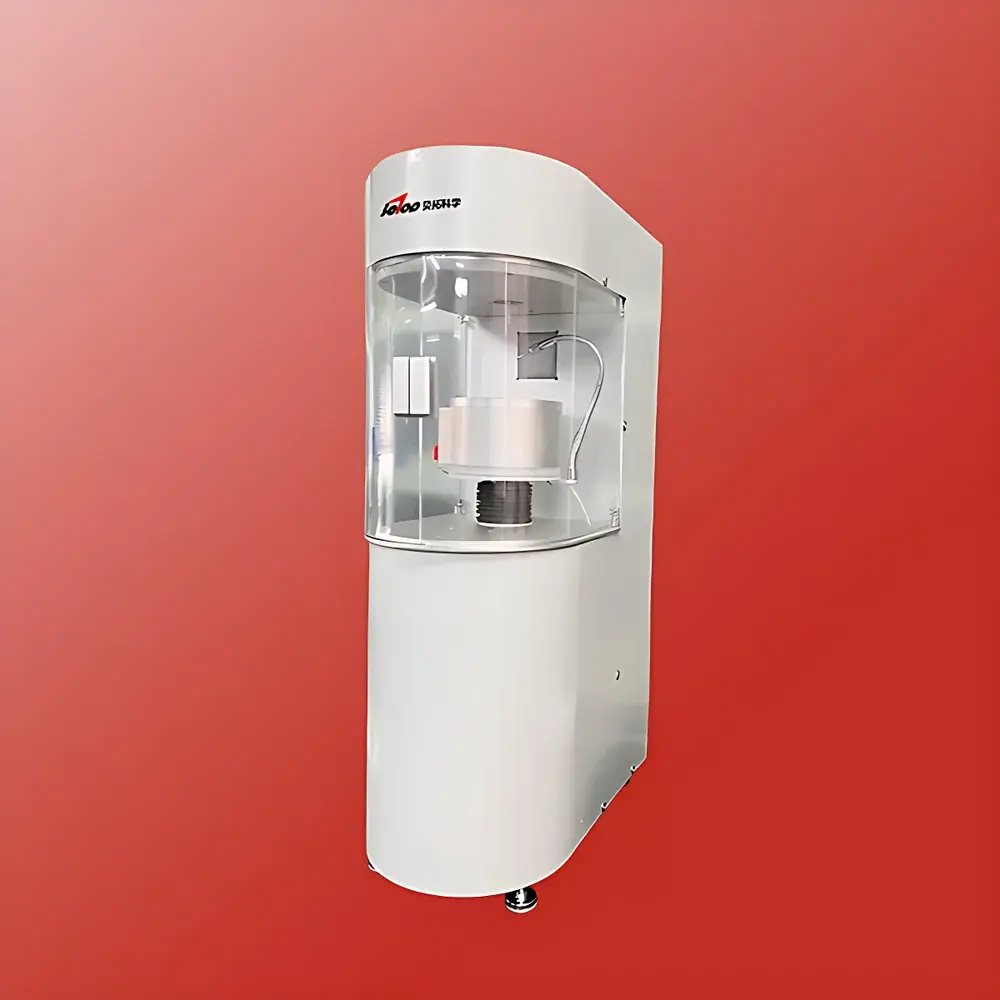
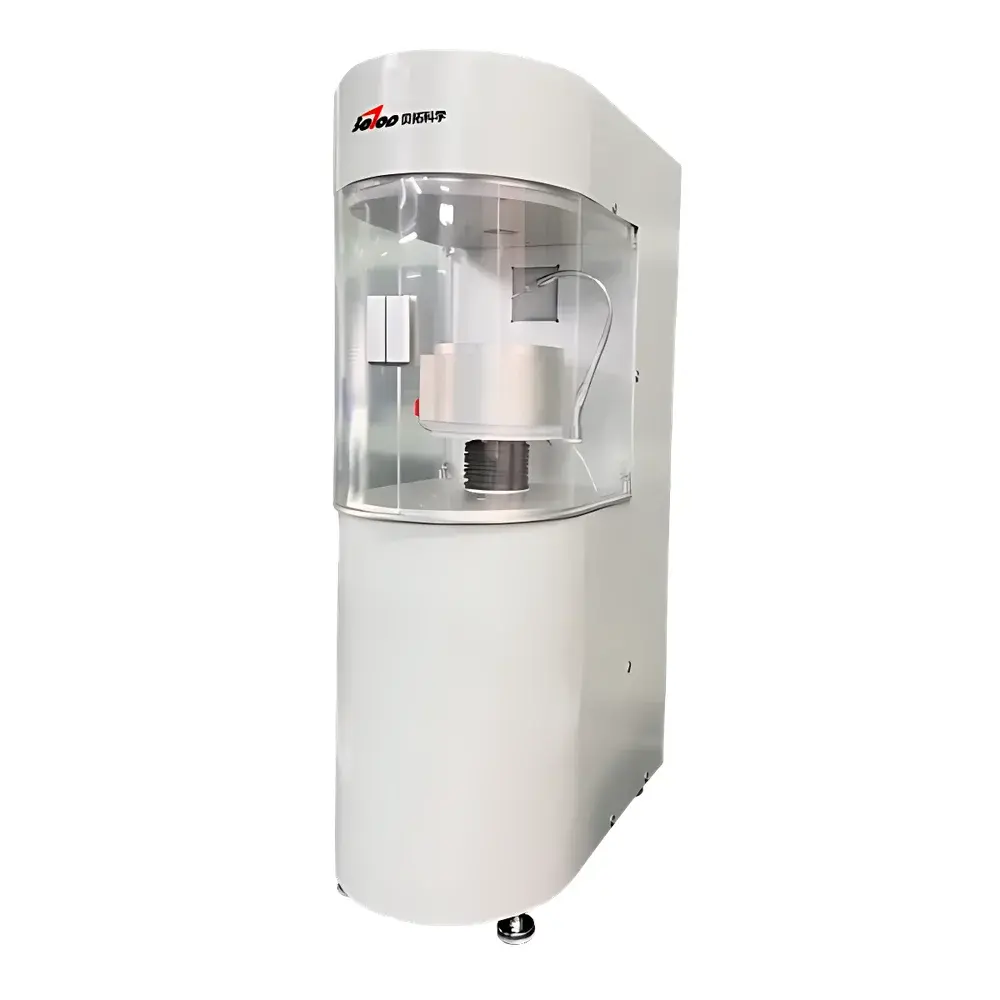
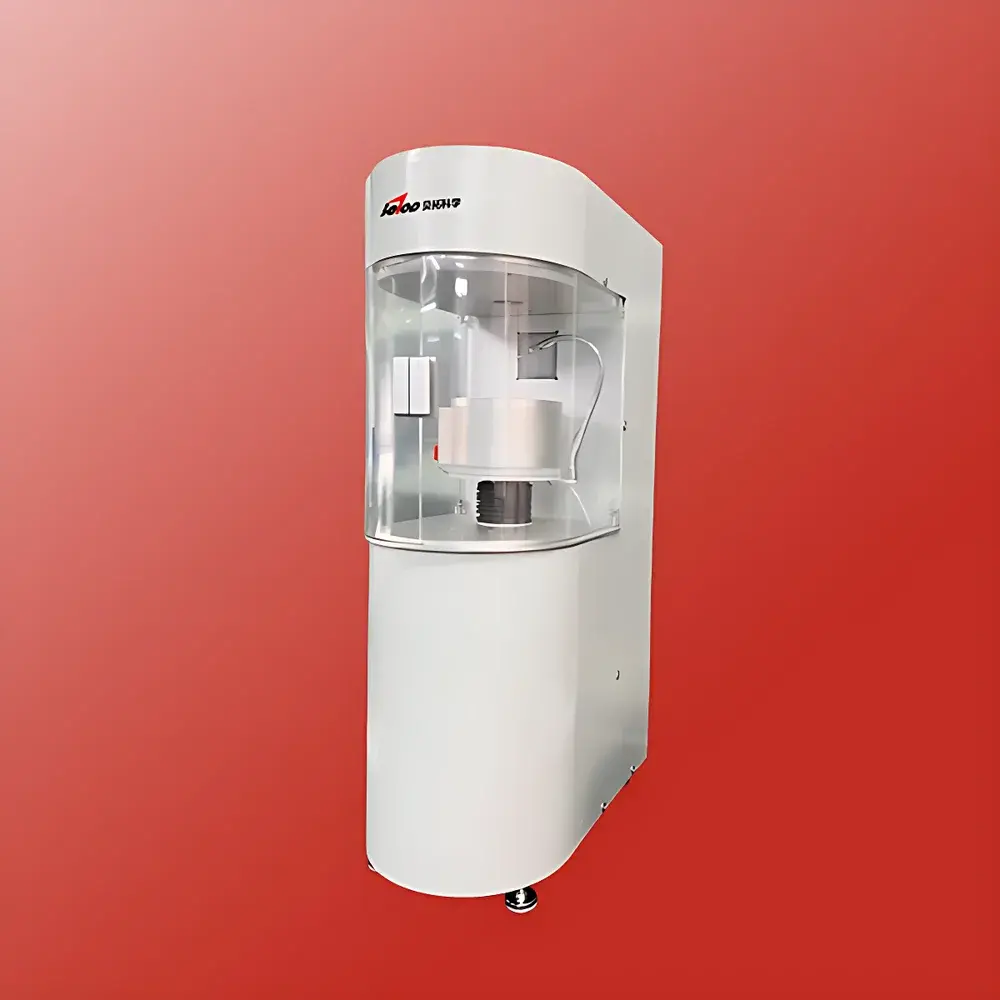
Betop Scientific PWA100 Automated Powder Wettability Analyzer
| Brand | Betop Scientific |
|---|---|
| Origin | Guangdong, China |
| Manufacturer Type | Direct Manufacturer |
| Country of Origin | China |
| Model | PWA100 |
| Measurement Range | 0–90° |
| Power Supply | AC 100–240 V, 50/60 Hz |
| Angular Accuracy | 0.1° |
| Angular Resolution | 0.01° |
| Sampling Frequency | 50 Hz |
| Surface/Interfacial Tension Range | 1–1000 mN/m |
| Surface/Interfacial Tension Resolution | 0.01 mN/m |
| Sample Cell Dimensions | 20 mm diameter × 95 mm height |
| Instrument Dimensions | 250 × 420 × 800 mm (L×W×H) |
| Weight | 25 kg |
| Interface | USB 3.0 or higher |
Overview
The Betop Scientific PWA100 Automated Powder Wettability Analyzer is a precision laboratory instrument engineered for quantitative characterization of solid powder–liquid interfacial interactions. It operates on the fundamental principle of capillary penetration kinetics, grounded in the Washburn equation—a well-established theoretical framework for dynamic wettability assessment of porous particulate media. In this method, a consolidated powder column functions analogously to a bundle of parallel capillaries with an effective average radius r. When brought into contact with a probe liquid of known surface tension (γLV), spontaneous capillary rise occurs due to interfacial energy minimization. The time-dependent mass uptake—measured continuously via high-resolution electromagnetic force compensation—is directly related to the contact angle (θ) between the liquid and powder surface. By analyzing the square-root-of-time dependence of mass gain, the PWA100 calculates θ and derives surface free energy components using multi-liquid probe methodology (e.g., Owens–Wendt, van Oss–Chaudhury–Good models). This approach delivers thermodynamically rigorous, reproducible metrics essential for formulation development, process optimization, and quality control across advanced materials and pharmaceutical manufacturing.
Key Features
- Automated capillary rise measurement with real-time mass acquisition at 50 Hz sampling frequency, enabling high-fidelity kinetic profiling of liquid ingress
- High-precision electromagnetic force sensor with ±0.1 mg repeatability and long-term drift stability suitable for GLP-compliant data generation
- Sub-micron resolution servo motor actuation (0.1 µm step size) ensuring smooth, vibration-free vertical positioning of the liquid reservoir during contact initiation
- Modular quartz sample cell (20 mm Ø × 95 mm H) designed for consistent powder packing density and minimal wall effects; reusable and chemically inert
- Programmable test sequences via intuitive Windows-based software—supports multi-liquid protocols, automatic baseline correction, and adaptive endpoint detection
- USB 3.0 interface ensures deterministic data streaming without packet loss; compatible with Windows 10/11 and supports timestamped binary export (CSV, TXT)
Sample Compatibility & Compliance
The PWA100 accommodates a broad spectrum of dry, free-flowing powders—including battery cathode/anode materials (e.g., NMC, LFP, graphite), pharmaceutical excipients (microcrystalline cellulose, lactose), pigment dispersions, catalytic metal oxides (e.g., TiO2, Al2O3), and polymer microparticles. Sample preparation follows standardized tapping or gravitational settling procedures defined in ASTM D6393 and ISO 4762 to ensure inter-laboratory comparability. All measurement outputs—including contact angle, surface energy components, and capillary penetration rate—are traceable to SI units. Software architecture supports audit trails, user access levels, and electronic signatures aligned with FDA 21 CFR Part 11 requirements for regulated environments. Data integrity is reinforced through checksum validation and immutable raw-data archiving.
Software & Data Management
The proprietary Betop Wettability Suite provides a full-featured analytical environment for method development, acquisition, and post-processing. Users define custom test templates specifying liquid selection, immersion delay, acquisition duration, and curve-fitting algorithms (linear, polynomial, or Washburn-transformed). Real-time visualization includes dual-axis plots (mass vs. √t; dM/dt vs. t), automatic inflection point detection, and outlier rejection based on statistical variance thresholds. Export modules generate reports compliant with ISO/IEC 17025 documentation standards, including uncertainty budgets per GUM (Guide to the Expression of Uncertainty in Measurement). Raw datasets retain full metadata (operator ID, environmental conditions, calibration timestamps), facilitating retrospective analysis and regulatory review.
Applications
- Quantitative evaluation of electrode slurry wettability in lithium-ion battery R&D—correlating contact angle hysteresis with binder distribution and coating uniformity
- Formulation screening of tablet disintegration behavior by measuring water penetration kinetics into compressed API–excipient compacts
- Stability assessment of pigment dispersions in coatings: correlating contact angle trends with aging-induced surface oxidation or surfactant depletion
- Quality-by-Design (QbD) support for inhalation powder products—linking powder surface energy to aerosolization efficiency and dose uniformity
- Catalyst pretreatment verification: detecting hydrophobic/hydrophilic transitions after calcination or silanization treatments
FAQ
What physical principle does the PWA100 use to determine powder contact angle?
It applies the Washburn equation to capillary-driven liquid penetration into a consolidated powder bed, deriving contact angle from the linear relationship between mass uptake squared and time.
Can the PWA100 measure surface free energy of powders?
Yes—using at least three probe liquids with known polar and dispersive surface tension components, the instrument computes total surface energy and its Lifshitz–van der Waals and acid–base contributions via established models.
Is the system compliant with pharmaceutical regulatory requirements?
The software supports 21 CFR Part 11 compliance features including role-based access control, electronic signatures, and secure audit trails for GMP/GLP workflows.
What is the minimum powder mass required for a valid measurement?
Typical loading is 0.8–1.2 g, compacted to a fixed height of 30–40 mm in the standard quartz cell; optimal mass depends on particle density and flowability.
Does the PWA100 require external calibration standards?
No—contact angle accuracy is inherently referenced to the Washburn model and verified using certified reference liquids (e.g., distilled water, diiodomethane, ethylene glycol) with traceable surface tension values.



