
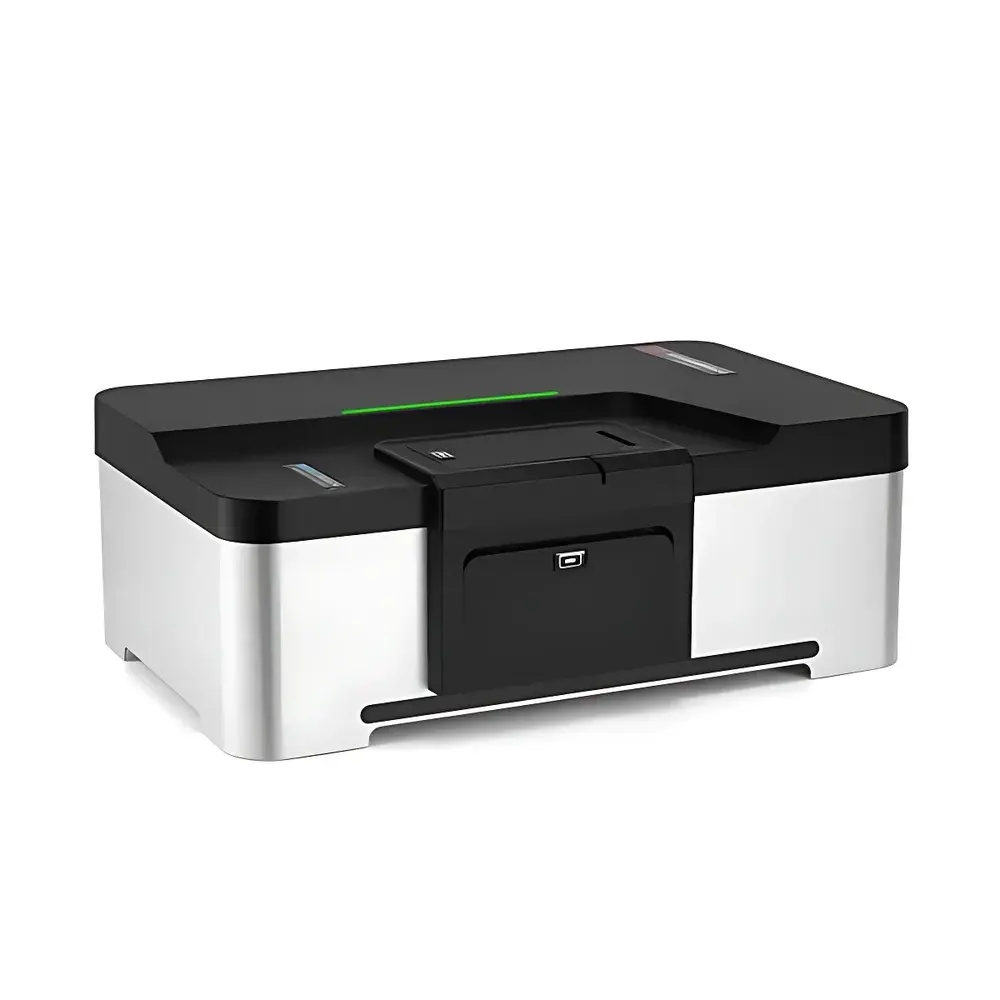
Bettersize BeNano 90 Zeta Nanoparticle Size and Zeta Potential Analyzer
| Brand | Bettersize |
|---|---|
| Origin | Liaoning, China |
| Manufacturer Type | Direct Manufacturer |
| Product Origin | Domestic (China) |
| Model | BeNano 90 Zeta |
| Price | Upon Request |
| Particle Size Range | 0.3 nm – 15 μm |
| Temperature Control Range | −15 °C to 120 °C |
| Temperature Stability | ±0.1 °C |
| Measurement Principles | Dynamic Light Scattering (DLS), Electrophoretic Light Scattering (ELS), Static Light Scattering (SLS) |
| Sample Volume | 3 μL – 1 mL |
| Zeta Potential Range | No Practical Limit |
Overview
The Bettersize BeNano 90 Zeta Nanoparticle Size and Zeta Potential Analyzer is a fully integrated optical platform combining DLS, ELS, and SLS in a single instrument. Engineered for precision and versatility in colloidal and macromolecular characterization, it delivers quantitative data on hydrodynamic diameter (Dh), polydispersity index (PDI), zeta potential distribution, electrophoretic mobility, absolute molecular weight (Mn, Mw, Mz), second virial coefficient (A2), and micro-rheological parameters including G′, G″, η*, and J(t). Its dual-angle detection geometry (90° + 11.2°) enables robust size analysis across three decades of scattering intensity, while the phase-analysis light scattering (PALS) module ensures high-resolution zeta potential measurement even in high-conductivity media (up to ≥270 mS/cm). The system operates with a 671 nm solid-state laser and an avalanche photodiode (APD) detector, supported by a multi-speed correlator (25 ns minimum sampling interval, 4000 channels, 1011 dynamic linear range) — all housed within a thermally stabilized enclosure capable of precise temperature control from −15 °C to 120 °C (±0.1 °C stability).
Key Features
- Triple-technique architecture: Simultaneous or sequential DLS, ELS, and SLS measurements in one platform, eliminating inter-instrument variability and enabling cross-validated results.
- Ultra-low sample consumption: Minimum 3 μL volume requirement supports precious biological samples (e.g., monoclonal antibodies, viral vectors, exosomes) without dilution or concentration.
- Extended zeta potential capability: PALS-based measurement with no practical lower or upper limit; validated for particles ranging from 1 nm to >120 μm and for electrophoretic mobilities exceeding ±20 μm·cm/V·s.
- Comprehensive micro-rheology: Derives viscoelastic moduli (G′, G″), complex viscosity (η*), creep compliance (J), and mean-squared displacement (MSD) directly from DLS autocorrelation functions—no external rheometer required.
- Automated trend analysis: Programmable temperature-, time-, and pH-dependent protocols with real-time transition point detection (e.g., Tm for protein unfolding, critical micelle temperature, or aggregation onset).
- Modular expandability: Compatible with FFF/GPC-SEC coupling via Flow Mode interface, BAT-1 automated titrator for pH/zeta titration, BeScan stability analyzer for accelerated shelf-life assessment, and 0° PD+CMOS module for refractive index and sedimentation-based concentration analysis.
Sample Compatibility & Compliance
The BeNano 90 Zeta accommodates aqueous and organic dispersions, protein formulations, polymer solutions, liposomal suspensions, nanocrystals, and colloidal metal oxides. Its wide conductivity tolerance (0–≥270 mS/cm) permits direct analysis of saline buffers, cell culture media, and industrial process streams without dilution. For regulated environments, the system supports audit-ready operation: raw correlation data, instrument metadata (laser power, temperature, count rate), and user-defined SOPs are timestamped and exportable in compliant formats (CSV, TXT, PDF). While not pre-certified to FDA 21 CFR Part 11 out-of-the-box, its data structure and logging architecture align with GLP/GMP documentation requirements when deployed with validated electronic lab notebook (ELN) integration and controlled access protocols.
Software & Data Management
The BeNano Control Suite provides a unified interface for method setup, real-time monitoring, batch processing, and report generation. Algorithms include Cumulants (ISO 22412), Non-Negative Least Squares (NNLS), CONTIN, and General Purpose mode for multimodal distributions. Molecular weight determination applies Debye and Zimm formalisms to SLS data; zeta potential reports include mobility histograms and Smoluchowski/Henry corrections. All datasets retain full traceability: each measurement file embeds acquisition parameters, calibration history, and environmental logs. Export options support LIMS integration (via CSV/ASCII), and raw correlator data (.cor) files are preserved for third-party reanalysis. Software updates follow a documented change control process, with version history and release notes archived per ISO 13485-aligned quality management practice.
Applications
- Biopharmaceutical development: Monitoring mAb aggregation kinetics, excipient screening via zeta-pH titration, and lot-release testing of lipid nanoparticles (LNPs) per ICH Q5A/Q5C guidelines.
- Materials science: Characterizing quantum dot surface charge under varying ionic strength, evaluating polymer nanoparticle stability during solvent exchange, and quantifying A2 for polymer-solvent compatibility assessment.
- Food & beverage R&D: Assessing casein micelle dissociation at low pH, measuring starch nanoparticle dispersion stability in acidic beverages, and validating emulsifier efficacy in oil-in-water systems.
- Academic research: Studying protein folding/unfolding transitions via temperature ramped DLS, probing polyelectrolyte complexation through zeta-pH curves, and mapping colloidal phase behavior using micro-rheology-derived yield stress estimates.
- Quality control labs: Implementing rapid, operator-independent particle sizing and charge verification for nanosuspension APIs, ceramic slurries, and catalyst dispersions in accordance with ASTM E2490 and ISO 13321 standards.
FAQ
What sample volume is required for reliable DLS and ELS measurements?
Minimum 3 μL is sufficient for both techniques when using the standard quartz cuvette; however, 1 mL is recommended for routine QC applications to ensure statistical reproducibility and minimize wall effects.
Can the BeNano 90 Zeta measure zeta potential in high-salt buffers commonly used in biologics formulation?
Yes—the PALS module maintains resolution and accuracy in conductivities up to ≥270 mS/cm, enabling direct analysis of PBS, HEPES, and other physiologically relevant buffers without dilution.
Is molecular weight determination by SLS suitable for regulatory submission?
Absolute molecular weight values derived from SLS comply with ISO 13877 and ASTM D7817; however, validation against orthogonal methods (e.g., SEC-MALS) is recommended for formal regulatory filings.
How does the Flow Mode interface enable coupling with size-exclusion chromatography?
The Flow Mode option provides analog/digital I/O for synchronized triggering between the BeNano detector and RI/UV detectors, allowing real-time DLS/SLS acquisition of eluting fractions—yielding model-independent size and MWD profiles.
Does the system support 21 CFR Part 11 compliance for pharmaceutical use?
The hardware and software architecture supports Part 11 implementation when paired with validated ELN/LIMS systems, role-based access controls, electronic signatures, and audit trail configuration—but final validation remains the responsibility of the end-user’s QA department.



