
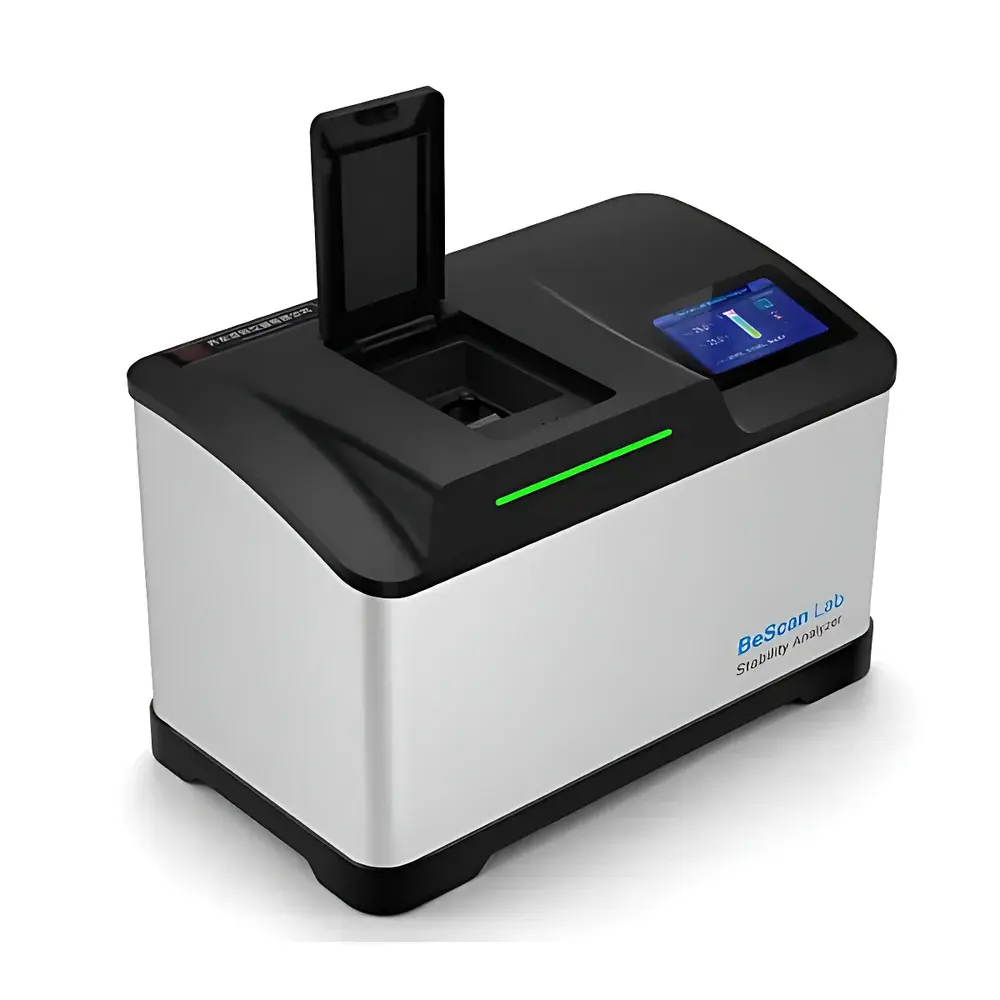
Bettersize BeScan Lab Stability Analyzer
| Brand | Bettersize |
|---|---|
| Origin | Liaoning, China |
| Manufacturer Type | Manufacturer |
| Origin Category | Domestic |
| Model | BeScan Lab |
| Pricing | Upon Request |
Overview
The Bettersize BeScan Lab Stability Analyzer is a high-precision, non-invasive instrument engineered for quantitative assessment of colloidal and particulate system stability based on static multiple light scattering (SMLS) and transmission photometry. It operates by simultaneously measuring backscattered light at 135° and transmitted light at 0° using an 850 nm high-stability LED source. As the optical probe scans vertically along the sample height (with 20 µm spatial resolution), it captures time-resolved profiles of photon transport—enabling real-time monitoring of microstructural evolution induced by sedimentation, creaming, flocculation, coalescence, phase separation, or aggregation. Unlike centrifugal or shear-based methods, BeScan Lab preserves native sample integrity, making it ideal for fragile formulations such as protein therapeutics, liposomal suspensions, or battery slurries. The instrument computes the BeScan Index (IUS)—a dimensionless instability index derived from normalized intensity gradients across the sample column—providing objective, reproducible ranking of formulation robustness. Its ability to resolve changes up to 200× faster than visual inspection significantly accelerates R&D cycles and supports predictive shelf-life modeling under controlled thermal conditions (20–80 °C, ±0.5 °C).
Key Features
- Non-destructive analysis: No centrifugation, dilution, or mechanical agitation required—preserves original dispersion state
- Multi-parameter detection: Simultaneous acquisition of IUS, particle migration velocity, layer thickness, and mean particle size (0.01–1000 µm, dependent on refractive index contrast and concentration)
- Programmable scanning modes: Height scan (vertical profiling), time scan (kinetic monitoring), and temperature ramp (accelerated aging from ambient to 80 °C)
- High spatial resolution: 20 µm step size enables precise localization of interface formation and gradient development
- Flexible sample handling: Compatible with standard cuvettes (4–25 mL) and micro-cells (2–4 mL); supports optical densities up to 95% v/v
- Scalable architecture: Up to 10 units can be synchronized via master-slave configuration for parallel multi-sample evaluation
- Robust optical design: Thermally stabilized 850 nm LED source ensures signal stability during long-term kinetic studies
Sample Compatibility & Compliance
The BeScan Lab accommodates a broad spectrum of complex fluids—including high-viscosity polymer melts, opaque suspensions, emulsions, foams, and concentrated pastes—without requiring dilution or pretreatment. It is validated for use with biological macromolecules (e.g., monoclonal antibodies, PEGylated proteins), nanomaterial dispersions (metallic/non-metallic colloids), pharmaceutical suspensions (oral liquids, lipid nanoparticles), energy materials (cathode/anode slurries), agrochemical formulations, and personal care products (shampoos, conditioners). The system complies with international technical guidance documents relevant to dispersion characterization: GB/T 38431–2019 (Chinese national standard for colloidal stability testing), ISO/TR 18811:2018 (light scattering principles for dispersed systems), ISO/TR 13097:2013 (guidance on stability assessment of emulsions and suspensions), ISO/TS 21357:2022 (instrumental methods for particle size and stability), and ISO/TS 22107:2021 (stability testing of nanomaterials in liquid media). While not inherently 21 CFR Part 11 compliant out-of-the-box, audit-trail functionality and user access control can be implemented via optional software modules aligned with GLP/GMP workflows.
Software & Data Management
BeScan Lab is operated via dedicated Windows-based software featuring intuitive workflow templates for method setup, real-time visualization, and automated report generation. Raw intensity profiles (IBS and IT vs. height), time-lapse IUS curves, and derivative metrics—including photon mean free path (ℓ) and transport mean free path (ℓ*)—are stored in vendor-neutral ASCII formats for third-party statistical analysis. Batch processing tools support comparative stability ranking across formulation variants. All measurement parameters (scan speed, temperature setpoints, dwell time, detector gain) are fully logged with timestamps and operator IDs. Export options include CSV, PNG, and PDF. For regulated environments, optional software upgrades provide electronic signatures, change control logs, and secure database archiving compatible with laboratory information management systems (LIMS).
Applications
- Quantitative stability screening of biopharmaceutical formulations (mAbs, vaccines, mRNA-LNPs)
- Kinetic modeling of aggregation onset and growth rates in protein solutions
- Optimization of surfactant selection and surface modification strategies for nanoparticle stabilization
- Evaluation of thermal reversibility in thermosensitive hydrogels (e.g., PNIPAM)
- Accelerated aging studies for shelf-life prediction of oral suspensions and topical emulsions
- Characterization of destabilization mechanisms in crude oil emulsions and demulsifier efficiency testing
- Assessment of flocculation dynamics in water treatment coagulants and flocculants
- Quality control of pigment dispersions in inks, coatings, and cosmetics
- Stability benchmarking of battery electrode slurries under shear-free storage conditions
- Monitoring of creaming/sedimentation behavior in dairy and plant-based beverages
FAQ
What physical principles underpin the BeScan Lab’s stability assessment?
It relies on static multiple light scattering theory combined with Beer–Lambert transmission analysis to quantify local changes in scattering coefficient and extinction coefficient over time and position.
Can the instrument measure particle size without calibration standards?
Yes—mean particle size is derived from the relationship between photon transport mean free path and particle concentration, assuming known refractive index contrast; no reference materials are required for relative sizing.
Is temperature control available during scanning?
Yes—the integrated Peltier module enables programmable temperature ramps and isothermal holds from 20 °C to 80 °C with ±0.5 °C accuracy.
How does BeScan Lab differentiate between creaming and sedimentation?
By analyzing the directionality and slope of intensity gradients in the backscattering profile: upward-moving interfaces indicate creaming; downward-moving interfaces indicate sedimentation.
Does the system support GMP-compliant data integrity requirements?
With optional software modules, it supports ALCOA+ principles—including attributable, legible, contemporaneous, original, and accurate data—with full audit trails and role-based access control.



