
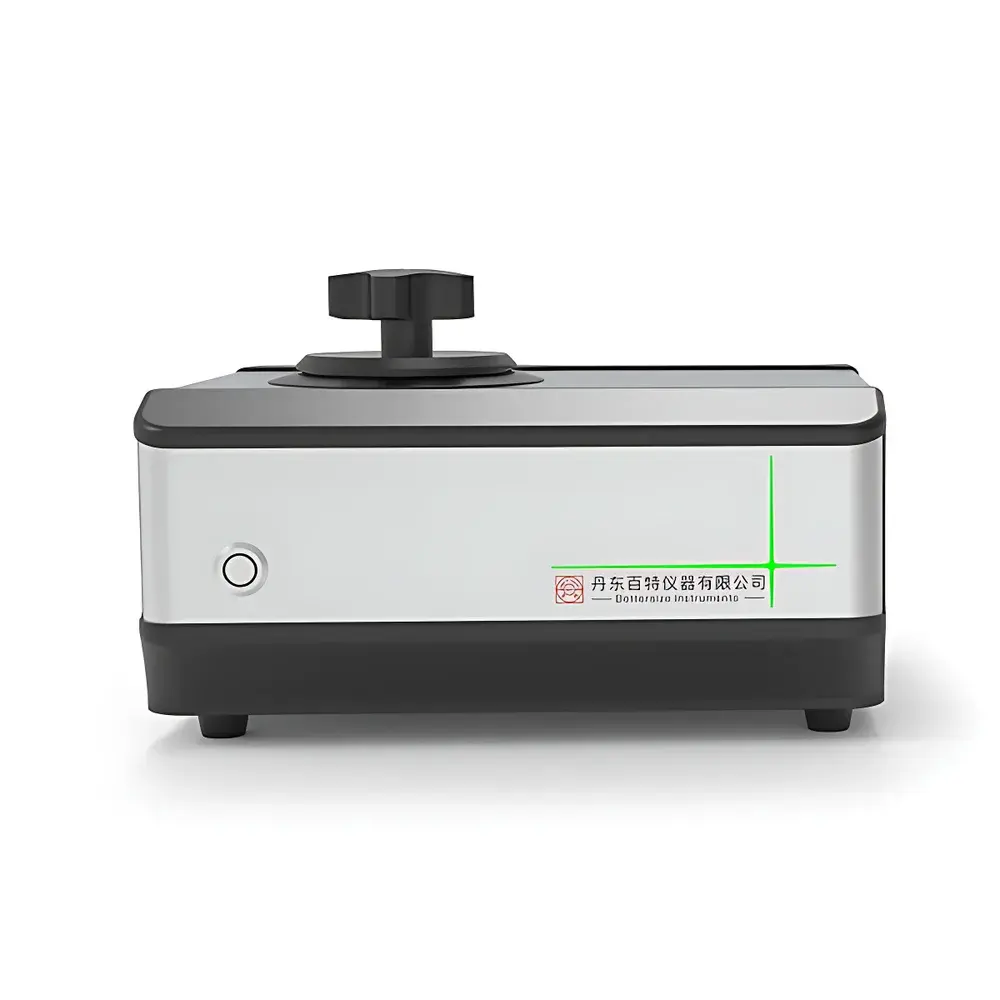
Bettersize BetterPyc 380 Multi-Function True Density Analyzer (Solid Content)
| Brand | Bettersize |
|---|---|
| Origin | Liaoning, China |
| Manufacturer Type | Direct Manufacturer |
| Product Category | Domestic |
| Model | BetterPyc 380 |
| Instrument Type | Multi-Function True Density Analyzer |
| Measurement Principle | Gas Pycnometry (Gas Displacement Method) |
| Accuracy | ±0.02% |
| Repeatability | ±0.01% |
| Resolution | 0.0001 g/cm³ |
| Operating Pressure Range | 0–22 psig (0–152 kPag) |
| Compatible Gases | Nitrogen or Helium |
| Gas Inlet Modes | Flow Mode & Vacuum Mode |
| Tubing Connection | Φ4 mm |
| Sample Cup Volumes | 10 cm³ / 35 cm³ / 100 cm³ |
| Sample Chamber Volume | 100 cm³ |
| Temperature Range | 10–65 °C |
| Relative Humidity Range | 20–80 % RH |
| Single Measurement Time | < 120 s |
| Pressure Sensor Accuracy | Better than 0.1 % |
| Power Supply | 100–240 VAC, 50/60 Hz, 1.4 A |
Overview
The Bettersize BetterPyc 380 Multi-Function True Density Analyzer is an engineered solution for high-precision volumetric and density characterization of solid, liquid, and heterogeneous materials using gas pycnometry—a gravimetrically traceable, internationally recognized method based on the ideal gas law. Unlike buoyancy-based hydrostatic techniques, this instrument measures true (skeletal) volume by quantifying the pressure differential induced when a known quantity of inert gas (N₂ or He) expands from a reference chamber into a sealed sample chamber containing the test material. This gas displacement principle enables direct determination of non-porous volume—critical for calculating true density, solid content in suspensions, open-cell porosity in foams, and bulk density corrections in powder processing workflows. Designed for laboratory environments requiring GLP-compliant data integrity, the BetterPyc 380 delivers sub-0.02% accuracy and 0.01% repeatability across its four core analytical modes, supporting routine QC, R&D validation, and regulatory submission protocols.
Key Features
- Four integrated measurement modes: true density of solids/powders, liquid density, solid content (in slurries, pastes, and colloidal dispersions), and open-cell porosity (for rigid and flexible foams)
- Triple-volume sample cup configuration (10 cm³, 35 cm³, 100 cm³) enabling scalable analysis—from microgram pharmaceutical excipients to gram-scale catalyst pellets
- Dual gas handling architecture supporting both flow-through purging and vacuum evacuation for optimal moisture/oxygen-sensitive sample conditioning
- High-stability pressure transducers with better-than-0.1% full-scale accuracy and temperature-compensated signal processing
- Automated thermal equilibration monitoring ensures measurements are only executed within the validated 10–65 °C operational window
- Robust stainless-steel fluidic path rated for continuous operation at up to 152 kPag, compliant with ISO 8573-1 Class 4 particulate and dew point specifications
Sample Compatibility & Compliance
The BetterPyc 380 accommodates granular, powdered, fibrous, porous, and liquid-phase samples without size restriction beyond cup geometry limits. Its gas displacement methodology eliminates surface tension artifacts inherent in liquid immersion methods—making it especially suitable for hydrophobic powders (e.g., fumed silica), low-density aerogels, and reactive metal powders used in additive manufacturing. The system meets or exceeds performance requirements specified in ASTM D923 (powder metallurgy), ASTM D6226 (open-cell foam), USP and Ph. Eur. 2.9.23 (pharmaceutical density verification), ISO 1183-3 (plastics), and GB/T 1033.3 (general solid density). All hardware and software components are designed to support audit-ready documentation under FDA 21 CFR Part 11, including electronic signatures, immutable audit trails, and user-access-controlled parameter locking.
Software & Data Management
Controlled via the EasyPyc desktop application (Windows 10/11, 64-bit), the BetterPyc 380 provides real-time graphical feedback—including animated chamber pressurization sequences, live pressure decay curves, and thermodynamic equilibrium indicators. Each analysis generates a structured XML report containing raw sensor timestamps, calculated volumes, intermediate gas law constants, and uncertainty propagation estimates per ISO/IEC 17025 Annex A.3. Report templates are configurable per SOP, with export options to CSV, PDF, and LIMS-compatible ASTM E1384 formats. Calibration routines include certified reference standards (e.g., fused quartz spheres traceable to NIST SRM 1921b), and all calibration events are logged with operator ID, date/time stamp, and deviation thresholds.
Applications
- Powder metallurgy: Quantifying green density and sintering shrinkage compensation in MIM and HIP feedstocks
- Pharmaceutical formulation: Verifying active ingredient dispersion homogeneity in wet-granulated tablets via slurry solid content
- Catalyst development: Correlating pore structure evolution during calcination cycles using sequential open-cell porosity tracking
- Battery materials: Measuring true density of cathode/anode powders (e.g., NMC, graphite) to validate tap density models
- Construction materials: Determining void fraction in lightweight aggregates and aerated concrete per ASTM C1760
- Geotechnical analysis: Characterizing specific gravity of fine-grained soils and tailings without mercury intrusion hazards
FAQ
What gases are supported, and why is helium sometimes preferred over nitrogen?
Helium is recommended for ultra-low-density or highly porous samples due to its smaller kinetic diameter (0.26 nm vs. 0.36 nm for N₂), enabling more complete intraparticle pore access. Nitrogen remains suitable for most industrial powders and liquids.
Can the BetterPyc 380 measure closed-cell porosity?
No—it is specifically configured for open-cell porosity determination via gas permeation. Closed-cell volume requires complementary techniques such as mercury intrusion porosimetry or X-ray CT.
Is temperature control active or passive?
The system monitors ambient chamber temperature continuously but does not include active heating/cooling. Users must maintain lab conditions within the 10–65 °C specification; optional external environmental enclosures are available.
How is solid content calculated for slurries?
By measuring the true density of the dry solid phase separately, then comparing the slurry’s bulk density against the theoretical mixture density derived from mass balance equations per ASTM D2990.
Does EasyPyc support multi-user permission levels?
Yes—administrator, analyst, and viewer roles can be assigned with granular controls over method editing, calibration execution, and report generation rights.



