
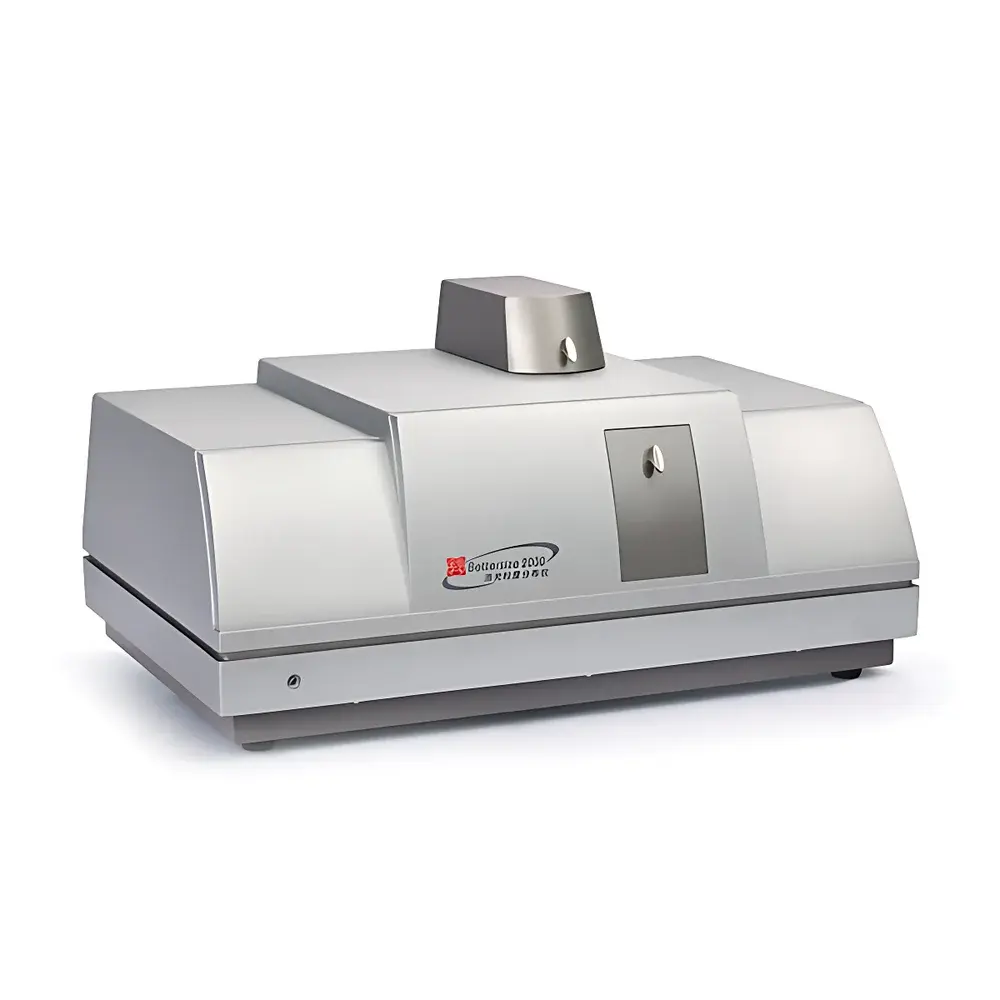
Bettersize Bettersize2000 Laser Particle Size Analyzer
| Brand | Bettersize |
|---|---|
| Origin | Liaoning, China |
| Manufacturer | Bettersize Instrument Co., Ltd. |
| Model | Bettersize2000 |
| Dispersion Method | Wet Dispersion |
| Instrument Type | Laboratory Laser Diffraction Particle Size Analyzer |
| Measurement Range | 0.02–2000 µm |
| Repeatability | ≤0.5% (D50 of NIST-traceable standard samples) |
| Single Measurement Time | ≤1 s |
| Optical System | Patented Dual-Lens Optical Configuration |
| Laser Source | High-Power Fiber-Coupled Semiconductor Laser |
| Detector Array | 90-Channel Photodiode Array (Forward & Backward Scattering) |
| Compliance | ISO 13320:2020, GB/T 19077–2024, GB/T 41949–2022, USP <429>, EP 2.9.38, ChP 0982 |
| Data Integrity | FDA 21 CFR Part 11–Compliant Audit Trail & Electronic Signature Support |
Overview
The Bettersize Bettersize2000 Laser Particle Size Analyzer is a high-precision laboratory instrument engineered for robust, reproducible particle size distribution (PSD) analysis across industrial R&D, QC/QA, and regulatory-compliant environments. It operates on the principle of laser diffraction—specifically, Mie scattering theory (default) with optional Fraunhofer approximation—enabling quantitative characterization of particulate systems from submicron to millimeter-scale particles. Its patented dual-lens optical architecture integrates a high-power fiber-coupled semiconductor laser with two precision-aspheric lens groups and a 90-channel photodetector array distributed across forward, side, and backward angular sectors. This design ensures optimal collection efficiency of scattered light across the full 0.02–2000 µm dynamic range while maintaining high signal-to-noise ratio—even for weakly scattering or low-concentration samples. The system’s monolithic integration of optical measurement and wet dispersion modules minimizes flow path length, reduces dead volume, and enhances hydraulic stability—critical factors in achieving ≤0.5% repeatability (D50) as verified against NIST-traceable reference materials.
Key Features
- Patented dual-lens optical system enabling simultaneous high-fidelity detection of forward and backward scattered light—maximizing angular coverage and resolution without mechanical reconfiguration.
- Integrated wet dispersion module featuring automatic water intake (via built-in suction pump and level sensor), programmable ultrasonic dispersion (0–50 W, continuously adjustable), auto-drain, auto-rinse, and bubble elimination—eliminating manual intervention and operator-induced variability.
- Intelligent automation suite: fully automated alignment, sample circulation, measurement sequence execution, data saving, and post-run cleaning—all configurable via SOP-driven workflows.
- FDA 21 CFR Part 11–compliant software architecture with role-based access control, electronic signatures, audit trail logging, and immutable data storage—meeting GLP/GMP documentation requirements for pharmaceutical, biotech, and regulated manufacturing labs.
- Comprehensive compliance framework: validated against ISO 13320:2020 (laser diffraction principles), GB/T 19077–2024 (Chinese national standard), USP (light diffraction method for pharmaceutical powders), and EP 2.9.38 (European Pharmacopoeia).
Sample Compatibility & Compliance
The Bettersize2000 supports aqueous and organic suspensions across diverse material classes—including inorganic oxides (SiO₂, ZrO₂, MgO), carbon-based powders (graphite, carbon black), metallics (Al, Cu, Zn, rare-earth alloys), battery cathode/anode materials (LiCoO₂, NMC, graphite), catalysts, pigments, pharmaceutical excipients, food-grade fillers, and geological sediments. Its wet dispersion system employs corrosion-resistant fluidic pathways and self-calibrating water-level monitoring to ensure consistent suspension stability and minimize agglomeration artifacts. All calibration and verification procedures adhere to JJF 1211–2008 and JJG 167–2020 metrological verification protocols for laser particle analyzers in China, with A-grade bimodal resolution performance certified per these standards.
Software & Data Management
The instrument is controlled by Bettersize Particle Analysis Software (v5.x), a Windows-based platform supporting multi-language UI, customizable report templates (PDF/Excel), statistical batch comparison, trend analysis, and raw scatter pattern visualization. Data files are stored in encrypted binary format with embedded metadata (timestamp, operator ID, SOP version, instrument configuration). Full audit trail functionality logs all user actions—including parameter changes, calibration events, and result exports—with time-stamped, non-erasable records. Export options include CSV for LIMS integration and XML for enterprise data warehouse ingestion. Software validation documentation (IQ/OQ/PQ protocols) is available upon request for regulated users.
Applications
The Bettersize2000 serves as a primary PSD characterization tool in quality control laboratories for cement, ceramics, coatings, and specialty chemicals; in R&D settings for nanomaterial synthesis optimization and formulation development; and in regulatory submissions for pharmaceutical powders (e.g., inhalation agents, tablet granules) where USP and ChP 0982 compliance is mandatory. It is routinely deployed in academic and governmental research institutes for sediment transport modeling, catalyst structure–activity correlation studies, and advanced battery material process qualification.
FAQ
Does the Bettersize2000 support dry powder dispersion?
No—it is configured exclusively for wet dispersion using liquid media (water or organic solvents); dry dispersion requires the optional Bettersize2600 add-on module.
Can the instrument be integrated into a LIMS environment?
Yes—via standardized CSV/XML export and optional OPC UA or REST API interface (available under custom configuration agreement).
Is factory calibration traceable to international standards?
Yes—each unit ships with a calibration certificate referencing NIST-traceable polystyrene latex standards (PSL) and ISO 13320–recommended verification protocols.
What maintenance intervals are recommended for routine operation?
Optical alignment verification every 6 months; ultrasonic transducer inspection annually; fluidic system cleaning after every 200 runs or when viscosity shifts exceed ±5% in baseline tests.
Does the software support multi-user permission levels?
Yes—administrator, analyst, reviewer, and auditor roles with granular permissions for method editing, result approval, audit log viewing, and system configuration changes.



