
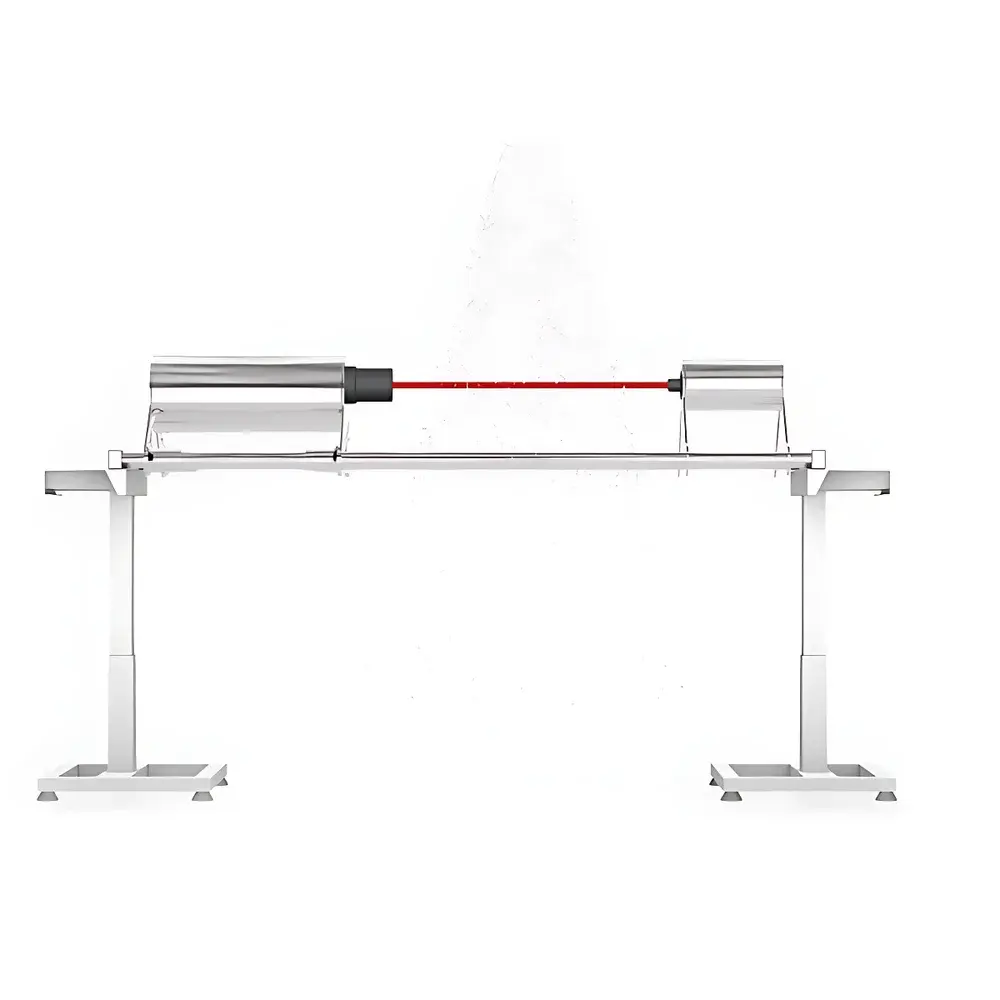
Bettersize Bettersize2000S Spray Laser Particle Size Analyzer
| Brand | Bettersize |
|---|---|
| Origin | Liaoning, China |
| Manufacturer | Bettersize Instrument Co., Ltd. |
| Model | Bettersize2000S |
| Dispersion Method | Wet Dispersion |
| Instrument Type | Laboratory Spray Laser Particle Size Analyzer |
| Measurement Range | 0.1–2000 µm |
| Repeatability | ≤1% (D50 deviation against certified reference materials) |
| Measurement Time | ≤10 s |
| Optical System | Fourier Transform Configuration with Parallel Beam Path |
| Scattering Theory | Mie Scattering (default), Fraunhofer Diffraction (optional) |
| Detector Array | 76-element photodiode array (forward and side scattering) |
| Sample Zone Length Adjustment | 0–700 mm (Standard), 0–1200 mm (Extended/Elevating/Comprehensive configurations) |
| IP Rating | IP65 |
| Laser Source | High-power semiconductor laser |
| Material | Full stainless-steel construction |
| Data Compliance | FDA 21 CFR Part 11 audit trail support |
| Standards Conformance | ISO 13320, GB/T 19077, GB/T 41949 |
Overview
The Bettersize Bettersize2000S Spray Laser Particle Size Analyzer is a purpose-built instrument engineered for high-fidelity characterization of droplet size distributions in dynamic spray fields. Unlike conventional laser diffraction systems optimized for static suspensions in narrow cuvettes (<5 mm path length), the Bettersize2000S operates in open-air, wide-field measurement geometry—supporting sample zones from 0 to 1200 mm in length—to capture real-time aerosol and atomized liquid behavior across industrial spray processes. Its optical architecture follows the internationally recommended Fourier transform configuration: a collimated semiconductor laser beam illuminates the spray plume; scattered light is collected by a large-aperture Fourier lens and resolved across a 76-channel photodetector array spanning forward and side angles. Particle size distribution is reconstructed using rigorous Mie scattering theory, with optional Fraunhofer approximation for rapid screening. This physical model selection ensures metrological traceability for both refractive and absorbing droplets—including aqueous, oily, solvent-based, pharmaceutical, and agrochemical formulations—under ambient or controlled environmental conditions (5–50 °C, <85% RH).
Key Features
- Modular, field-configurable design: Four operational variants—Standard (0–700 mm), Extended (0–1200 mm), Elevating (0–1200 mm + vertical positioning), and Comprehensive (elevating + integrated droplet generation)—enable precise adaptation to nozzle scale, spray height, and experimental protocol.
- Robust stainless-steel construction: Fully corrosion-resistant housing withstands exposure to oils, acids, alkalis, organic solvents, pesticides, and active pharmaceutical ingredients—ensuring long-term stability in demanding lab and pilot-line environments.
- IP65-rated enclosure: Dust-tight and protected against low-pressure water jets, enabling reliable operation in non-classified industrial settings including engine test cells, agricultural spray chambers, and pharmaceutical inhaler development labs.
- Auto-alignment and variable measurement zone: Motorized optical alignment system maintains beam centering without manual intervention; software-controlled adjustment of effective detection length allows spatially resolved profiling (e.g., near-nozzle vs. far-field droplet evolution).
- High-speed signal acquisition: Optimized USB-to-RS485 interface enables stable, noise-immune data transmission over distances up to 100 m—critical for integration into large-scale combustion rigs or outdoor spray test facilities.
Sample Compatibility & Compliance
The Bettersize2000S accommodates a broad spectrum of spray media without requiring dilution or carrier gas conditioning. It supports water-based emulsions, hydrocarbon fuels (diesel, jet fuel), ethanol–water blends, glycerol–propylene glycol mixtures (common in nebulized therapeutics), pesticide suspensions, and polymer solutions used in spray drying. All measurements comply with ISO 13320:2016 (laser diffraction particle sizing), GB/T 19077–2016 (Chinese national standard aligned with ISO), and GB/T 41949–2022 (spray-specific methodology). Accuracy is verified using NIST-traceable polystyrene latex standards; repeatability ≤1% D50 deviation meets JJF 1211–2008 and JJG 167–2020 metrological verification requirements. For regulated environments, the system implements FDA 21 CFR Part 11–compliant electronic records—including user authentication, audit trails, and immutable report generation.
Software & Data Management
The proprietary Bettersize Spray Analysis Software provides full control of hardware parameters, real-time visualization of scattering patterns, and automated calculation of volume-weighted (Dv10, Dv50, Dv90), number-weighted, and surface-area distributions. Batch processing supports time-series analysis across multiple spray events under varying pressure, flow rate, or nozzle geometry. Reports are exportable in editable formats (Word, Excel), publication-ready PDFs, and bitmap images (BMP). Data integrity safeguards include password-protected method templates, version-controlled calibration logs, and timestamped raw scatter profiles stored in HDF5 format for third-party reprocessing. Optional GLP/GMP mode enforces electronic signatures and dual-operator approval workflows.
Applications
- Pharmaceutical inhaler development: Quantifying respirable fraction (RF) and fine particle fraction (FPF) of pressurized metered-dose inhalers (pMDIs) and dry powder inhalers (DPIs) per USP & Ph. Eur. guidelines.
- Agricultural spray optimization: Correlating droplet spectra with canopy penetration, drift potential, and biological efficacy for herbicide, fungicide, and insecticide delivery systems.
- Combustion engineering: Mapping fuel atomization quality in diesel injectors, gas turbine nozzles, and rocket propulsion systems to improve ignition delay, flame stability, and soot formation.
- Aerosol science: Characterizing medical nebulizers, humidifiers, disinfectant foggers, and consumer fragrance dispensers for regulatory submission and product benchmarking.
- Nozzle R&D: Validating CFD simulations with empirical droplet Sauter mean diameter (SMD), span, and distribution skewness across Reynolds and Weber number regimes.
FAQ
What distinguishes the Bettersize2000S from standard laboratory laser diffraction analyzers?
It employs an open-path Fourier optical design with adjustable measurement zone length (up to 1200 mm), enabling direct in-situ characterization of unconfined spray plumes—whereas conventional instruments require confined, diluted samples in narrow flow cells.
Can the system measure opaque or highly absorbing liquids?
Yes—Mie scattering modeling accounts for complex refractive indices, allowing accurate sizing of diesel, crude oil, pigment dispersions, and drug-loaded liposomes without empirical correction factors.
Is the instrument suitable for GMP-regulated pharmaceutical testing?
Yes—when configured with audit trail, electronic signature, and secure user access controls, it satisfies FDA 21 CFR Part 11 and EU Annex 11 requirements for analytical instrumentation in quality control laboratories.
How is optical contamination prevented during extended operation in dusty or humid environments?
The patented tilted-angle lens mount incorporates a protective groove that deflects particulates and condensate away from the optical surface; combined with IP65 sealing and stainless-steel housing, it eliminates reliance on continuous purge gas.
Does the system support custom reporting for regulatory submissions?
Yes—templates conform to ICH M4 Q5 and USP <729> formatting conventions; all raw data, metadata, and processing parameters are embedded in export files for full traceability.



