
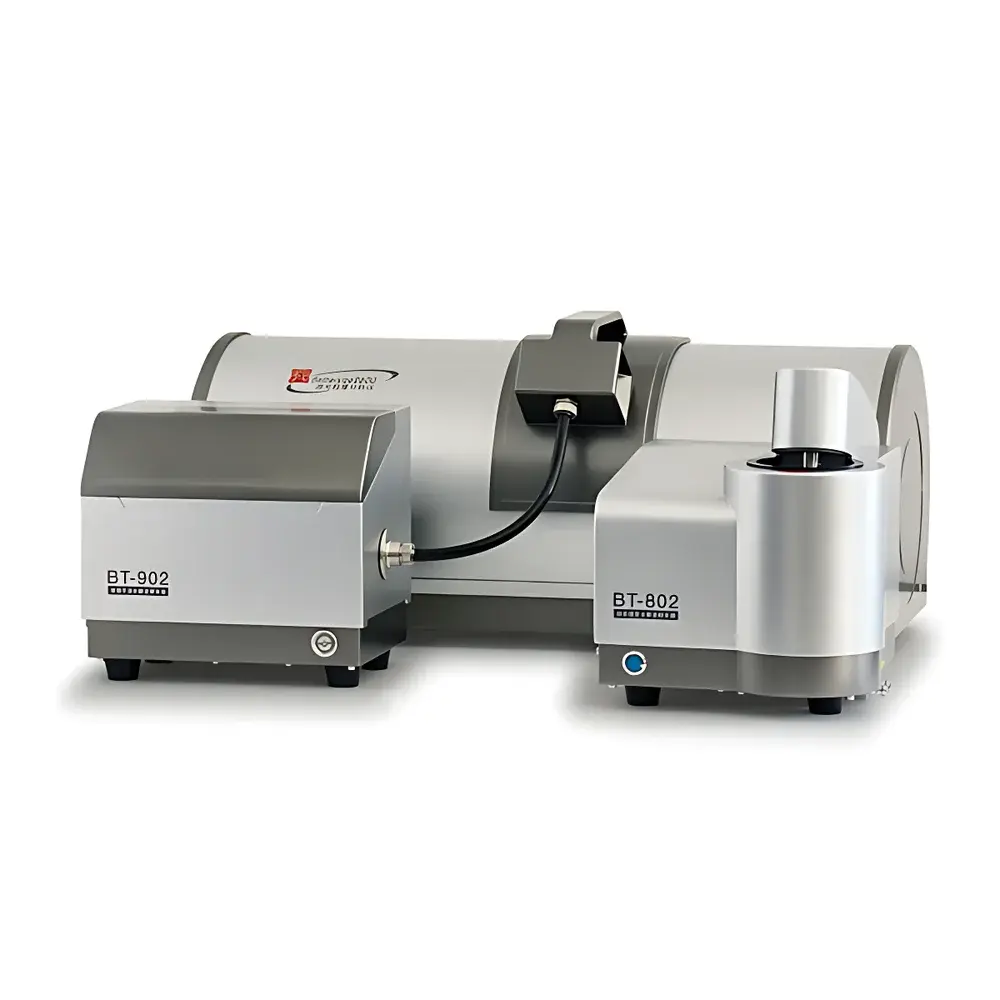
Bettersize Bettersize2600 Laser Particle Size Analyzer
| Brand | Bettersize |
|---|---|
| Origin | Liaoning, China |
| Manufacturer Type | Direct Manufacturer |
| Model | Bettersize2600 |
| Dispersion Method | Dry & Wet Dispersion |
| Instrument Type | Laboratory Laser Diffraction Particle Size Analyzer |
| Measurement Range | 0.02–2600 µm (wet), 0.1–2600 µm (dry) |
| Repeatability | ≤0.5% (D50 of NIST-traceable standards) |
| Single Measurement Time | ≤1 s |
| Optical System | Patented Forward-Reverse Fourier Hybrid Optical Path |
| Detector Channels | 92 (covering forward, side, and backward scattering angles) |
| Laser Source | High-Power Polarized Fiber Laser |
| Refractive Index Measurement | Integrated Real-Time Sample RI Determination |
| Compliance | ISO 13320:2020, GB/T 19077–2024, GB/T 41949–2022, USP <429>, EP 2.9.38, ChP 0982 |
| Data Integrity | FDA 21 CFR Part 11–Compliant Audit Trail & Electronic Signatures |
Overview
The Bettersize Bettersize2600 Laser Particle Size Analyzer is a high-precision laboratory instrument engineered for universal particle size distribution (PSD) characterization across nanoscale to millimeter-range materials. It operates on the Mie scattering theory—default and rigorously validated for optically heterogeneous samples—with optional Fraunhofer approximation and dynamic imaging modules for complementary morphological analysis. Its core innovation lies in the patented Forward-Reverse Fourier Hybrid Optical Path, a single-beam architecture that enables continuous, gap-free detection of scattered light from 0.015° to 165°—eliminating angular discontinuities inherent in multi-laser systems while avoiding refractive index artifacts caused by wavelength multiplexing. This design ensures metrological consistency across the full 0.02–2600 µm range (wet mode; extendable to 3500 µm with optional imaging module), with verified D100 capability and sub-micron resolution down to 20 nm. The tilted sample cell geometry further enhances signal fidelity for fine particles by minimizing multiple scattering and optical path distortion.
Key Features
- Patented Optical Architecture: 92-channel photodetector array distributed across forward, side, and backward scattering zones, enabling simultaneous capture of low-angle diffraction (coarse particles) and high-angle scattering (fine/nano particles) without mechanical reconfiguration.
- Integrated Refractive Index Measurement: Onboard optical sensor determines real-time complex refractive index (n + ik) of suspended or dry samples—critical for accurate Mie inversion and eliminating manual RI assumptions.
- Auto-Alignment & Contamination Control: Closed-loop motorized alignment system maintains laser beam centering within ±0.1 µm tolerance; negative-pressure lens protection prevents dust deposition during dry dispersion.
- Dual-Mode Dispersion Flexibility: Five interchangeable dispersion modules: (1) aqueous automatic circulation system with anti-dry-burn ultrasonic disperser (0–50 W, continuously adjustable), (2) solvent-based micro-circulation (8 mL volume), (3) manual/automated solvent loop, (4) standard dry powder feeder (5–20 g), and (5) micro-dry feeder (milligram-scale). All systems support fully automated SOP-driven workflows.
- Regulatory-Ready Software Infrastructure: Compliant with FDA 21 CFR Part 11 requirements—including role-based access control, electronic signatures, immutable audit trails, and data integrity validation protocols aligned with ALCOA+ principles.
Sample Compatibility & Compliance
The Bettersize2600 accommodates diverse material classes without compromise: water-soluble pharmaceutical actives, organic pigments, magnetic metal oxides, hydrophobic nanomaterials, abrasive ceramics, and fragile biological aggregates. Its wet dispersion systems are compatible with deionized water, ethanol, isopropanol, acetone, and other common solvents (chemical resistance certified per ASTM D543). Dry dispersion supports inert gas (N2, Ar) or compressed air operation at 0.1–0.8 MPa, with real-time concentration monitoring to prevent detector saturation. Regulatory conformance includes ISO 13320:2020 (laser diffraction), GB/T 19077–2024 (Chinese national standard), USP (light scattering), European Pharmacopoeia 2.9.38, and Chinese Pharmacopoeia General Chapter 0982. Validation reports include traceability to NIST SRM 1963 (silica) and ERM-FD102 (polystyrene latex), confirming ≤0.5% repeatability (RSD) on D50 across ≥10 replicate runs.
Software & Data Management
Equipped with Bettersize Particle Analysis Suite (BPAS) v5.x, the instrument delivers GxP-aligned data handling. BPAS supports method-defined SOPs with parameter locking, version-controlled template libraries, and automated report generation (PDF/CSV/XLSX) compliant with GLP/GMP documentation requirements. Raw scattering patterns, Mie inversion matrices, and residual error plots are archived with metadata (operator ID, timestamp, environmental conditions, calibration status). The software integrates with LIMS via ASTM E1384-compliant HL7 messaging and supports IQ/OQ/PQ protocol execution with built-in test scripts and certificate templates. All user actions—including data export, method modification, and calibration events—are logged with digital signatures and tamper-proof timestamps.
Applications
The Bettersize2600 serves as a primary PSD characterization tool in R&D, QC, and manufacturing environments across regulated and non-regulated sectors. In pharmaceutical development, it quantifies API crystallinity, excipient uniformity, and inhalable aerosol fractions per USP . Battery material labs use it to monitor cathode/anode particle growth during synthesis and assess slurry homogeneity pre-coating. Catalyst manufacturers rely on its bimodal resolution (JJF 1211–2008 Class A certified) to distinguish active phase distributions from support matrix peaks. Ceramics, coatings, and pigment producers leverage its wide dynamic range to correlate grinding efficiency with fineness-of-grind metrics (e.g., D90 < 2 µm for high-gloss automotive paints). Academic users apply its imaging module for shape-factor correlation studies (aspect ratio, circularity) alongside size data—enabling structure–property modeling in nanocomposites and colloidal systems.
FAQ
What optical theory does the Bettersize2600 use by default, and when would Fraunhofer approximation be appropriate?
It defaults to Mie scattering theory, which accounts for particle refractive index, absorption, and wavelength-dependent interactions—essential for accuracy across diverse materials. Fraunhofer approximation may be selected for rapid screening of opaque, large particles (>50 µm) where optical constants are unknown or less critical.
How is instrument accuracy maintained over time?
Through integrated reference standard verification (e.g., NIST SRM 1963), automated optical alignment, real-time RI measurement, and scheduled performance qualification using certified reference materials per ISO/IEC 17025 guidelines.
Can the system comply with FDA 21 CFR Part 11 for electronic records in pharmaceutical QA?
Yes. BPAS software provides full Part 11 compliance: electronic signatures with biometric or PKI authentication, audit trail review tools, and secure, encrypted database storage with backup integrity verification.
What is the smallest detectable particle size, and how is sub-100 nm resolution achieved?
The lower limit is 0.02 µm (20 nm) under optimized wet dispersion. Sub-100 nm resolution relies on high-sensitivity backward-scattering detection (up to 165°), polarized laser coherence enhancement, and advanced noise-reduction algorithms in the inversion engine.
Is method transfer possible between Bettersize2600 units in multi-site operations?
Yes. SOPs—including dispersion parameters, optical models, and reporting formats—are exportable/importable as encrypted XML files. Cross-unit equivalence is verified via inter-laboratory round-robin testing per ISO 5725.



