
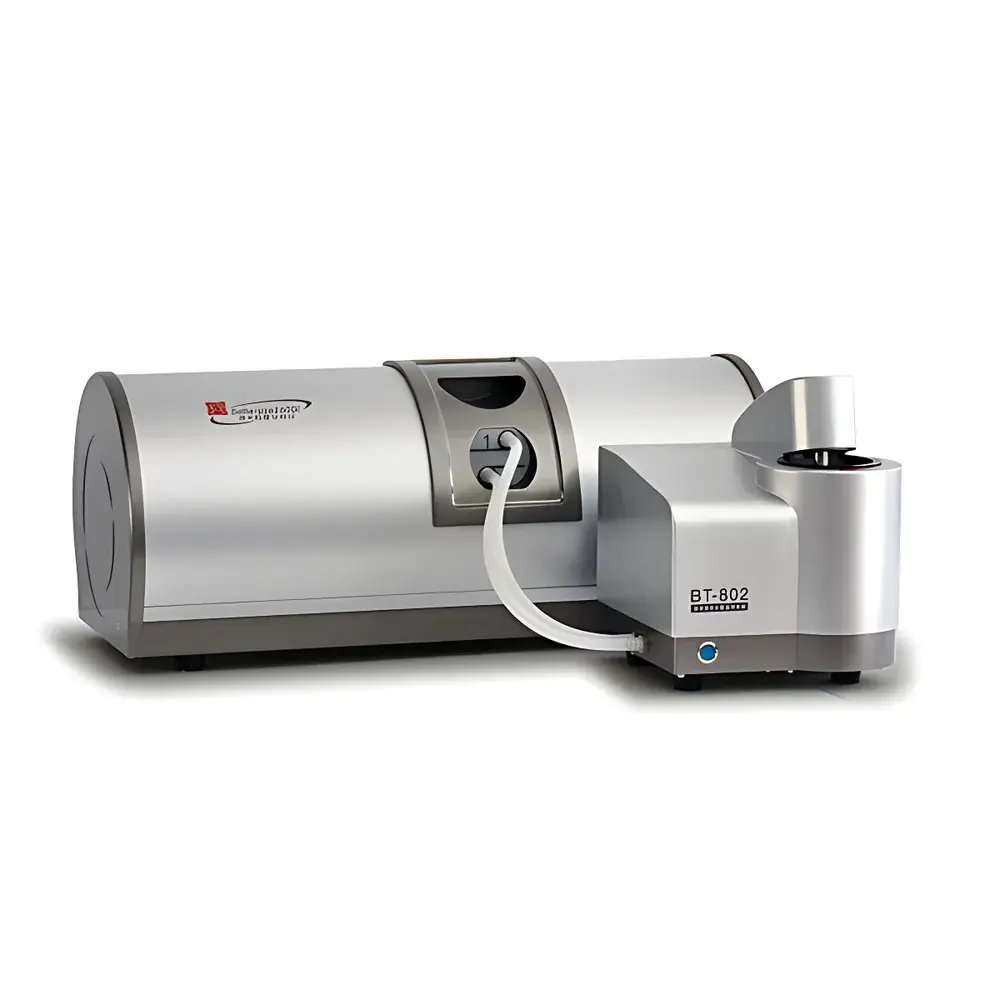
Bettersize Bettersize2600E Laser Particle Size Analyzer
| Brand | Bettersize |
|---|---|
| Origin | Liaoning, China |
| Manufacturer Type | Direct Manufacturer |
| Model | Bettersize2600E |
| Dispersion Method | Dry & Wet |
| Instrument Type | Laboratory Laser Particle Size Analyzer |
| Measurement Range | 0.1–1500 µm |
| Repeatability | ≤0.5% |
| Single Measurement Time | <1 s |
| Optical Principle | Mie Scattering (default), Fraunhofer Diffraction (optional) |
| Detector Channels | 90 (forward, side, and backward scattering) |
| Laser Source | High-power polarized fiber laser |
| Optical Design | Inverted Fourier optical system with tilted sample cell (patented) |
| Refractive Index Measurement | Yes (patented) |
| Wet Dispersion | Automatic water circulation system with anti-dry-burn ultrasonic disperser (0–50 W, adjustable) |
| Dry Dispersion | Standard auto-feeder (5–20 g) |
| Compliance | ISO 13320:2020, GB/T 19077–2024, GB/T 41949–2022, USP <429>, EP 2.9.38, ChP 0982 |
| Data Security | FDA 21 CFR Part 11 compliant |
| Regulatory Alignment | Supports GLP/GMP audit trails and SOP-driven workflows |
Overview
The Bettersize Bettersize2600E Laser Particle Size Analyzer is a dual-mode laboratory instrument engineered for high-precision particle size distribution (PSD) analysis across the full range of 0.1–1500 µm. It operates on the physical principle of laser light scattering—primarily Mie scattering theory for optically dense or submicron particles, with optional Fraunhofer diffraction modeling for rapid screening of coarse or weakly scattering materials. Its inverted Fourier optical architecture integrates a patented tilted sample cell design and a high-numerical-aperture achromatic lens assembly to maximize angular coverage of scattered light, enabling robust resolution of both fine and coarse fractions within polydisperse samples. Unlike conventional entry-level analyzers, the Bettersize2600E retains core metrological capabilities—including refractive index determination, multi-peak resolution (A-grade per JJF1211–2008 and JJG167–2020), and traceable accuracy calibration—while delivering cost-effective operation through an optimized optical path that eliminates redundant detector redundancy without compromising data fidelity.
Key Features
- Dual dispersion capability: Fully integrated dry and wet measurement modes in a single platform, with tool-free switching between configurations
- Patented anti-contamination airflow path: Aerodynamically designed inlet/outlet channels prevent lens fouling during dry dispersion, extending optical component service life
- Automated wet dispersion system: Includes programmable ultrasonic energy control (0–50 W), auto-fill/auto-drain cycles, degassing algorithms to eliminate microbubbles, and self-cleaning protocols between runs
- Micro-dry sampling option: Enables quantitative analysis of mg-scale samples—critical for high-value catalysts, pharmaceutical actives, or nanomaterials
- Polarized fiber laser source: Delivers stable, low-noise illumination with minimal thermal drift, supporting long-term repeatability under continuous operation
- 90-channel photodetector array: Covers forward, lateral, and wide-angle backward scattering angles, essential for resolving bimodal or multimodal distributions
- Real-time signal stabilization: Combines stochastic noise recognition algorithms with high-bandwidth pre-amplification to suppress environmental and electrical interference
Sample Compatibility & Compliance
The Bettersize2600E accommodates diverse particulate systems—including water-soluble pharmaceuticals, magnetic metal powders, cementitious binders, and organic pigments—without cross-contamination risk. Its dry mode uses inert gas-compatible pressure regulation (0.1–0.8 MPa), permitting safe analysis of pyrophoric or oxidation-sensitive materials. The wet module supports aqueous and non-aqueous solvents (minimum 8 mL volume), with temperature-stable flow control for viscosity-sensitive suspensions. Regulatory alignment includes full compliance with ISO 13320:2020 (laser diffraction standards), GB/T 19077–2024 (Chinese national standard for particle sizing), and pharmacopeial methods USP , EP 2.9.38, and ChP 0982. Instrument validation, calibration traceability, and electronic record integrity meet FDA 21 CFR Part 11 requirements—including role-based access control, audit trail generation, and electronic signature support for GLP/GMP environments.
Software & Data Management
The embedded software platform supports SOP-driven workflows with customizable test templates, automated pass/fail criteria, and batch reporting in PDF/CSV/XLSX formats. All measurement parameters—including laser power, ultrasonic amplitude, dispersion pressure, and refractive index—are logged with timestamps and user IDs. Raw scattering intensity data is preserved in binary format for retrospective reprocessing using alternative optical models. Multi-instrument synchronization enables centralized fleet management, while API integration supports LIMS connectivity and automated data ingestion into enterprise QA/QC databases. Software updates are delivered via secure HTTPS channel with cryptographic signature verification.
Applications
This analyzer serves routine quality control and R&D applications across industrial and academic sectors. It is routinely deployed for characterization of non-metallic minerals (e.g., calcium carbonate, kaolin, talc), metallic powders (Al, Zn, W, rare-earth alloys), battery cathode/anode materials (LiCoO₂, graphite), catalysts (zeolites, Pt/C), pharmaceutical excipients and APIs, ceramic slurries, pigment dispersions, and environmental particulates (river sediments, airborne dust). Its broad dynamic range and dual-mode flexibility make it especially suitable for labs handling heterogeneous feedstocks—such as additive manufacturing suppliers qualifying both polymer-coated metal powders and uncoated ceramics—or contract testing facilities managing client samples with variable solubility and density profiles.
FAQ
Does the Bettersize2600E require external calibration standards for daily use?
No—built-in reference verification routines allow users to confirm optical alignment and detector response stability before each session using internal diagnostic patterns; certified NIST-traceable standards are recommended for periodic accuracy validation (e.g., quarterly or per ISO/IEC 17025).
Can the instrument measure particle shape or morphology?
No—the Bettersize2600E reports only equivalent spherical diameter (ESD) based on scattering intensity distribution; morphological analysis requires complementary techniques such as SEM imaging or dynamic image analysis.
Is remote monitoring or troubleshooting supported?
Yes—via optional Ethernet-enabled remote desktop access with encrypted VNC tunneling, allowing qualified service engineers to diagnose hardware status, review log files, and adjust low-level firmware parameters without onsite visits.
What maintenance intervals are recommended for the ultrasonic disperser and dry dispersion nozzles?
Ultrasonic transducers should be inspected every 500 operating hours for cavitation erosion; dry dispersion nozzles require cleaning after every 200 dry tests or immediately following hygroscopic or adhesive samples to prevent clogging.
How does the system handle samples with high aspect ratio or agglomerated structures?
The wet module’s variable-power ultrasonication (0–50 W) and programmable duty cycle allow optimization of deagglomeration energy, while the dry mode’s adjustable dispersion pressure and shear nozzle geometry enable controlled break-up of fragile aggregates without fracturing primary particles.
Related Products



