
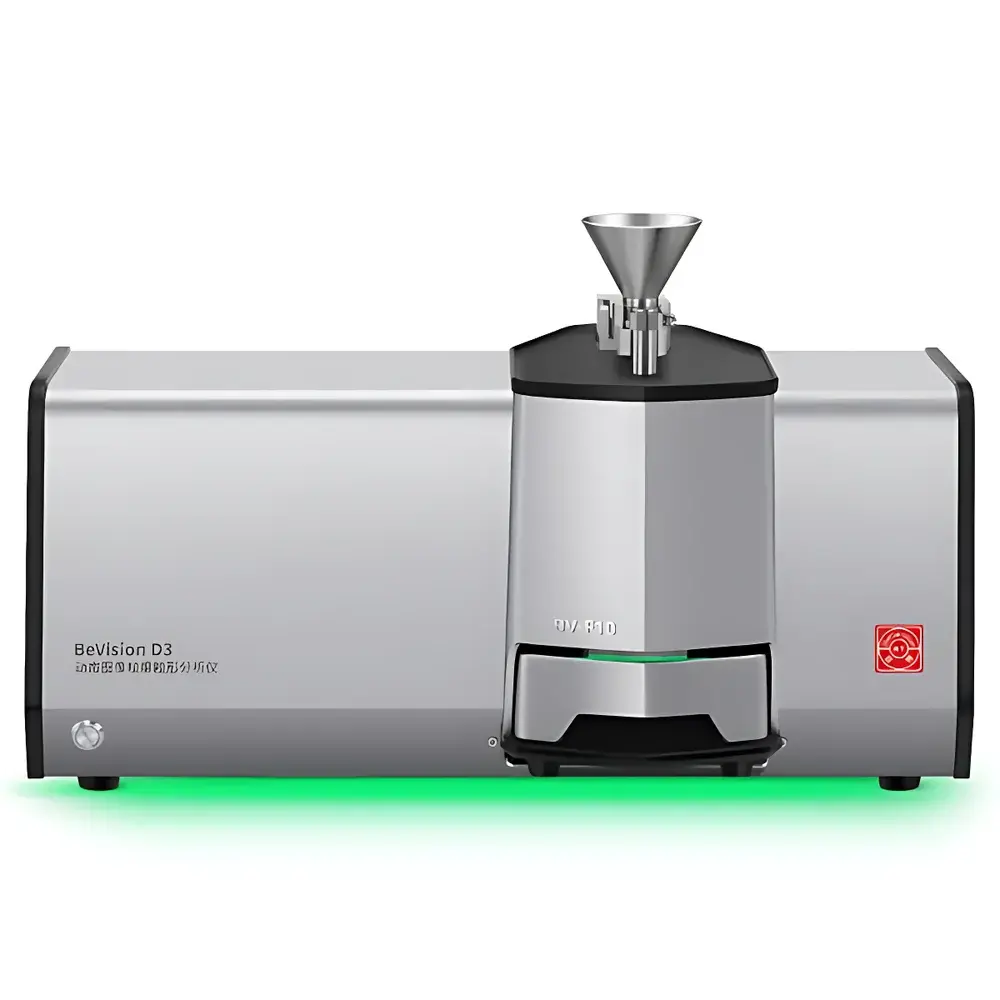
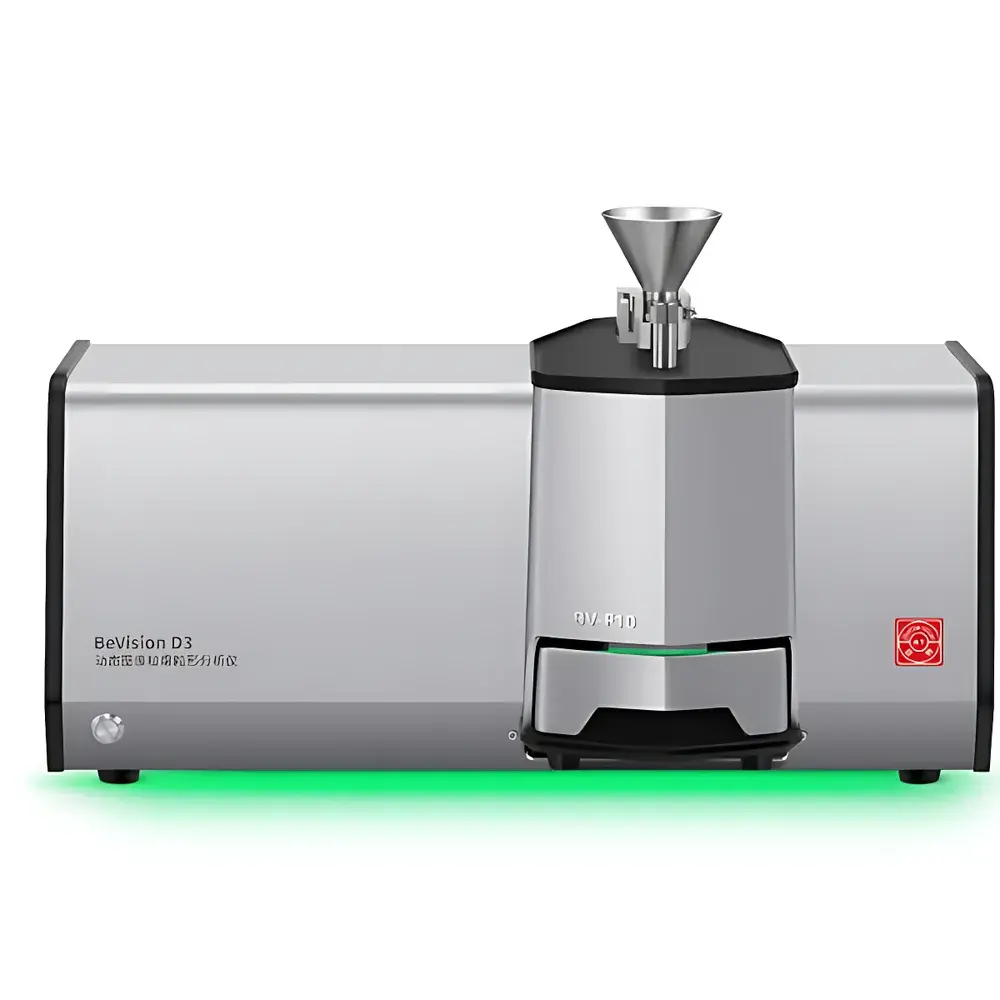
Bettersize BeVision D3 Dynamic Image-Based Particle Size and Shape Analyzer
| Brand | Bettersize |
|---|---|
| Origin | Liaoning, China |
| Manufacturer | Bettersize Instrument Co., Ltd. |
| Model | BeVision D3 |
| Instrument Type | Dynamic |
| Measurement Principle | Dynamic Image Analysis (DIA) |
| Optical System | Dual-CMOS Imaging System (BeVision D3 Pro variant) / Single-CMOS (other variants) |
| Measuring Range | 0.5–16,000 µm (model-dependent |
| ISO-compliant range | 2–8,000 µm) |
| Camera Resolution | 5 MP |
| Light Source | Green LED and/or Blue LED |
| Repeatability (D50, standard reference material) | ≤0.5% |
| Software | BeVision 5.0 |
| Compliance | ISO 13322-2, ISO 9276, GB/T 21649, GB/T 15445 |
| Dimensions (L×W×H) | 686 × 300 × 325 mm |
| Weight | 24 kg |
| Power Supply | 100–240 VAC, 50/60 Hz |
| PC Requirements | Intel Core i9 (14th gen), 32 GB RAM, Windows 10+, 1 TB SSD |
Overview
The Bettersize BeVision D3 is a high-performance, fully automated dynamic image-based particle size and shape analyzer engineered for precision characterization of dry, free-flowing powders and granular materials. It operates on the principle of Dynamic Image Analysis (DIA), where particles undergo controlled gravitational dispersion in free-fall while being imaged in real time by high-speed CMOS cameras. Unlike static image analysis systems that require sedimentation or manual sample preparation, the BeVision D3 captures particles in motion—ensuring representative sampling of dispersed states critical for assessing flowability, packing behavior, and process suitability. Its dual-camera configuration (in the D3 Pro variant) enables simultaneous wide-field and high-magnification imaging, extending effective measurement coverage across ultra-fine (15 mm) particle populations without hardware reconfiguration. The system integrates BV-F10 gravity-fed dry dispersion technology—featuring vibration-assisted feed control, selectable friction-coefficient sample troughs, and auto-regulated feed rate—to achieve consistent deagglomeration and minimize particle interaction artifacts. All optical components—including telecentric lenses and monochromatic, uniform planar illumination—are calibrated to eliminate perspective distortion, depth-of-field bias, and chromatic aberration, ensuring metrologically traceable pixel-to-length mapping per ISO 13322-2.
Key Features
- Real-time dynamic imaging with synchronized dual-CMOS acquisition (D3 Pro) or high-resolution single-CMOS (D3, D3 Macro, D3 Zoom) for broad-range particle capture
- Automated, closed-loop feed-rate control via BV-F10 dispersion module—optimizing dispersion efficiency, measurement repeatability, and throughput
- ISO 13322-2 compliant optical architecture: telecentric imaging path, collimated monochromatic illumination (green or blue), and distortion-free field calibration
- Comprehensive particle segmentation algorithm suite—automatically rejecting dust, fiber contaminants, agglomerates, and out-of-focus objects prior to analysis
- Granular-level feature extraction: over 37 quantitative parameters derived from each individual particle—including 13 size descriptors (e.g., area-equivalent diameter, Feret diameters, sieve-equivalent diameter) and 14 shape metrics (e.g., aspect ratio, circularity [11 algorithms], convexity, solidity, elongation)
- Customizable classification logic: user-defined filters enable selective analysis of subpopulations (e.g., rod-shaped catalysts, angular abrasives) within heterogeneous mixtures
- Sieve-correlation engine: applies empirically validated correction models to align DIA-derived size distributions with legacy sieve data—enabling seamless transition from mechanical sieving to digital analysis
- High statistical robustness: >106 particles analyzed per typical 3-minute run, supporting reliable detection of trace oversized/undersized fractions (<0.01% abundance)
Sample Compatibility & Compliance
The BeVision D3 is validated for dry, non-cohesive, and moderately cohesive particulates exhibiting sufficient flowability for gravity-driven dispersion. It accommodates materials ranging from pharmaceutical excipients and catalytic supports to mineral ores, food powders, battery electrode slurries (after drying), and additive manufacturing feedstocks. Sample introduction requires no solvents, surfactants, or vacuum systems—reducing operational complexity and eliminating liquid-phase artifacts (e.g., swelling, dissolution, or hydrodynamic drag). All measurement protocols adhere strictly to ISO 13322-2 (Part 2: Dynamic image analysis methods) and ISO 9276 (representation of particle size distribution). The instrument’s traceable calibration workflow satisfies GLP and GMP documentation requirements, including full audit trails for instrument settings, environmental logs (temperature/humidity), and raw image metadata. Optional BV-F10 accessories—including 150 mL and 600 mL stainless-steel hoppers and dual-friction troughs—allow optimization for fine, dense, or fibrous materials.
Software & Data Management
BeVision 5.0 is a modular, 64-bit Windows application built on a deterministic image-processing pipeline with embedded validation checkpoints. It supports full FAIR (Findable, Accessible, Interoperable, Reusable) data principles: all raw images, binary masks, feature vectors, and statistical summaries are stored in vendor-neutral HDF5 containers with embedded EXIF-like metadata. The software provides configurable reporting templates compliant with 21 CFR Part 11—enabling electronic signatures, role-based access control, and immutable audit logs for critical quality attributes (CQAs). Users can export results in multiple formats: Excel (.xlsx) with pivot-ready tables, CSV for LIMS integration, PDF reports with embedded interactive charts, and bitmap exports (JPG/BMP) for publication. Advanced analytics include bivariate scatter plots (e.g., circularity vs. aspect ratio), hierarchical clustering of particle morphologies, and batch comparison tools with statistical significance testing (Kolmogorov–Smirnov, Anderson–Darling). Custom Python scripting interfaces allow extension into AI-driven classification workflows (e.g., deep learning–based defect identification).
Applications
- Pharmaceutical solid dosage development: quantifying API crystal habit, excipient sphericity, and blend uniformity—supporting QbD initiatives and ICH Q5A/Q5C compliance
- Catalyst and adsorbent R&D: correlating pore accessibility with external morphology (e.g., rod aspect ratio, surface roughness) for structure–activity modeling
- Mineral processing optimization: grading crushed ore based on angularity and surface texture to predict downstream flotation efficiency
- Food powder quality control: monitoring starch granule integrity, sugar crystal polymorphism, and milk powder dispersibility
- Advanced materials: characterizing 3D-printing metal powders (sphericity, satellite count), battery cathode agglomerates, and ceramic green-body homogeneity
- Regulatory submissions: generating ISO-aligned particle data packages for FDA, EMA, or PMDA filings—particularly where morphological CQAs impact dissolution or aerosolization performance
FAQ
How does the BeVision D3 ensure measurement repeatability across operators and laboratories?
The system eliminates operator-dependent variables through fully automated dispersion, fixed optical geometry, and standardized image segmentation protocols—achieving ≤0.5% D50 repeatability on irregular materials (e.g., fractured soybean particles) and <0.1% on monodisperse standards.
Can BeVision D3 replace traditional sieve analysis in QC labs?
Yes—the integrated sieve-correlation algorithm adjusts DIA outputs to match historical sieve data within ±2% relative error, enabling direct substitution without method revalidation in most GMP environments.
What particle characteristics are most relevant for predicting powder flowability?
Circularity, convexity, and aspect ratio collectively explain >85% of variance in Hausner ratio and Carr index—parameters directly extractable from BeVision D3’s shape library and exportable to flow modeling software.
Is the instrument suitable for measuring fragile or friable particles?
The BV-F10 dispersion module uses low-energy vibration and gravity-fed transport—avoiding impeller shear or pneumatic stress—making it appropriate for delicate crystalline APIs or porous microspheres.
How is calibration verified and maintained?
NIST-traceable stage micrometers and certified PSL sphere standards are used for daily focus and scale verification; full optical alignment checks are performed semiannually per ISO 17025 guidelines.



