
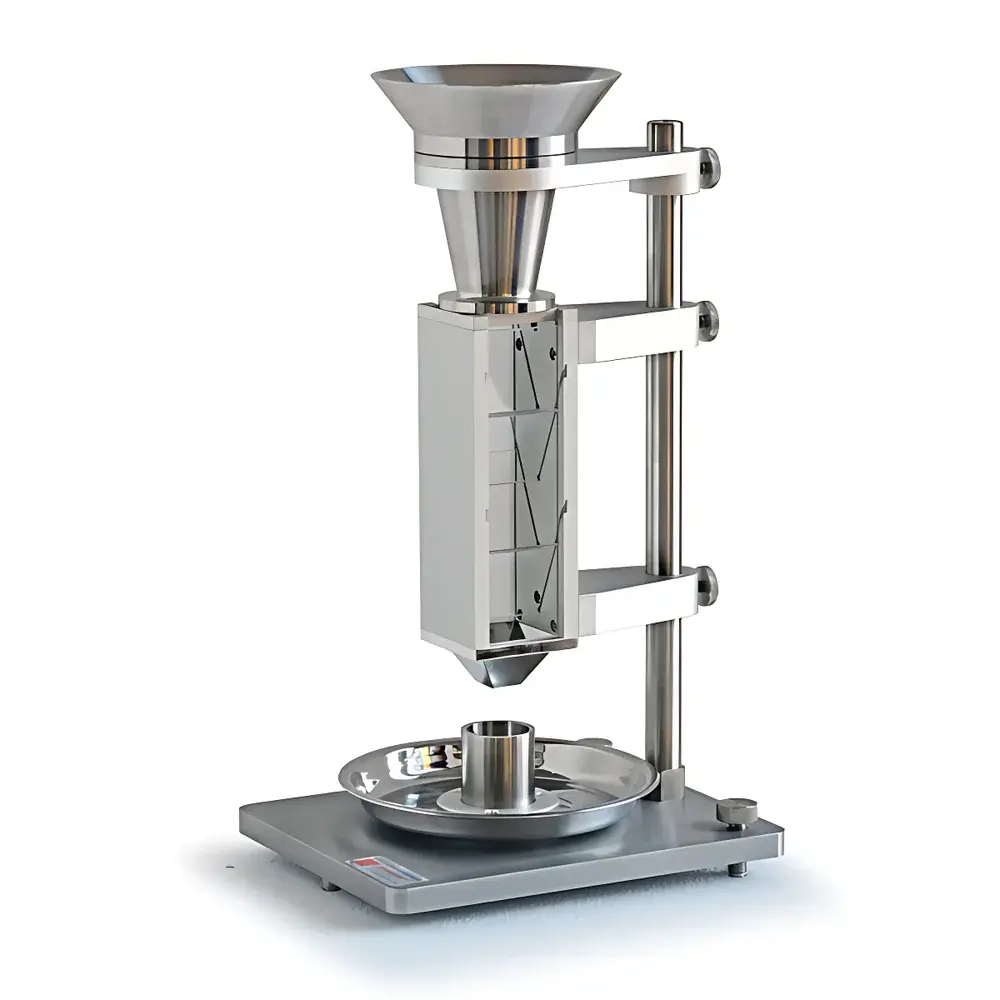
Bettersize BT-101 Scott Volumeter for Apparent Density Measurement
| Brand | Bettersize |
|---|---|
| Origin | Liaoning, China |
| Manufacturer | Yes |
| Country of Origin | China |
| Model | BT-101 |
| Instrument Type | Apparent Density Tester (Scott Volumeter Method) |
| Measurable Material | Metal Powders |
| Compliance Standards | GB/T 1479.2–2011, ISO 3923-2, USP <616>, Ph. Eur. 2.9.34, ChP 2020 General Chapter 0993 |
Overview
The Bettersize BT-101 Scott Volumeter is a precision-engineered apparatus designed for the standardized determination of apparent (bulk) density of free-flowing metal powders and other granular materials. It implements the Scott volumeter method—a gravimetric technique defined by controlled gravitational flow through a calibrated multi-stage funnel system—to quantify the volume occupied by a known mass of powder under reproducible, low-energy packing conditions. Unlike tap density or vibrated density measurements, the Scott method simulates low-disturbance filling behavior relevant to silo storage, hopper discharge, and gravity-fed processing environments. Its operational principle relies on consistent powder flow regulation via a stainless-steel sieve, damping chamber, and square-section outlet funnel—ensuring minimal particle segregation and kinetic energy dissipation prior to volumetric containment in a standardized 25 cm³ brass cup. The resulting apparent density value (g/cm³) serves as a critical quality attribute in powder metallurgy, pharmaceutical solid dosage manufacturing, battery electrode material qualification, and regulatory batch release testing.
Key Features
- Compliant mechanical design per GB/T 1479.2–2011, ISO 3923-2, USP , and European Pharmacopoeia 2.9.34—enabling direct use in GLP/GMP-regulated laboratories.
- Integrated brass volumetric cup (25.00 ± 0.05 cm³) with precision-machined rim for repeatable刮平 (leveling) using a 45°-angle straight-edge scraper.
- Multi-stage flow control assembly: 200 µm stainless-steel sieve, perforated damping box, and square-section funnel (19 mm × 19 mm outlet) to minimize air entrapment and flow turbulence.
- Modular base platform compatible with standard analytical balances (0.01 g readability recommended); cup tare function supported via external balance zeroing.
- Optional ASTM B329-compliant configuration available upon request—including dimensional adjustments to funnel geometry and cup volume for specification alignment.
- Non-electronic, mechanically robust architecture requiring no calibration software or firmware—ideal for audit-trail simplicity and long-term operational stability.
Sample Compatibility & Compliance
The BT-101 is validated for use with metal powders (e.g., iron, aluminum, titanium, nickel alloys), ceramic precursors, and pharmaceutical excipients exhibiting moderate to high flowability (Hausner ratio < 1.4). It is not suitable for cohesive, hygroscopic, or electrostatically charged powders without pre-conditioning (e.g., drying, anti-static treatment). Regulatory compliance includes full traceability to pharmacopoeial monographs: USP mandates Scott volumeter use for “Apparent Density of Metal Powders” in compendial testing; ChP 2020 General Chapter 0993 references identical procedural logic for raw material acceptance. All test procedures adhere to documented Standard Operating Procedures (SOPs) supporting FDA 21 CFR Part 11–aligned data integrity frameworks when paired with compliant balance systems and electronic lab notebooks.
Software & Data Management
The BT-101 operates as a standalone mechanical instrument with no embedded electronics or proprietary software. Data acquisition and reporting are performed externally using laboratory balance interfaces and validated spreadsheet templates or LIMS-integrated platforms. Users may implement automated calculation modules that enforce the pharmacopoeial requirement: three independent determinations, arithmetic mean reported to 0.01 g/cm³, with outlier reporting (max/min values disclosed if deviation exceeds ±1% of mean). Audit trails—including balance calibration certificates, environmental monitoring logs (temperature/humidity), and operator identification—are maintained per ISO/IEC 17025 and ICH Q5C guidelines.
Applications
- Quality control of atomized metal powders for additive manufacturing feedstock qualification (ASTM F3049).
- Batch-to-batch consistency verification in lithium-ion cathode/anode material production (e.g., NMC, LFP, graphite).
- Pharmaceutical excipient characterization per ICH Q5E and USP powder flow assessment matrices.
- Research-grade correlation studies between apparent density, particle size distribution (PSD), and sintering behavior.
- Regulatory submission support for ANDA, NDA, and MDR technical documentation requiring compendial density data.
FAQ
What standards does the BT-101 comply with?
It conforms to GB/T 1479.2–2011, ISO 3923-2, USP , Ph. Eur. 2.9.34, and ChP 2020 General Chapter 0993. ASTM B329 compliance is available as a factory-configured option.
Can the BT-101 be used for non-metallic powders?
Yes—provided the material exhibits sufficient flowability and passes through the 200 µm sieve without bridging or static adhesion. Validation per USP is recommended for pharmaceutical applications.
Is operator training required to achieve reproducible results?
Yes. Consistent technique—including controlled spooning rate, scraper angle (45°), unidirectional leveling motion, and avoidance of vibration—is essential. Bettersize provides SOP templates and operator qualification protocols aligned with ISO 8503-2.
Does the instrument require annual recalibration?
No electronic components exist; however, volumetric cup dimensions and sieve aperture must be verified annually per ISO/IEC 17025 using certified metrology tools (e.g., optical comparator, laser micrometer).
How is measurement uncertainty assessed?
Uncertainty budgeting follows EURACHEM/CITAC Guide CG4, incorporating balance repeatability (k=2), cup volume tolerance (±0.2%), and operator-induced variability (determined during method validation). Typical expanded uncertainty is ≤0.03 g/cm³ at k=2.



