
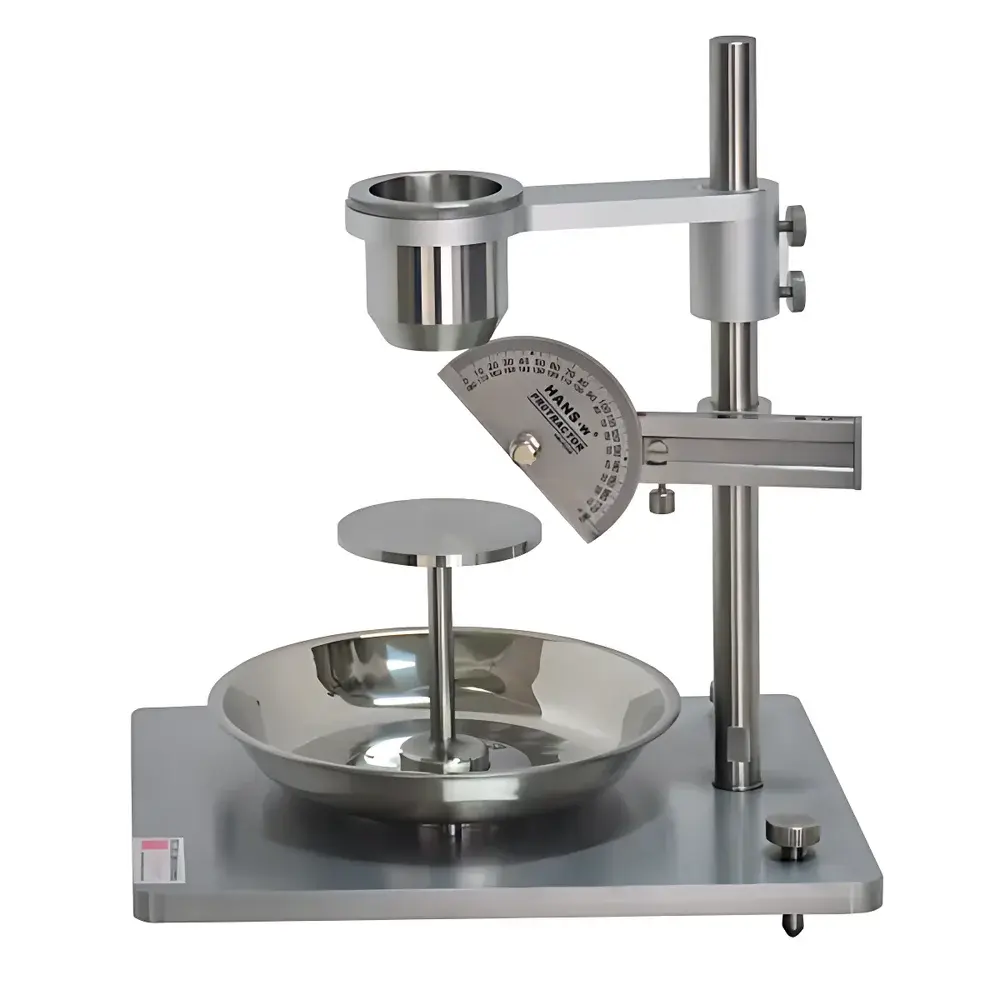
Bettersize BT-103 Powder Flowability Tester (Angle of Repose Analyzer)
| Brand | Bettersize |
|---|---|
| Model | BT-103 |
| Measurement Principle | Fixed-base funnel method (gravity-fed conical pile formation) |
| Measured Parameter | Angle of Repose (θr) |
| Compliance | GB/T 16913–2008, USP <1174>, Ph. Eur. 2.9.36 |
| Origin | Liaoning, China |
| Manufacturer Type | Original Equipment Manufacturer (OEM) |
Overview
The Bettersize BT-103 Powder Flowability Tester is a precision-engineered instrument designed to determine the angle of repose (θr) of free-flowing and cohesive powders under standardized gravitational conditions. Based on the fixed-base funnel method—where powder is discharged from a defined orifice onto a flat, non-adhesive circular base—the device enables reproducible formation of a conical powder pile. The angle of repose is defined as the maximum acute angle between the sloping surface of the static cone and the horizontal supporting plane. This parameter serves as a fundamental, empirically validated indicator of bulk powder flow behavior, directly correlating with interparticle friction, cohesion, particle shape, surface roughness, and moisture content. Unlike dynamic or shear-based methods, the BT-103 provides rapid, low-cost, and operator-independent assessment aligned with internationally recognized pharmacopeial and industrial test protocols.
Key Features
- Standard-compliant funnel geometry and base platform dimensions per GB/T 16913–2008, USP , and Ph. Eur. 2.9.36—ensuring regulatory traceability and cross-laboratory comparability.
- Adjustable funnel height and orifice diameter optimized for consistent powder discharge kinetics across diverse material classes (e.g., lactose, API blends, cathode active materials, food starches).
- Rotatable 360° calibrated receiving plate with three fixed measurement positions (0°, 120°, 240°), enabling triple-angle acquisition to mitigate localized pile asymmetry and improve statistical robustness.
- Dual-mode operation: gravity-driven flow for free-flowing powders; optional gentle mechanical agitation (via calibrated tap or probe) for marginally cohesive or bridging-prone samples—without altering fundamental test physics.
- Modular stainless-steel construction with anti-static treatment and smooth internal funnel surfaces to minimize wall adhesion and ensure clean powder release.
- No electronic sensors or moving parts in the core measurement path—maximizing long-term mechanical stability and eliminating calibration drift associated with load cells or optical encoders.
Sample Compatibility & Compliance
The BT-103 accommodates dry, granular, and powdered materials with particle size distributions ranging from ~10 µm to 2 mm, including pharmaceutical excipients (microcrystalline cellulose, mannitol), battery electrode powders (NMC, LFP), catalysts, metal alloys, polymer granules, and food-grade ingredients (whey powder, flour). It is not intended for wet, sticky, fibrous, or highly electrostatic materials requiring fluidization or shear cell analysis. All operational procedures strictly adhere to the sample preparation, environmental conditioning (20–25°C, 40–60% RH unless otherwise specified), and measurement repeatability requirements outlined in GB/T 16913–2008. For GMP-regulated environments, the manual workflow supports documented SOP execution, raw data recording in lab notebooks, and audit-ready traceability—fully compatible with GLP/GMP documentation frameworks and FDA 21 CFR Part 11–compliant electronic record systems when integrated with approved digital loggers.
Software & Data Management
While the BT-103 operates as a stand-alone mechanical instrument without embedded electronics, it is fully compatible with third-party digital documentation ecosystems. Users may integrate high-resolution angle measurement via calibrated smartphone applications or digital protractors certified to ISO 6789–2:2017 accuracy standards. Raw angular values (θr1, θr2, θr3) are recorded manually or imported into LIMS or ELN platforms supporting structured metadata capture—including batch ID, operator name, ambient conditions, sieve fraction used, and time/date stamps. Optional Excel-based calculation templates (provided by Bettersize upon request) automate arithmetic mean computation, standard deviation reporting, and trend chart generation across multiple lots or process stages—facilitating routine QC release testing and formulation development workflows.
Applications
- Pharmaceutical solid dosage development: screening excipient compatibility, detecting moisture-induced flow degradation during stability studies, and qualifying blend uniformity prior to tableting.
- Battery material quality control: monitoring flow consistency of cathode/anode slurries’ dry powders to ensure uniform die-filling and coating integrity in roll-to-roll manufacturing.
- Food & nutraceutical processing: evaluating flow performance of hygroscopic powders (e.g., vitamin C, probiotics) under varying humidity conditions to optimize hopper design and prevent arching.
- Chemical catalyst handling: assessing flowability changes induced by calcination temperature or surface passivation treatments.
- Academic research: serving as a foundational reference method in powder mechanics laboratories for validating computational discrete element modeling (DEM) simulations.
- Storage & handling engineering: correlating θr trends with silo discharge behavior, ratholing propensity, and minimum hopper outlet sizing per Jenike methodology.
FAQ
What is the recommended sample mass for BT-103 testing?
Typical sample volume is 100 mL (measured using the supplied volumetric cup), corresponding to mass ranges of 30–120 g depending on powder density. Overfilling or underfilling affects cone geometry and must be avoided per GB/T 16913–2008.
Can the BT-103 measure other flow parameters besides angle of repose?
No. The BT-103 is purpose-built exclusively for angle of repose determination. It does not provide Hausner ratio, compressibility index, or shear strength data—those require complementary instruments such as tap density testers or rotational shear cells.
Is calibration required before each test?
The instrument requires no periodic calibration. However, users must verify levelness of the base platform and alignment of the funnel centerline using the included spirit level and alignment gauge prior to each test session.
How does humidity affect angle of repose measurements?
Relative humidity significantly influences interparticle capillary forces and electrostatic charge retention. Testing must be conducted in a controlled environment (ideally 20–25°C, 40–60% RH) with samples preconditioned for ≥24 h to ensure equilibrium moisture content.
Does the BT-103 comply with FDA or EMA regulatory expectations for pharmaceutical use?
Yes—its methodology is explicitly referenced in USP and Ph. Eur. 2.9.36, both cited in FDA guidance documents and EMA reflection papers on powder characterization for QbD-based product development.



