
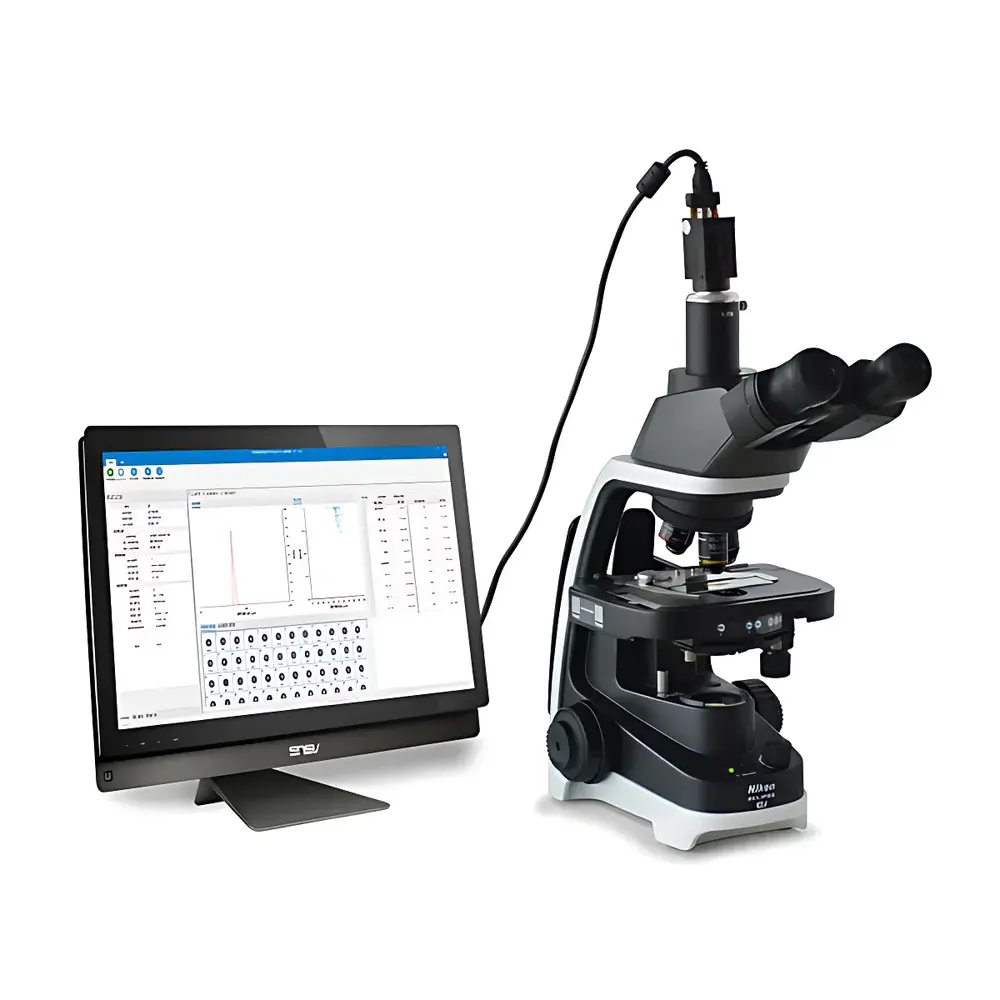
Bettersize BT-1600 Static Image-Based Particle Size and Shape Analyzer
| Brand | Bettersize |
|---|---|
| Origin | Liaoning, China |
| Manufacturer | Bettersize Instruments Co., Ltd. |
| Type | Static Image Analyzer |
| Measurement Range | 0.3–4500 µm |
| Magnification Options | 80× / 160× / 400× / 1600× / 4000× |
| Camera Resolution | 12 MP |
| Repeatability & Accuracy (D50) | ≤1% (per GB/T standard reference materials) |
| Calibration Standard | NIST-traceable micrometer scale (10 µm division) |
| Pixel-to-Size Calibration | Direct pixel mapping via stage-mounted graticule |
| Operating System | Windows 10/11 |
| Interface | USB 3.0 |
| Particle Parameters | Area-equivalent diameter, perimeter-equivalent diameter, major/minor axis (Feret), conjugate Feret diameter, Legendre ellipse major/minor axis, Martin length/width |
| Shape Parameters | Aspect ratio, circularity (11 algorithms), elongation, straightness, ellipticity, irregularity, compactness, convexity, concavity, solidity, convex hull ratio |
Overview
The Bettersize BT-1600 Static Image-Based Particle Size and Shape Analyzer is a precision optical metrology system engineered for quantitative morphological characterization of dry or dispersed particulate solids. It operates on the principle of high-magnification digital microscopy coupled with deterministic pixel-based geometric measurement. Unlike laser diffraction or dynamic light scattering methods, the BT-1600 captures static, high-resolution monochrome or color images of individual particles immobilized on a glass slide or membrane filter—enabling direct, non-invasive quantification of both size and shape descriptors at the single-particle level. This approach is particularly suited for irregular, anisotropic, or fragile particles where ensemble-averaged techniques may obscure critical morphological heterogeneity. The system integrates an imported biological or metallurgical microscope platform, a 12-megapixel scientific-grade CCD camera, and proprietary image acquisition and analysis software compliant with ISO 13322-1:2020 (Microscopic image analysis — Part 1: Static image analysis). Its calibrated pixel-to-length mapping ensures traceability to SI units, supporting GLP-compliant reporting in regulated R&D and QC environments.
Key Features
- Multi-magnification optical configuration (80× to 4000×) with interchangeable objective lenses and precise mechanical stage control for optimal resolution across broad size ranges (0.3–4500 µm)
- Automated image acquisition sequence: supports time-synchronized focus stacking and Z-stack capture for out-of-plane particle height estimation
- Robust segmentation engine employing adaptive thresholding, watershed separation, and morphological post-processing to resolve touching or overlapping particles
- Batch processing mode: enables sequential analysis of ≥50 image fields per sample; cumulative particle statistics eliminate sampling bias inherent in single-field systems
- Comprehensive shape descriptor library: 13 standardized shape metrics—including 11 distinct circularity algorithms per ISO/IEC 17025 validation protocols—calculated from binary contours and convex hulls
- On-the-fly calibration verification: integrated 10 µm precision graticule allows real-time pixel size recalibration without external reference standards
- USB 3.0 interface ensures low-latency image transfer and deterministic frame timing for reproducible acquisition workflows
Sample Compatibility & Compliance
The BT-1600 accommodates a wide spectrum of particulate materials—dry powders (e.g., spherical graphite, atomized aluminum), suspended colloids (e.g., polystyrene latex, milk fat globules), biological cells, and abrasive grits (e.g., SiC, corundum). Sample preparation follows ASTM D7927-21 guidelines for microscopic particle dispersion and mounting. All reported size distributions (D10/D50/D90), aspect ratio histograms, and circularity frequency plots are generated in accordance with ISO 9276-2:2019 (Representation of results of particle size analysis — Part 2: Calculation of average particle sizes/diameters and moments of the particle size distribution). System validation includes repeatability testing per GB/T 19077–2016 (Particle size analysis — Laser diffraction methods), using certified reference materials traceable to NIST SRM 1980 and SRM 2800 series. Data audit trails meet FDA 21 CFR Part 11 requirements when deployed with optional electronic signature modules.
Software & Data Management
The BT-1600 Analysis Suite (v5.2+) provides a validated Windows-native environment supporting raw image storage in TIFF-6.0 format with embedded EXIF metadata (magnification, exposure time, lens ID, calibration timestamp). Statistical outputs include cumulative distribution curves, scatter plots (circularity vs. aspect ratio), bivariate contour maps, and customizable export to CSV, Excel, or PDF. Batch report generation supports configurable templates aligned with internal SOPs or external regulatory submissions (e.g., ICH Q5A, USP ). All user actions—including parameter adjustments, manual corrections, and calibration events—are logged with operator ID, timestamp, and hash-verified integrity stamps. Software architecture complies with IEC 62304 Class B medical device software safety requirements, enabling deployment in GMP manufacturing quality control labs.
Applications
- Quality assurance of battery cathode/anode powders: quantifying sphericity degradation after milling cycles or thermal treatment
- Metallurgical powder certification: verifying aspect ratio consistency in gas-atomized Ti-6Al-4V for additive manufacturing feedstock qualification
- Pharmaceutical excipient characterization: detecting agglomeration or crystal habit changes during granulation or drying
- Geotechnical soil analysis: distinguishing angular vs. rounded quartz grains in sedimentary classification studies
- Food science research: measuring starch granule morphology evolution during gelatinization or retrogradation
- Academic materials science: correlating particle shape anisotropy with flow behavior in hopper discharge simulations
FAQ
What magnification is required to resolve a 0.5 µm particle?
At 4000× total magnification (100× objective + 40× eyepiece equivalent digital zoom), the system achieves effective resolution ≤0.3 µm under Köhler illumination—sufficient for reliable detection and boundary tracing of sub-micron features.
Can the BT-1600 analyze transparent or low-contrast particles?
Yes—via adjustable LED ring illumination, polarization filters, and differential interference contrast (DIC) compatibility on supported microscope platforms; contrast enhancement algorithms further improve edge detection fidelity.
Is batch processing compatible with GMP audit requirements?
Yes—each processed image file retains full provenance metadata, and batch reports include digital signatures, calibration logs, and version-stamped software build identifiers per Annex 11 and ALCOA+ principles.
How does the system handle particles that overlap or touch?
The software applies iterative watershed segmentation combined with concavity-driven splitting and user-validated manual override tools—ensuring morphological integrity while maintaining statistical representativeness.
Does the system support automated pass/fail criteria based on shape thresholds?
Yes—customizable rule sets can trigger alerts or flag batches when >X% of particles exceed user-defined circularity or aspect ratio limits, exporting flagged images with annotations to designated network folders.



