
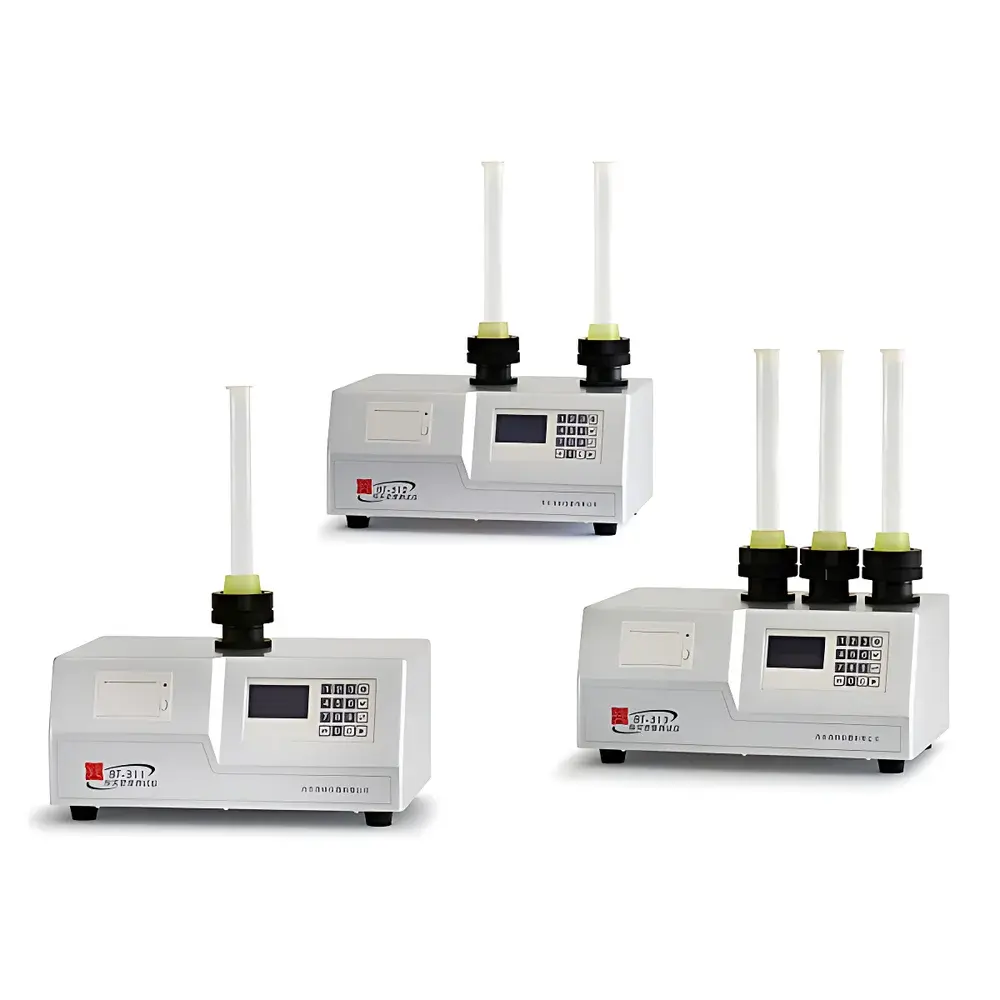
Bettersize BT-310 Series Tap Density Tester
| Brand | Bettersize |
|---|---|
| Origin | Liaoning, China |
| Manufacturer | Bettersize Instruments Co., Ltd. |
| Model | BT-310 Series (BT-311 / BT-312 / BT-313) |
| Instrument Type | Tap Density Tester |
| Cylinder Volumes | 25 mL, 100 mL, 250 mL (customizable) |
| Sample Mass Options | 10 g, 100 g, or user-defined |
| Tap Amplitude | 3 mm or 14 mm |
| Tap Frequency Range | 100–300 taps/min (continuously adjustable) |
| Max Counter Capacity | 99,999 taps |
| Sample Throughput | BT-311: 1 sample/batch |
| BT-312 | 2 samples/batch |
| BT-313 | 3 samples/batch |
| Repeatability | ≤1% RSD |
| Power Supply | 100–240 VAC, 50/60 Hz, 50 W |
| Compliance | ChP 2020, GB/T 31057–2018, GB/T 21354–2008, USP <616>, Eur. Ph. 2.9.34, ASTM D7481, ASTM B527, ISO 787–11, ISO 3953:1993 |
Overview
The Bettersize BT-310 Series Tap Density Tester is an electromechanical instrument engineered for the standardized determination of tap density (also known as tapped density or settled density) of free-flowing powders and granular materials. Based on the principle of controlled vertical tapping—where a graduated cylinder containing a defined mass of powder undergoes repetitive, uniform mechanical impacts—the instrument measures the reduction in bulk volume after a specified number of taps until volume stabilization occurs. The final tap density is calculated as the ratio of sample mass (determined gravimetrically prior to testing) to the stabilized tapped volume. This methodology conforms to internationally harmonized protocols for powder characterization in pharmaceutical development, battery cathode/anode material qualification, catalyst evaluation, and advanced ceramic processing.
Key Features
- Triple-model architecture: BT-311 (single-position), BT-312 (dual-position), and BT-313 (triple-position) configurations enable scalable throughput without compromising measurement integrity.
- Patented horizontal rotation mechanism: Integrated with vertical tapping motion to maintain powder surface planarity during compaction—minimizing edge effects and improving volumetric reproducibility across cylinder geometries.
- Programmable tap parameters: Adjustable frequency (100–300 taps/min) and amplitude (3 mm or 14 mm) allow method adaptation per material class—from low-cohesion metal powders to cohesive pharmaceutical excipients.
- Integrated counter and thermal printer: Automatic tap counting with real-time display; post-test report generation includes operator ID, sample ID, tap count, mass, volume, calculated tap density, and timestamp—supporting audit-ready documentation.
- Modular cylinder support: Interchangeable calibrated cylinders (25 mL, 100 mL, 250 mL) meet application-specific requirements—including ChP 2020-compliant 250 mL testing for drug substance qualification.
- Robust industrial-grade construction: Precision-machined drive train, sealed stepper motor, and vibration-damped base ensure long-term stability and ≤1% repeatability under routine laboratory use.
Sample Compatibility & Compliance
The BT-310 Series accommodates a broad spectrum of dry, non-agglomerating particulate solids including but not limited to metallic powders (e.g., Al, Ni, Co alloys), inorganic oxides (LiCoO₂, SiO₂), polymer microspheres, pharmaceutical actives and excipients, food-grade starches, and abrasive grits. All models are fully compliant with pharmacopeial and industrial standards governing tap density measurement: Chinese Pharmacopoeia (ChP) 2020, USP , European Pharmacopoeia 2.9.34, ISO 3953:1993, ISO 787–11, ASTM D7481 (for metal powders), ASTM B527 (for metal powder flowability), GB/T 21354–2008, and GB/T 31057–2018. These alignments ensure data acceptability in regulatory submissions, QC release testing, and cross-laboratory method transfer studies.
Software & Data Management
While the BT-310 Series operates via embedded firmware rather than PC-based software, its human-machine interface supports full traceability in accordance with GLP and GMP principles. Each test session requires entry of operator name, sample identifier, and method parameters (tap count, frequency, amplitude), all logged internally and printed immediately upon completion. The thermal printer output satisfies FDA 21 CFR Part 11 requirements for handwritten-equivalent records when paired with laboratory SOPs defining operator authentication and data review procedures. For laboratories requiring electronic data archiving, raw values (mass, volume, tap count) may be manually transcribed into LIMS or ELN systems. Optional calibration certificates (traceable to NIM, China) and IQ/OQ documentation packages are available upon request.
Applications
- Pharmaceutical solid dosage development: Excipient selection, blend uniformity assessment, and capsule/fill weight prediction using tap density–derived Hausner ratio and compressibility index.
- Battery materials R&D: Quantification of electrode powder packing behavior to correlate with slurry rheology, coating uniformity, and cell energy density.
- Metallurgy and additive manufacturing: Qualification of gas-atomized metal powders for laser powder bed fusion (LPBF) processes where consistent tap density reflects particle sphericity and flow consistency.
- Quality control in chemical manufacturing: Batch-to-batch verification of pigment dispersion, catalyst loading, and detergent granule density for dosing accuracy.
- Academic research: Teaching fundamental powder mechanics concepts—including interparticle friction, cohesion, and void fraction evolution under dynamic compaction.
FAQ
What is the difference between tap density and bulk density?
Tap density is measured after mechanical densification via standardized tapping; bulk density is the mass-to-volume ratio of powder in its freely poured, untapped state. The ratio of tap density to bulk density yields the Hausner ratio—a key indicator of flowability.
Can the BT-310 Series be used for cohesive or hygroscopic powders?
It is optimized for free-flowing, dry powders. Cohesive or moisture-sensitive materials require pre-conditioning (e.g., drying, anti-static treatment) and may necessitate alternative methods such as shear cell or rotational flow testing.
Is calibration required before each test?
Cylinder volume calibration is performed at manufacture and certified per GB/T 31057–2018; users must verify cylinder integrity and cleanliness prior to each test. Mass calibration of the analytical balance used for sample weighing remains the responsibility of the end-user lab.
Does the instrument support automated mass input?
No—sample mass must be determined externally using a calibrated analytical balance and entered manually. This design ensures flexibility across diverse mass ranges and maintains compliance with pharmacopeial instructions mandating independent gravimetric measurement.
How is compliance with USP verified?
The BT-310 Series implements the exact tap frequency (250 ± 10 taps/min), amplitude (3 mm), and cylinder specifications (250 mL, stainless steel) stipulated in USP . Full validation documentation, including performance qualification against reference standards, is available under NDA.



