
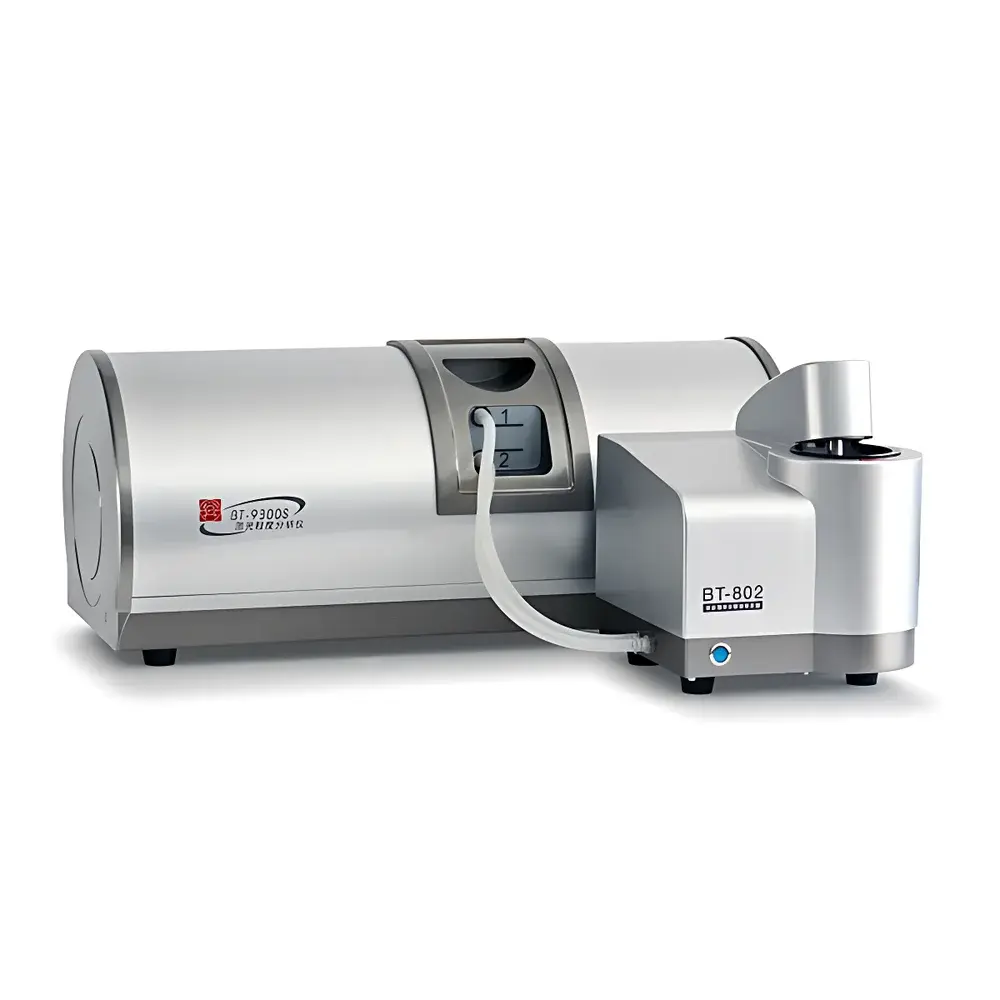
Bettersize BT-9300S Laser Particle Size Analyzer
| Brand | Bettersize |
|---|---|
| Origin | Liaoning, China |
| Manufacturer Type | Direct Manufacturer |
| Instrument Type | Laboratory Laser Diffraction Particle Size Analyzer |
| Measurement Range | 0.1–1200 µm |
| Repeatability | ≤1% (D50 of certified reference materials) |
| Measurement Time | ≤10 s per analysis |
| Dispersion Method | Wet Dispersion |
| Optical Principle | Mie Scattering Theory (default), Fraunhofer Diffraction (optional) |
| Detector Array | 86-element photodiode array |
| Laser Source | High-power fiber-coupled laser |
| Optical Design | Patented dual-lens optical system with forward-, side-, and back-scatter detection |
| Compliance | ISO 13320:2020, GB/T 19077–2024, GB/T 41949–2022, USP <429>, EP 2.9.38, ChP 0982 |
| Data Integrity | FDA 21 CFR Part 11 compliant audit trail and electronic signature support |
Overview
The Bettersize BT-9300S Laser Particle Size Analyzer is a rigorously engineered laboratory-grade instrument designed for high-fidelity particle size distribution (PSD) measurement across diverse industrial and research environments. It operates on the physical principle of laser diffraction, applying Mie scattering theory—calibrated for refractive index and absorption coefficient—to deliver quantitative PSD data from 0.1 µm to 1200 µm in a single measurement cycle. Its patented dual-lens optical architecture enables simultaneous collection of forward-, side-, and backward-scattered light across an 86-channel photodetector array, significantly enhancing angular signal resolution and minimizing truncation error at both extremes of the dynamic range. This design ensures robust performance under variable sample conditions and supports traceable compliance with ISO 13320:2020 requirements for diffraction-based particle sizing. The modular mechanical layout—separating optical core from dispersion subsystems—facilitates seamless integration with water-based circulation, solvent-compatible micro-cell (8 mL), or fully automated solvent circulation modules, enabling method flexibility without hardware reconfiguration.
Key Features
- Patented dual-lens optical system with extended angular detection geometry for improved sensitivity to submicron and coarse fractions
- Automated alignment mechanism ensuring continuous optical centering—critical for long-term measurement stability and inter-laboratory reproducibility
- BT-802 integrated wet dispersion module featuring programmable ultrasonic power (0–50 W, non-contact), auto-fill, auto-drain, bubble elimination, and self-cleaning cycles
- Three operational modes: SOP-driven one-click analysis, manual parameter adjustment, and continuous monitoring for process development
- FDA 21 CFR Part 11-compliant software architecture with role-based access control, electronic signatures, and immutable audit trails
- Calibration traceability via NIST-traceable or ISO-certified reference materials; built-in accuracy verification protocol
- A-class resolution per JJF 1211–2008 and JJG 167–2020 standards, validated using bimodal polystyrene latex standards
Sample Compatibility & Compliance
The BT-9300S accommodates a broad spectrum of particulate systems including inorganic oxides (e.g., SiO₂, ZrO₂, MgO), metallic powders (Al, Cu, Mo, rare-earth alloys), functional ceramics (silicon carbide, alumina), battery cathode/anode materials (NMC, LFP, graphite), pharmaceutical excipients and APIs, agrochemical suspensions, pigment dispersions, and geological sediments. Its wet dispersion versatility—supporting aqueous, organic (e.g., ethanol, acetone, xylene), and low-volume (8 mL) protocols—ensures compatibility with moisture-sensitive, solvent-reactive, or high-value samples. Regulatory alignment includes full adherence to USP for pharmaceutical aerosols and suspensions, European Pharmacopoeia EP 2.9.38, Chinese Pharmacopoeia ChP 0982, and ISO 13320:2020. All firmware and software modules undergo periodic validation per GLP/GMP documentation requirements, with calibration records retained in encrypted, time-stamped format.
Software & Data Management
The embedded BT-Online software provides ISO-aligned reporting templates, customizable pass/fail criteria based on D10/D50/D90 thresholds, statistical trend analysis across batches, and export-ready outputs (CSV, PDF, XML) compatible with LIMS and MES platforms. Raw intensity data is preserved alongside processed distributions, supporting retrospective reanalysis with updated optical models or refractive index inputs. Multi-user permission levels enforce separation of duties: operators execute SOPs, supervisors approve reports, and QA personnel manage calibration logs and audit trail reviews. All electronic records comply with ALCOA+ principles (Attributable, Legible, Contemporaneous, Original, Accurate, Complete, Consistent, Enduring, Available) as defined in FDA guidance.
Applications
This analyzer serves as a primary metrology tool in quality assurance laboratories for raw material release (e.g., precipitated calcium carbonate, titanium dioxide pigments), in-process control of milling and classification operations, formulation optimization of colloidal suspensions (inkjet inks, catalyst slurries), and R&D characterization of novel nanomaterials and composite powders. It is routinely deployed in cement manufacturing for fineness validation, in lithium-ion battery production for electrode slurry homogeneity assessment, and in environmental labs for sediment grain-size classification per ASTM D422 and ISO 14688-1. Its proven reliability in multi-shift industrial settings—demonstrated by >2100 installed units across 15+ countries—reflects its suitability for environments demanding operational continuity and regulatory defensibility.
FAQ
What optical model is applied by default, and how is refractive index handled?
Mie scattering theory is applied by default, requiring user input of real and imaginary components of refractive index. A library of common materials is preloaded, and custom values may be entered or optimized via iterative fitting against reference standards.
Is dry powder dispersion supported?
No—the BT-9300S is configured exclusively for wet dispersion. Dry dispersion requires separate instrumentation (e.g., Bettersize BT-2900).
Can the system be integrated into a networked lab environment?
Yes—Ethernet connectivity supports centralized data archiving, remote diagnostics, and synchronization with enterprise LIMS via standard TCP/IP protocols and configurable API endpoints.
How frequently must optical alignment be verified?
Automatic real-time alignment occurs before each measurement; no manual intervention is required. Annual verification using alignment test kits is recommended per ISO/IEC 17025 internal calibration schedules.
Does the instrument support Good Manufacturing Practice (GMP) workflows?
Yes—software features include electronic signatures, change control logs, and 21 CFR Part 11-compliant audit trails, enabling use in FDA- and EMA-regulated manufacturing facilities.



