
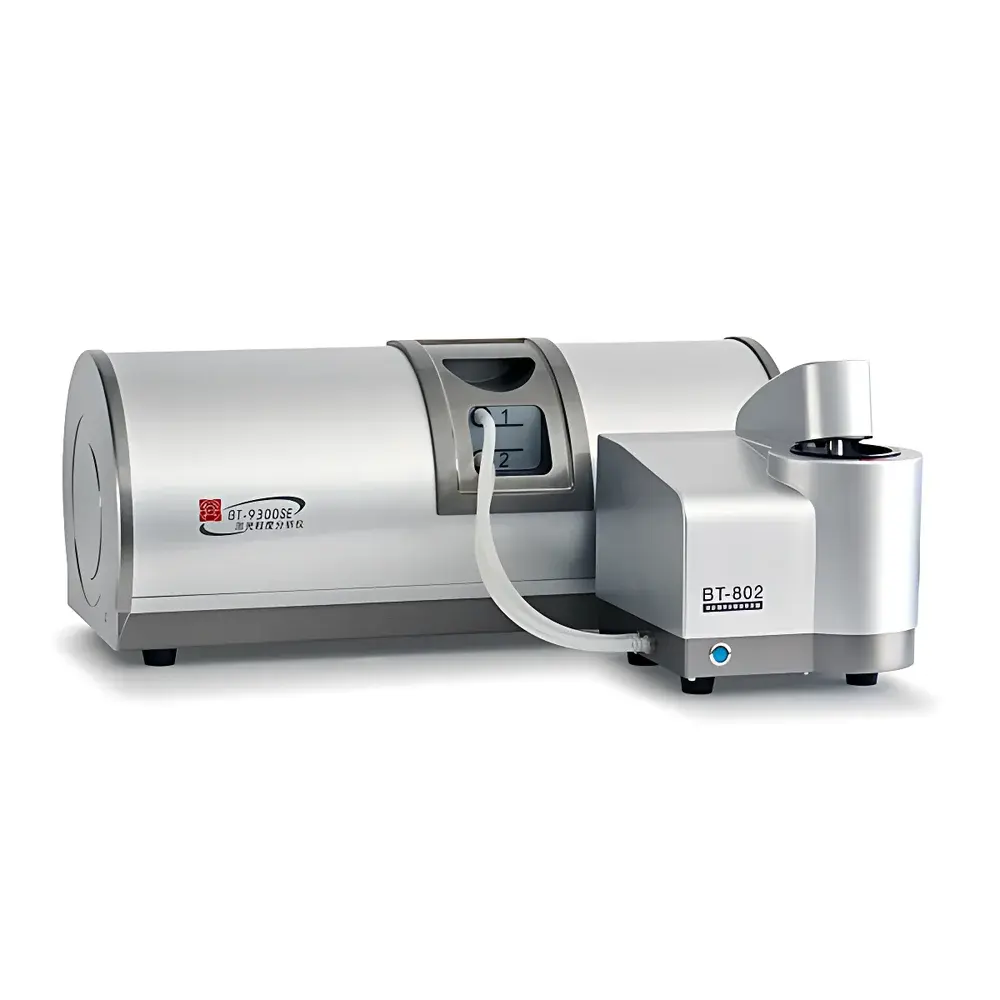
Bettersize BT-9300SE Laser Particle Size Analyzer
| Brand | Bettersize |
|---|---|
| Origin | Liaoning, China |
| Manufacturer Type | Direct Manufacturer |
| Instrument Type | Laboratory Laser Particle Size Analyzer |
| Measurement Range | 0.1–1000 µm |
| Repeatability | ≤1% (D50 deviation vs. certified reference materials) |
| Measurement Time | ≤10 s per run |
| Dispersion Method | Wet Dispersion |
| Optical Principle | Mie Scattering Theory (default), Fraunhofer Diffraction (optional) |
| Detector Array | 80-channel photodiode array (forward + side scattering) |
| Laser Source | High-power fiber-coupled laser |
| Optical Design | Single-lens Fourier optical system |
| Compliance | ISO 13320:2020, GB/T 19077–2024, GB/T 41949–2022, USP <429>, EP 2.9.38, ChP 0982 |
| Data Integrity | FDA 21 CFR Part 11–compliant audit trail and electronic signature support |
Overview
The Bettersize BT-9300SE Laser Particle Size Analyzer is a precision-engineered, cost-optimized laboratory instrument designed for reliable micro-scale particle size distribution (PSD) analysis in the 0.1–1000 µm range. It operates on the fundamental principles of Mie scattering theory—applied by default for optically heterogeneous or high-refractive-index particles—and supports optional Fraunhofer diffraction modeling for rapid, approximate analysis of low-contrast suspensions. Its single-lens Fourier optical architecture integrates a high-stability fiber-coupled laser source with an 80-element photodetector array covering forward and side-scattering angles, ensuring comprehensive capture of angular light intensity profiles across the full measurement range. Unlike monolithic integrated systems, the BT-9300SE adopts a modular, split-body design: the optical unit (host) is physically decoupled from dispersion modules, enabling seamless interchange between water-based circulation, solvent-compatible micro-cell (8 mL), and automated solvent circulation configurations. This modularity enhances long-term serviceability, simplifies calibration validation, and supports method transfer across diverse sample matrices without hardware modification.
Key Features
- Modular optical–dispersion architecture: Independent host and dispersion units allow flexible integration with BT-802 automatic circulation system, solvent micro-cell, or manual dispersion setups.
- High-fidelity optical detection: 80-channel photodiode array optimized for angular resolution in both forward (0.02°–30°) and side-scattering (30°–150°) domains ensures robust signal capture for submicron to coarse particles.
- Fully automated dispersion control: BT-802 system delivers auto-alignment, auto-fill, auto-drain, auto-degassing, auto-rinse, and dry-run protection for ultrasonic dispersers (0–50 W, continuously adjustable).
- Regulatory-ready software: Compliant with FDA 21 CFR Part 11 requirements—including role-based access control, electronic signatures, and immutable audit trails—for GMP/GLP environments.
- Standardized performance validation: Verified against NIST-traceable reference materials; repeatability ≤1% RSD (D50); dual-peak resolution certified to Class A per JJF 1211–2008 and JJG 167–2020.
- Multi-standard alignment: Software includes built-in calculation modes conforming to ISO 13320:2020, GB/T 19077–2024, USP , EP 2.9.38, and Chinese Pharmacopoeia 0982.
Sample Compatibility & Compliance
The BT-9300SE accommodates a broad spectrum of particulate materials suspended in aqueous or organic media—including non-metallic powders (e.g., calcium carbonate, kaolin, silica), metallic powders (e.g., Al, Zn, W, rare-earth alloys), functional materials (e.g., battery cathodes/anodes, catalysts, pharmaceutical excipients), and complex dispersions (e.g., emulsions, ceramic slurries, pigment pastes). Its wet-dispersion capability supports refractive index matching across common solvents (water, ethanol, isopropanol, xylene) via interchangeable flow cells and temperature-stabilized circulation paths. Regulatory documentation—including IQ/OQ/PQ protocols, calibration certificates traceable to national metrology institutes, and raw data export in ASTM E1962-compliant CSV format—is provided to facilitate compliance with ISO/IEC 17025, ICH Q5a, and FDA process validation guidelines.
Software & Data Management
The proprietary Bettersize Analysis Software v5.x provides SOP-driven operation with three measurement modes: one-click (for routine QC), manual (for method development), and continuous (for real-time monitoring). All raw scattering patterns, intermediate calculations, and final PSD reports are stored in encrypted project files with time-stamped metadata. The software enforces ALCOA+ principles: Attributable, Legible, Contemporaneous, Original, Accurate, Complete, Consistent, Enduring, and Available. Full audit trail logs capture user actions, parameter changes, and instrument status events. Export options include PDF reports with embedded spectra, Excel-compatible tabular outputs, and XML for LIMS integration. Remote diagnostics and firmware updates are supported via secure HTTPS channel.
Applications
The BT-9300SE serves as a primary analytical tool in quality assurance laboratories for powder-based manufacturing—particularly in ceramics, coatings, agrochemicals, food additives, and lithium-ion battery material production. Its validated repeatability and regulatory alignment make it suitable for release testing under USP for inhalation powders or EP 2.9.38 for injectable suspensions. In R&D settings, it supports formulation optimization (e.g., stabilizer screening, milling endpoint determination), batch-to-batch consistency assessment, and stability studies under accelerated aging conditions. Academic users leverage its open data structure for correlation studies between PSD metrics (D10/D50/D90, span, specific surface area) and functional properties such as sintering density, dissolution rate, or catalytic turnover frequency.
FAQ
What particle size standards are used for factory calibration and user verification?
Certified reference materials including NIST SRM 1963 (silica), ISO 13320 Annex B glass beads, and GBW(E) 130110 (calcium carbonate) are employed during final calibration. Users receive a full certificate of conformance and can perform daily verification using supplied secondary standards.
Can the BT-9300SE be integrated into a fully automated production line?
Yes—via optional RS-232/RS-485 serial interface or Ethernet TCP/IP protocol, the analyzer supports handshake-triggered measurements, real-time data streaming to SCADA/MES systems, and alarm-based feedback to dispersion pumps or mill controls.
Is method transfer possible between BT-9300SE and other Bettersize models (e.g., BT-9300ST or BT-2900)?
Method parameters—including refractive index, absorption coefficient, dispersion medium, and detector weighting—are fully portable across the Bettersize platform when using identical optical configurations and validated dispersion protocols.
How does the automatic alignment system maintain optical fidelity over time?
A closed-loop servo mechanism monitors laser beam position on a quadrant photodiode; deviations >±2 µm trigger real-time motorized lens repositioning, ensuring continuous collimation within ±0.1° angular tolerance throughout instrument lifetime.
Does the software support multivariate statistical analysis (e.g., PCA, PLS) for trend detection?
Basic statistical functions (mean, SD, CV%, histogram overlay, trend charts) are native; advanced chemometric analysis requires export to third-party tools (e.g., MATLAB, Unscrambler X) via standardized .csv or .xlsx formats.



