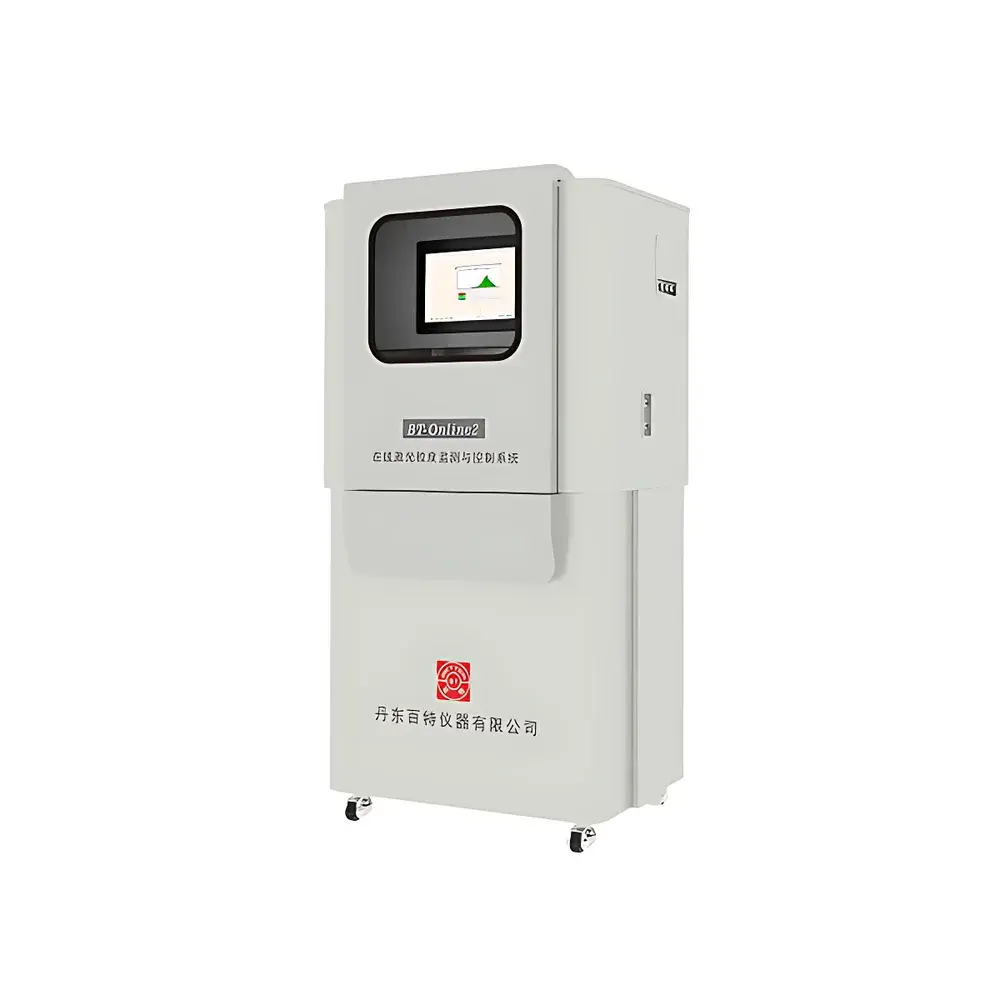
Bettersize BT-Online2 Wet-Process Online Laser Diffraction Particle Size Monitoring and Control System
| Brand | Bettersize |
|---|---|
| Origin | Liaoning, China |
| Manufacturer Type | OEM Manufacturer |
| Country of Origin | China |
| Model | BT-Online2 |
| Pricing | Upon Request |
| Measurement Range | 0.02–2000 µm |
| Principle | Mie Scattering Theory (default), Fraunhofer Diffraction Theory (optional) |
| Accuracy & Repeatability | ≤0.5% D50 deviation vs. NIST/ISO reference standards |
| Calibration | Built-in standard sample verification protocol |
| Laser Source | High-power fiber-coupled laser |
| Detector Array | 92-element photodetector array (forward, side, and backward scattering) |
| Optical Design | Patented dual-path Fourier/inverse-Fourier hybrid optical system with tilted flow cell |
| Sampling Methods | (1) Peristaltic pump + direct suction probe |
| Minimum Test Interval | 3 min (including cleaning & priming) |
| Dispersion System | 600 mL recirculating chamber |
| Purified Water System | 40 L capacity with auto-refill, temperature stabilization (±0.5 °C), and filtration |
| Solvent Recovery System | Closed-loop solvent storage, filtration, and reuse circuit |
| Monitoring Channels | 1–4 parallel process streams (1:1 to 1:4 configuration) |
| Output Interfaces | Modbus-RTU, Modbus-TCP, 4–20 mA analog output |
| Data Integrity Compliance | FDA 21 CFR Part 11 (audit trail, electronic signature, role-based access) |
| Standards Conformance | ISO 13320:2020, GB/T 19077–2024, GB/T 41949–2022 |
| Power Supply | AC 220 V, 50/60 Hz, 200 W |
| Key Reported Metrics | D10, D50, D90, D97, D98, D[4,3], D[3,2], span, distribution trend plots |
Overview
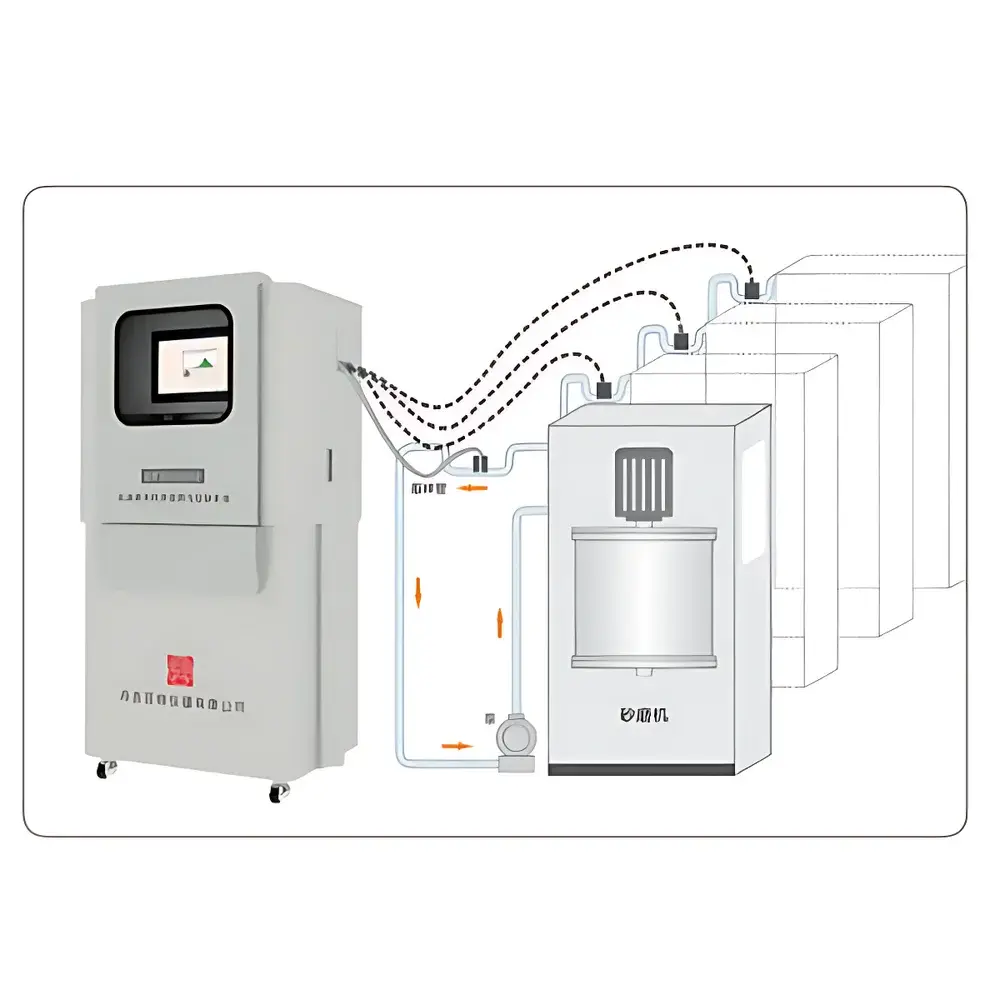
The Bettersize BT-Online2 is an industrial-grade, fully automated online laser diffraction particle size monitoring and control system engineered for real-time integration into wet-process production lines—particularly those involving bead milling, attrition grinding, or chemical synthesis in stirred tank reactors. Unlike laboratory-based analyzers requiring manual sampling and offline analysis, the BT-Online2 performs continuous, unattended measurement directly within the process stream using first-principles laser diffraction physics grounded in Mie scattering theory (with Fraunhofer mode selectable for non-absorbing, micron-scale particles). Its hybrid Fourier/inverse-Fourier optical architecture—protected under Bettersize’s patented design—enables simultaneous detection of forward, side, and backward scattered light across a full angular range (0.02°–165°), ensuring high resolution for sub-100 nm particles while maintaining robustness up to 2000 µm. The system is deployed adjacent to critical unit operations such as sand mills or reaction vessels, where it interfaces with existing process control infrastructure to close the feedback loop between measured particle size distribution (PSD) and operational parameters like agitator speed, media charge, or residence time.
Key Features
- Patented tilted-flow-cell optical design minimizes multiple scattering artifacts and sedimentation bias during continuous flow measurement.
- Reciprocating auto-sampling mechanism with pneumatic actuation enables reliable, contamination-free sampling from pressurized or sealed reactor environments—fully compliant with ATEX Zone 2/IECEx requirements when configured with intrinsically safe components.
- Integrated dispersion subsystem includes a 600 mL recirculation chamber, 750 W ultrasonic transducer, programmable dispersant dosing, and optional high-intensity ultrasonic module for refractory materials (e.g., α-Al₂O₃, LiCoO₂ cathode slurries).
- Multi-channel monitoring capability supports up to four independent process streams from a single analyzer chassis via time-multiplexed sampling and synchronized data tagging.
- FDA 21 CFR Part 11-compliant firmware provides full audit trail logging, electronic signatures, user role management, and immutable data archiving—meeting GLP/GMP validation requirements for pharmaceutical and battery material manufacturing.
- Self-calibrating architecture incorporates routine verification against traceable NIST-traceable polystyrene latex standards, with automated pass/fail reporting embedded in the measurement workflow.
Sample Compatibility & Compliance
The BT-Online2 accommodates aqueous and organic-phase suspensions across a broad viscosity range (up to 5000 cP with optional high-shear inlet). Its closed-loop solvent recovery system filters and recirculates solvents such as NMP, DMF, or ethanol—reducing consumable costs and eliminating hazardous waste discharge. For abrasive or corrosive slurries (e.g., transition metal oxide cathode precursors), wetted components are constructed from 316L stainless steel, PTFE, and sapphire optical windows. Regulatory alignment includes full conformance with ISO 13320:2020 (laser diffraction methodology), GB/T 19077–2024 (Chinese national standard for particle characterization), and GB/T 41949–2022 (online process analytical technology guidelines). All hardware and software modules undergo IQ/OQ/PQ documentation support per GAMP 5 principles.
Software & Data Management
The embedded control software runs on a ruggedized industrial PC with real-time Linux OS and supports OPC UA, Modbus-RTU/TCP, and 4–20 mA analog outputs for seamless integration into DCS/SCADA platforms (e.g., Siemens PCS7, Emerson DeltaV, Honeywell Experion). Users define SOP-driven measurement sequences—including target metrics (D10/D50/D90/D97/span), alarm thresholds, and auto-triggered corrective actions (e.g., adjust mill speed if D50 drifts beyond ±1.5%). Raw scattering patterns, PSD histograms, and trend charts are stored in HDF5 format with SHA-256 checksums. Historical datasets export to CSV, Excel, or LIMS-compatible XML schemas. Remote diagnostics and firmware updates occur over TLS-secured HTTPS channels with certificate-based authentication.
Applications
Primary deployment domains include lithium-ion battery cathode slurry production (NCM, LFP), pharmaceutical wet-milled suspensions (e.g., nanosuspensions for oral bioavailability enhancement), pigment and ink jet ink manufacturing, ceramic precursor processing, and fine chemical synthesis. In battery material lines, the BT-Online2 enables real-time adjustment of milling energy input to maintain narrow D50 tolerances (<±0.1 µm) required for electrode coating uniformity and cycle-life consistency. In pharma applications, it supports Quality-by-Design (QbD) initiatives by linking PSD shifts to critical quality attributes (CQAs) such as dissolution rate and content uniformity—facilitating continuous process verification per ICH Q5A(R2) and Q8(R3).
FAQ
How does the BT-Online2 ensure measurement accuracy during continuous operation?
It performs periodic self-validation using certified reference materials, logs all calibration events with timestamps and operator IDs, and applies real-time Mie-based refractive index correction based on process fluid properties.
Can the system operate in explosion-hazardous environments?
Yes—when equipped with pneumatic reciprocating samplers and intrinsically safe signal isolators, it meets IEC 60079-0 and IEC 60079-11 for Zone 2 gas group IIB applications.
What is the minimum detectable particle size under typical process conditions?
With optimized dispersion and background subtraction, the system reliably resolves primary particles down to 20 nm in low-turbidity aqueous slurries at solids concentrations ≤15 wt%.
Is remote monitoring and troubleshooting supported?
Yes—the embedded web server provides secure, role-limited access to live trends, diagnostic logs, and configuration editors via modern browsers without proprietary client software.
How is data integrity maintained for regulatory submissions?
All raw scattering data, processed distributions, and user-initiated actions are cryptographically hashed and archived with immutable timestamps, satisfying FDA 21 CFR Part 11 and EU Annex 11 requirements for electronic records and signatures.