
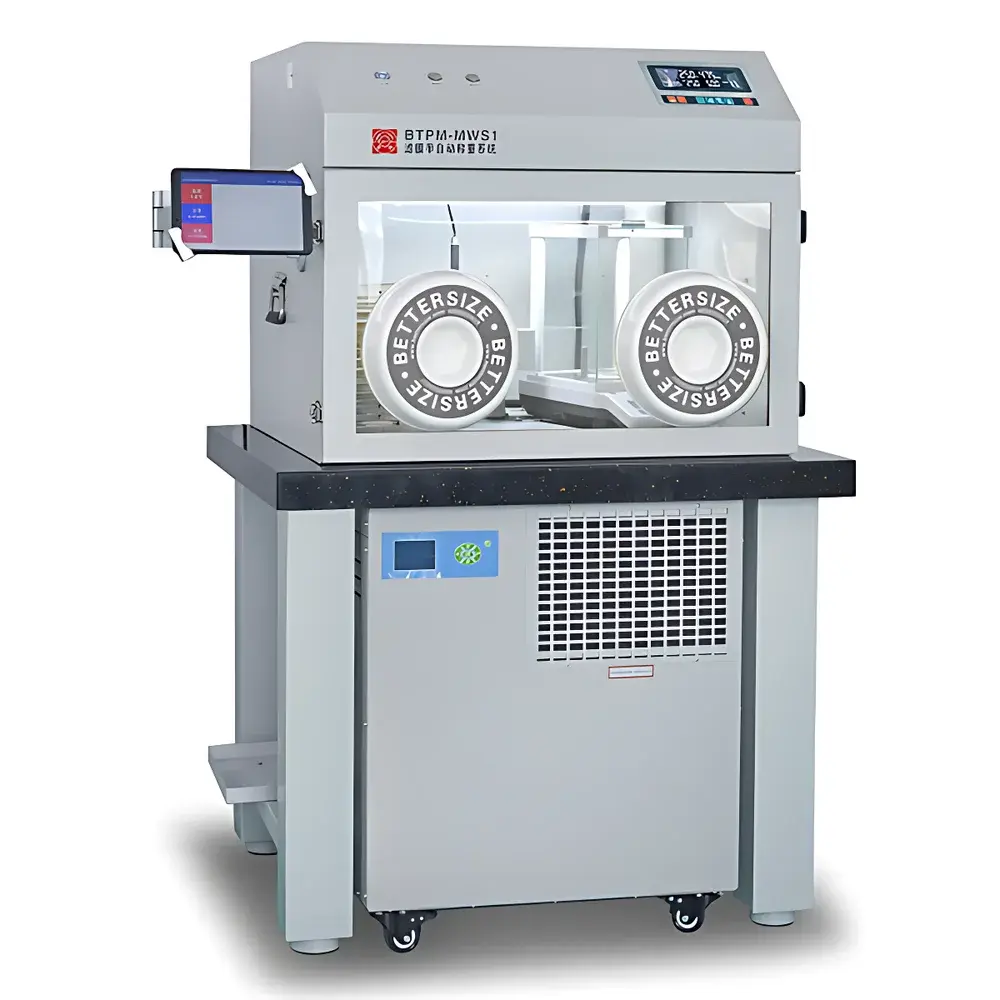
Bettersize BTPM-MWS1 Semi-Automatic Filter Membrane Weighing System
| Brand | Bettersize |
|---|---|
| Origin | Liaoning, China |
| Manufacturer | Bettersize Instrument Co., Ltd. |
| Model | BTPM-MWS1 Constant Temperature & Humidity Weighing System |
| Measurement Method | Gravimetric Filter Weighing |
| Measured Parameters | PM₁₀ / PM₂.₅ / PM₁ |
| Measurement Range | 0–52 mg |
| Cycle Time | 24 h |
| Sampling Flow Rate | 1.0 L/min |
| LOD | 1 µg/m³ |
| Flow Stability | ±1% (not 100%) |
| Pre-conditioning Capacity | 60 × 47 mm filters / 36 × 90 mm filters / 30 filter tips or cartridges |
| Balance Resolution | 0.01 mg (0.001 mg optional) |
| Temperature Control Range | 15–30 °C (±0.5 °C) |
| Humidity Control Range | 40–60 %RH (±3 %RH) |
| Vibration Isolation | 4-stage active/passive damping platform |
| Electrostatic Neutralization | Ionizing air bar (non-radioactive, CE-compliant) |
| Power Supply | AC 220 V / 50 Hz, 2000 W |
| Operating Environment | 10–40 °C, 10–75 %RH |
| Data Interface | Wireless tablet integration with real-time logging and export |
Overview
The Bettersize BTPM-MWS1 Semi-Automatic Filter Membrane Weighing System is an engineered solution for gravimetric analysis of atmospheric particulate matter in compliance with international reference methods. It implements a controlled-environment weighing protocol based on standardized temperature and humidity conditioning—performed prior to and during mass measurement—to eliminate hygroscopic bias and mechanical drift. Designed specifically for regulatory-grade PM₁₀, PM₂.₅, and PM₁ monitoring workflows, the system adheres to the core physical principle of mass difference quantification: the net weight gain of a pre-weighed, conditioned filter membrane after airborne particle collection reflects ambient particulate concentration when normalized to sampled air volume. Its architecture integrates ISO/IEC 17025-aligned metrological rigor with operational pragmatism—eliminating the need for dedicated walk-in environmental chambers while maintaining traceable stability across extended 24-hour cycles.
Key Features
- Integrated constant-temperature/humidity chamber with dual PID-controlled HVAC subsystems, maintaining ≤ ±0.5 °C temperature stability and ≤ ±3 %RH humidity precision across full operational range (15–30 °C / 40–60 %RH).
- High-stability analytical balance (0.01 mg resolution; 0.001 mg optional) mounted on a four-stage vibration isolation platform incorporating passive damping materials and active inertial decoupling to suppress micro-vibrations from building infrastructure or adjacent equipment.
- Electrostatic neutralization via certified ionizing air bars—non-radioactive, low-noise, and compliant with IEC 61340-5-1 for ESD-sensitive environments—ensuring consistent charge dissipation across glass fiber, quartz, PTFE, and cellulose ester membranes.
- Modular sample staging: independent slots for 60 × 47 mm filters, 36 × 90 mm filters, or 30 filter tips/cartridges, each positioned for uniform exposure to conditioned airflow without shadowing or laminar stagnation.
- Sealed glove-port workstation (two ergonomic access ports) with HEPA-filtered internal atmosphere (ISO Class 5 equivalent), preventing ambient particulate intrusion during handling and eliminating secondary contamination risks.
- Embedded industrial tablet interface supporting real-time visualization of balance readings, temperature/humidity profiles, and time-stamped metadata; all data stored locally with optional cloud sync for audit-ready traceability.
Sample Compatibility & Compliance
The BTPM-MWS1 accommodates standard EPA, EN, and Chinese environmental filter formats—including 47 mm and 90 mm diameter membranes (glass fiber, quartz, Teflon®, polyvinyl chloride), as well as conical filter tips and quartz-fiber cartridges used in source apportionment studies. Its operational protocol satisfies methodological requirements of HJ 656–2013 and HJ 836–2017 (China MEE), EPA Methods IO-3.2 and 201A, EN 12341:2014 and EN 14907:2005, and ISO 12103-1 for aerosol filter handling. All hardware and software components support GLP/GMP-aligned documentation practices, including user authentication, electronic signatures, and immutable audit trails for balance calibration logs, environmental setpoint deviations, and raw weight records—fully compatible with FDA 21 CFR Part 11 data integrity expectations.
Software & Data Management
The embedded Android-based control application provides intuitive workflow navigation: automatic sequence initiation (pre-conditioning → tare → weighing → post-conditioning), configurable dwell times per filter batch, and dynamic adjustment of RH ramp rates to prevent condensation on hydrophilic substrates. Each measurement event captures timestamp, operator ID, balance serial number, environmental conditions, and digital image snapshot (optional camera module). Export formats include CSV, PDF reports with embedded metadata, and XML structured for LIMS integration. Data encryption (AES-256) and role-based access control ensure confidentiality and regulatory readiness. No external network dependency is required for core operation; Wi-Fi or Ethernet connectivity enables remote diagnostics and firmware updates without compromising data sovereignty.
Applications
- Reference-grade gravimetric analysis in national and provincial environmental monitoring stations conducting routine PM₂.₅ and PM₁₀ surveillance under national ambient air quality standards.
- Source apportionment campaigns requiring high-precision inter-laboratory comparison of filter loading across multiple sampling sites and receptor models (e.g., PMF, CMB).
- Method validation and intercomparison exercises organized by NMET, CNAS, or international bodies such as the World Health Organization’s Global Air Quality Monitoring Project.
- Research laboratories studying hygroscopic growth factors, filter artifact correction, or long-term stability of reference filters under varying RH regimes.
- Third-party testing organizations performing accredited emissions testing per HJ 836–2017 for low-concentration stack particulate measurements in thermal power plants and industrial kilns.
FAQ
Does the BTPM-MWS1 meet U.S. EPA equivalency requirements for Federal Reference Methods?
Yes—the system fulfills the environmental conditioning, balance performance, and procedural documentation criteria specified in EPA 40 CFR Part 53 and Appendix L for FRM/FEM filter handling protocols.
Can the system be validated for ISO/IEC 17025 accreditation?
Yes—its design includes documented uncertainty budgets for mass measurement, environmental parameter traceability to NIM (China) or NIST-traceable references, and full audit trail functionality required by ILAC-G8 and CNAS-CL01.
Is the ionizing air bar certified for laboratory use without radiation licensing?
Yes—it utilizes corona discharge technology compliant with IEC 61340-5-1 and carries CE marking for electromagnetic compatibility and safety; no radioactive isotopes are employed.
What maintenance intervals are recommended for long-term metrological reliability?
Annual balance recalibration against certified weights, biannual HVAC sensor verification using NIST-traceable hygrometers and thermometers, and quarterly inspection of glove port seals and HEPA filter differential pressure.
How does the system handle filter substrates with high moisture affinity, such as quartz fiber?
The programmable RH ramp function allows gradual equilibration (e.g., 40% → 50% → 60% over 2 hours) to minimize surface condensation and ensure thermodynamic equilibrium prior to final weighing.
Related Products







