
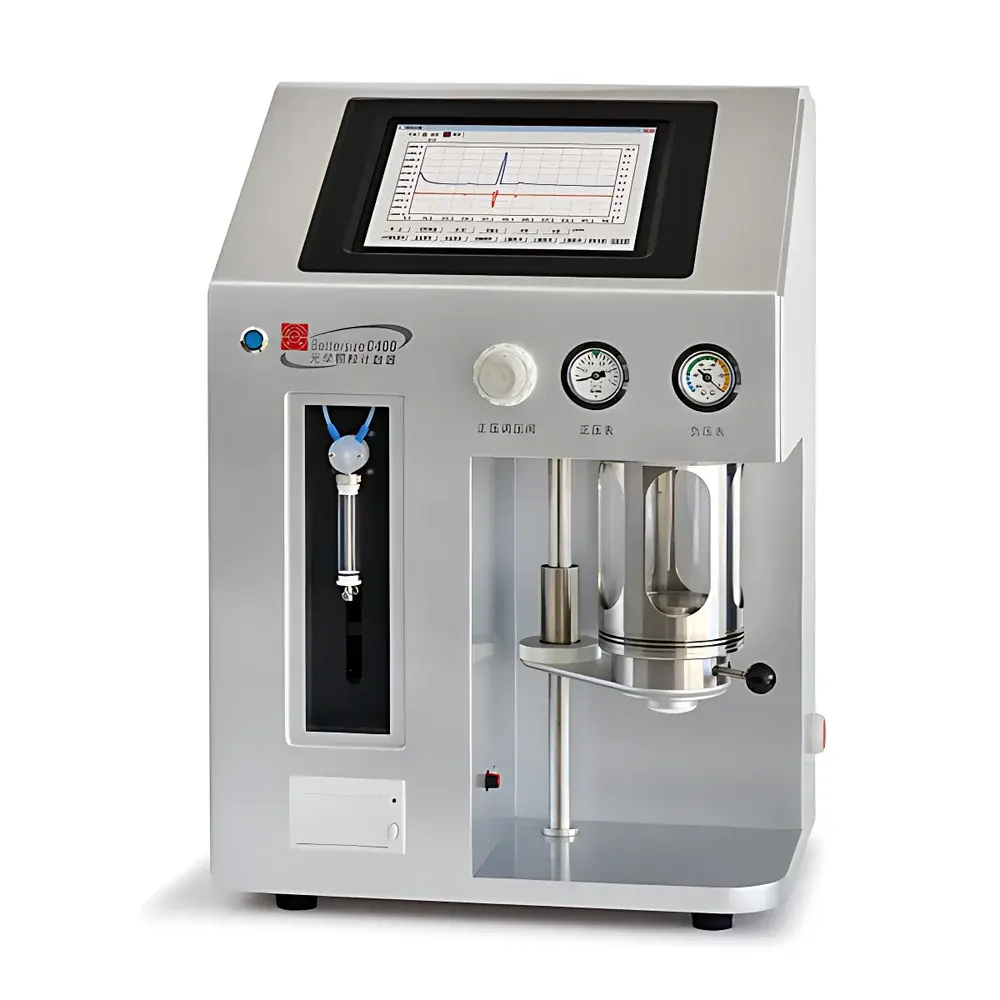
Bettersize C400 Optical Particle Counter
| Brand | Bettersize (Dandong Better Instruments Co., Ltd.) |
|---|---|
| Origin | Liaoning, China |
| Manufacturer Type | Direct Manufacturer |
| Instrument Type | Optical Particle Counter |
| Model | Bettersize C400 |
| Detection Principle | Combined Light Obscuration and Angular Light Scattering |
| Particle Size Range | 0.5–400 µm |
| Laser Source | Semiconductor Slab Beam Laser |
| Detection Channels | 4–100 (user-definable bin boundaries) |
| Sample Volume | 0.1–200 mL |
| Sampling Pump | 10 mL piston pump, accuracy ≤ ±1% |
| Flow Rate | 5–60 mL/min |
| Maximum Count Concentration | 45,000 particles/mL |
| Counting Repeatability Error | < ±1.5% (for standard particles >2000/mL, 10 mL sample) |
| Counting Resolution | <10% per ISO 21501-4 / GB/T 18854–2015 / USP <788> |
| Vacuum Capability | up to 0.08 MPa |
| Pressure Rating | up to 0.6 MPa |
| Sample Viscosity Range | 0–400 cSt |
| Sample Temperature Range | 0–80 °C |
| Environmental Operating Conditions | 10–40 °C, RH ≤80%, non-condensing |
| Power Supply | 200–240 VAC, 50/60 Hz, 200 W (without air pump) |
| Compliance Standards | ISO 4406, NAS 1638, GB/T 14039, GJB 420A/B, ISO 21501-4, USP <788>, EP 2.9.19, JP 17 |
Overview
The Bettersize C400 Optical Particle Counter is an advanced dual-mode particle characterization instrument engineered for high-fidelity, trace-level contamination analysis in liquid media. It employs a hybrid detection architecture integrating light obscuration (LO) and angular light scattering (ALS), enabling accurate, metrologically traceable particle counting and sizing across an extended dynamic range of 0.5–400 µm. Unlike single-principle counters, the C400 leverages complementary physical interactions: LO dominates for coarse particles (>40 µm), where optical shadow amplitude correlates linearly with projected area; ALS provides superior sensitivity for fine particles (0.5–40 µm), where Mie scattering intensity and angular distribution are functionally dependent on diameter, refractive index, and wavelength. This dual-signal acquisition—simultaneously captured as each particle traverses a precision-bore capillary measurement zone—eliminates interpolation gaps and mitigates systematic bias inherent in monomodal calibration. The system utilizes a stabilized semiconductor slab-beam laser, delivering uniform irradiance across the sensing volume via proprietary top-hat beam profiling—thereby eliminating positional signal variance common in Gaussian-profile systems and ensuring <±1.5% counting repeatability under GLP-compliant conditions.
Key Features
- Dual-detection architecture: Synchronized light obscuration and angular light scattering channels for cross-validated particle sizing and counting across 0.5–400 µm
- Top-hat laser beam profile: Eliminates radial intensity gradients, ensuring consistent pulse height response regardless of particle trajectory within the sensing zone
- High-speed signal acquisition: 40 MB/s real-time data throughput via USB 3.0 interface; ARM-based embedded controller handles analog-to-digital conversion, pulse shaping, and baseline correction prior to host transfer
- Full-range certified calibration: Traceable to NIST-traceable particle standards at five discrete size segments (coarse, medium-coarse, medium, medium-fine, fine), validated per ISO 21501-4 Annex B
- Integrated fluid handling: Precision 10 mL piston pump (±1% volumetric accuracy), programmable flow control (5–60 mL/min), vacuum-assisted sampling (up to 0.08 MPa), and pressure-rated sample chamber (0.6 MPa)
- Multi-phase compatibility: Validated for aqueous (e.g., WFI, purified water, parenteral solutions) and hydrocarbon-based liquids (hydraulic oil, turbine oil, aviation fuel, transformer oil) with viscosity up to 400 cSt
Sample Compatibility & Compliance
The Bettersize C400 meets stringent regulatory and industry requirements for particulate matter quantification in critical applications. Its measurement methodology and calibration protocol comply with ISO 21501-4 (determination of particle size distribution by light extinction and light scattering), USP (Particulate Matter in Injections), EP 2.9.19 (Particulate Contamination of Parenteral Preparations), and JP 17 (General Tests for Particulate Matter). For industrial fluid cleanliness, it supports automated reporting against ISO 4406 (fluid contamination codes), NAS 1638 (aerospace hydraulic fluids), and GJB 420A/B (Chinese military specifications). All firmware and software modules support audit trail generation, electronic signature capability, and user-access-level controls aligned with FDA 21 CFR Part 11 and EU Annex 11 requirements. Calibration certificates include uncertainty budgets referenced to national metrology institutes (NIM, China).
Software & Data Management
The proprietary ParticleView™ software suite provides full control over instrument operation, data acquisition, and compliance-driven reporting. It supports customizable channel configuration (4–100 bins), real-time histogram display, cumulative distribution plots, and automatic ISO 4406/NAS code assignment. Raw pulse data—including individual particle amplitude, width, and scattering angle—is preserved in binary format for reprocessing. The software implements ALCOA+ principles: attributable, legible, contemporaneous, original, accurate, complete, consistent, enduring, and available. Audit trails record all user actions, parameter changes, and calibration events with timestamps and operator IDs. Export formats include CSV, PDF (with digital signature), and XML for LIMS integration. Optional 21 CFR Part 11 compliance package includes role-based access, electronic signatures, and immutable archive mode.
Applications
- Pharmaceutical & Biotechnology: Particulate testing of Water for Injection (WFI), sterile filtration validation, container closure integrity assessment, and final-fill solution monitoring per USP and EU GMP Annex 1
- Aerospace & Power Generation: Hydraulic fluid cleanliness verification (MIL-STD-1246C, NAS 1638), turbine oil degradation tracking, and transformer oil particulate load trending per IEC 60296 and ASTM D6786
- Medical Devices & Diagnostics: Quantification of leachables from IV bags, tubing, and filters; evaluation of nanoparticle drug delivery systems
- Materials Science Research: Filter media efficiency testing (beta-ratio analysis), slurry stability assessment, and two-phase flow particle dynamics studies
- Food & Beverage Quality Control: Monitoring of ultra-pure process water, beverage clarification efficacy, and packaging rinse water cleanliness
FAQ
Does the Bettersize C400 require periodic recalibration using certified reference materials?
Yes. Per ISO/IEC 17025 and manufacturer recommendations, full-channel recalibration using NIST-traceable polystyrene latex (PSL) or silica standards is required every 12 months—or after any maintenance affecting optical alignment, fluid path geometry, or detector gain.
Can the instrument differentiate between viable and non-viable particles?
No. The C400 is a physical particle counter based on optical properties only; it does not provide morphological, fluorescent, or biological identification. Integration with flow cytometry or Raman spectroscopy requires external coupling.
Is the system compatible with viscous lubricants above 100 cSt?
Yes. With optional heated sample module (0–80 °C) and pressure-assisted sampling, the C400 reliably analyzes oils up to 400 cSt without dilution or preheating.
How is data integrity ensured during long-duration batch testing?
All raw pulse data is buffered in non-volatile memory onboard the ARM controller before transmission; USB 3.0 handshake protocols prevent packet loss, and software implements cyclic redundancy checks (CRC-32) on every data frame.
Does the system support automated cleaning cycles between samples?
Yes. The integrated wash protocol executes solvent flush (e.g., isopropanol, filtered water), air purge, and baseline stabilization—programmable per sample sequence and logged in the audit trail.



